Recognizing shapes Grade 3 Adding up to 1000 Without Regrouping Worksheets
3 filtered results
-
From - To
Enhance your third graders' mathematics skills with our engaging "Recognizing Shapes and Adding Up to 1000 Without Regrouping Worksheets." Specifically designed for Grade 3, these worksheets help students not only identify various shapes but also develop their addition skills by solving problems that total up to 1000 without regrouping. Through fun activities and visuals, children will seamlessly integrate geometry with arithmetic, making learning enjoyable and effective. These resources build a strong foundation in both subjects, encouraging critical thinking and problem-solving abilities. Perfect for classroom use or at-home practice, our worksheets inspire confidence in young learners while fostering a love for math.
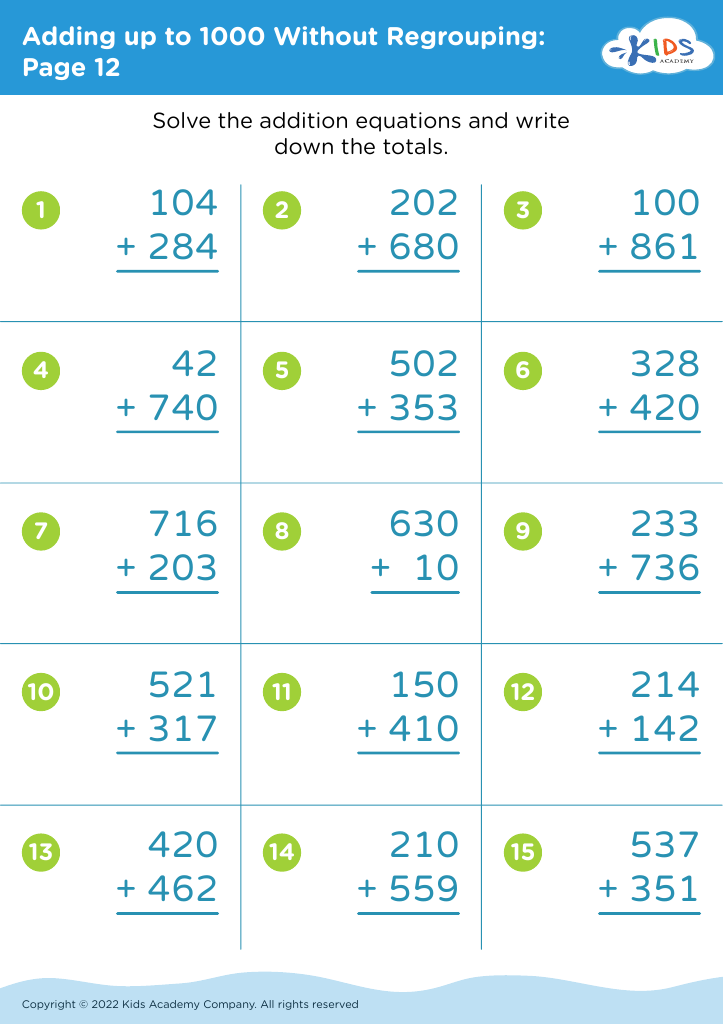
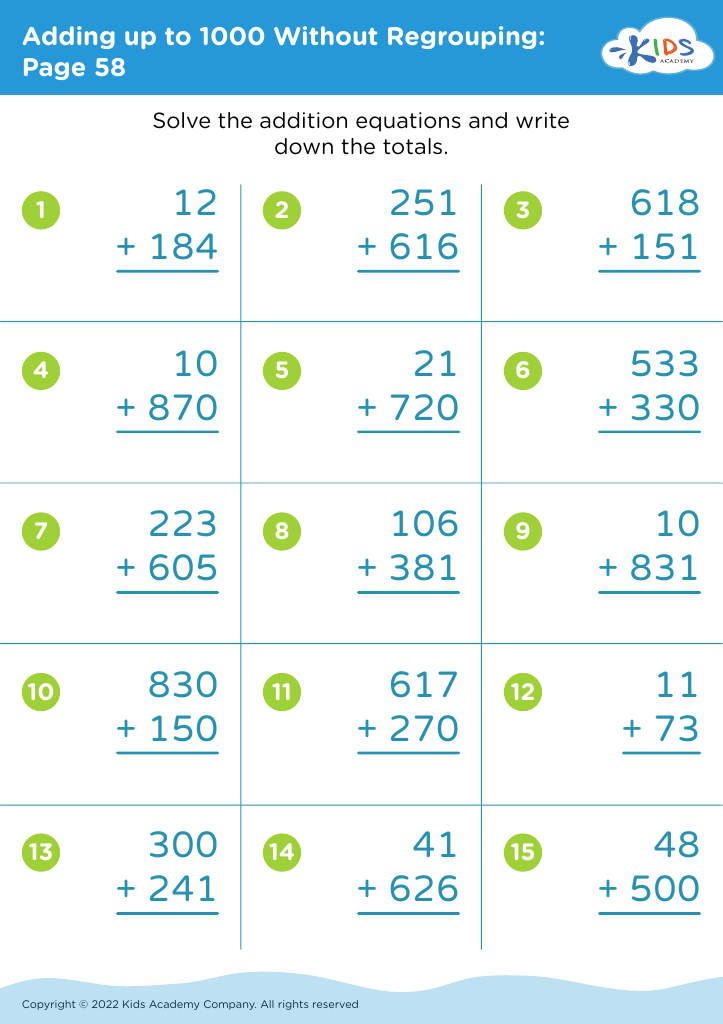
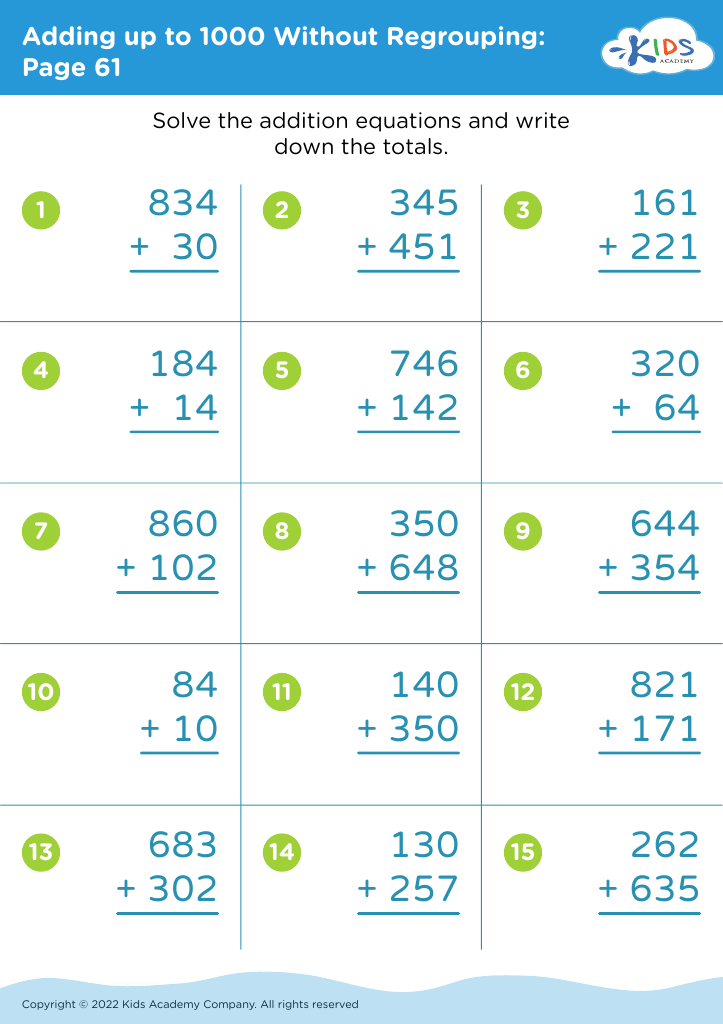


Recognizing shapes and understanding basic mathematics, such as adding up to 1,000 without regrouping, are crucial skills for third graders. For parents and teachers, fostering these skills in children lays a strong foundation for their future academic success.
Recognizing shapes is essential as it develops spatial awareness, critical thinking, and problem-solving abilities. These skills are not only integral to mathematics but also influence art, design, and daily life activities like navigation. When children become comfortable with shapes and their properties, they can better understand more complex mathematical concepts in later grades.
Similarly, mastering addition without regrouping helps build a strong number sense, which is vital for more advanced operations. By learning to add numbers to form sums up to 1,000, students enhance their computational fluency and confidence. This competence allows them to tackle word problems and real-world situations effectively.
Together, these skills foster greater intellectual curiosity and perseverance in young learners. When parents and teachers emphasize the importance of recognizing shapes and addition, they contribute significantly to a child's cognitive development and lifelong learning, equipping them with the tools necessary to navigate an increasingly complex world.








