Understanding quantity Grade 3 Addition Worksheets
4 filtered results
-
From - To
Discover our engaging "Understanding Quantity Grade 3 Addition Worksheets" designed to enhance students' mastery of addition concepts. These thoughtfully crafted worksheets encourage third graders to develop a strong foundation in understanding quantities through interactive exercises. By using visuals and real-life examples, students will learn to compare, combine, and manipulate numbers confidently. From simple addition to word problems, our worksheets cater to diverse learning styles, making math both fun and accessible. With a focus on practical applications, these resources empower learners to engage with numbers in meaningful ways, building essential skills that will benefit them in their academic journey. Explore our collection today!
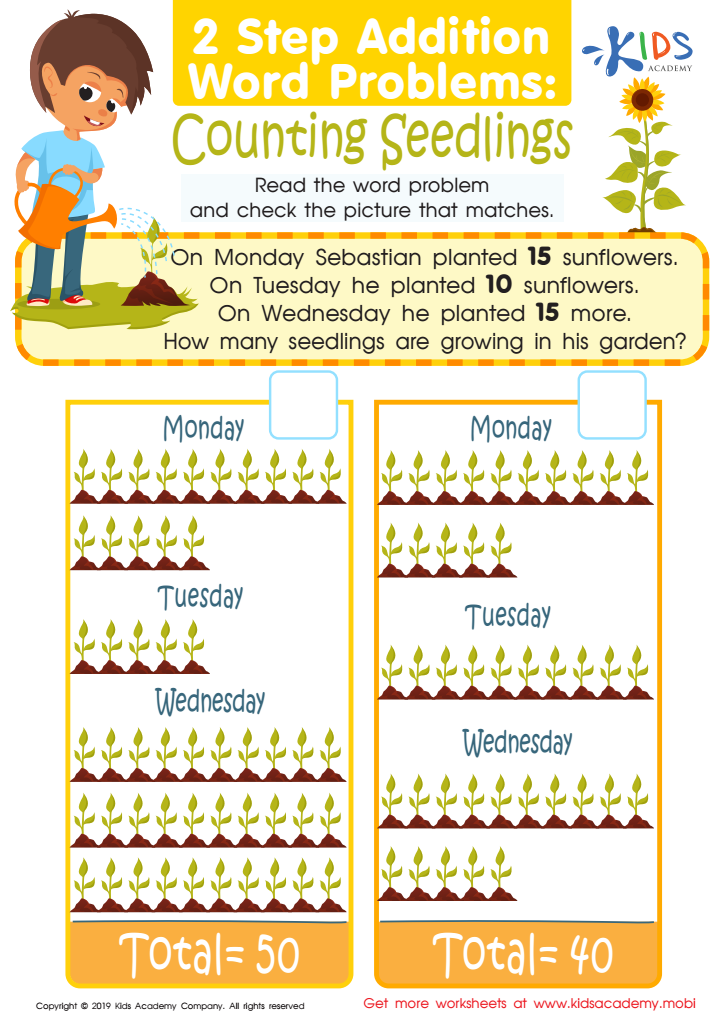
Counting Seedlings Worksheet
 Assign to My Students
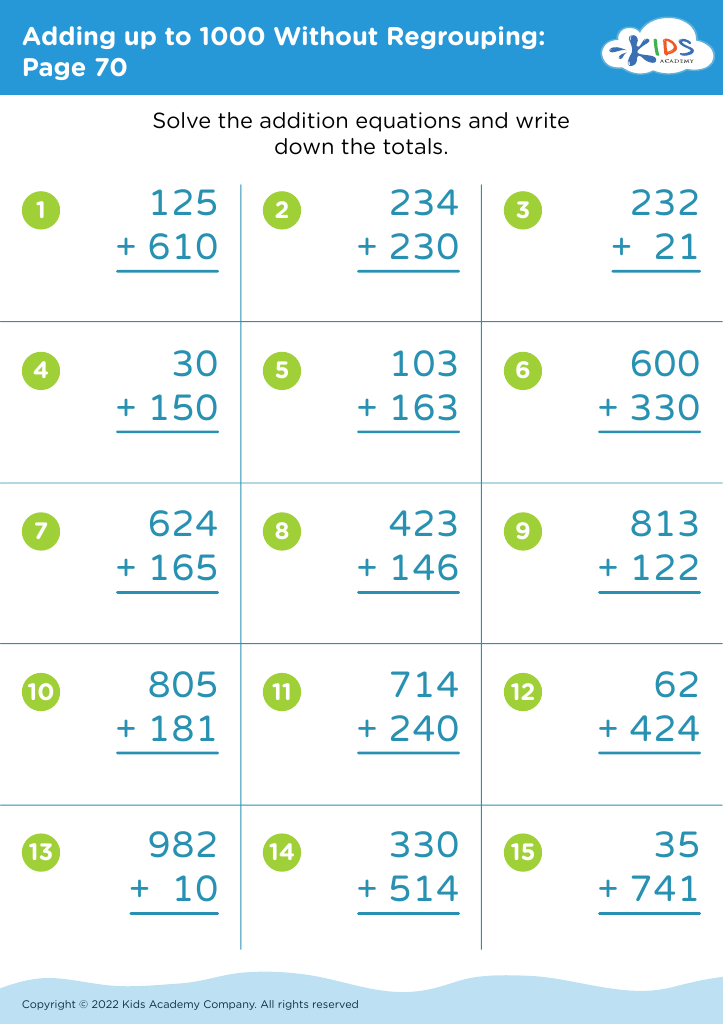







Understanding quantity and addition in Grade 3 is crucial for both parents and teachers as it lays the foundation for a child's mathematical development and critical thinking skills. At this stage, children transition from basic arithmetic to more complex concepts, including problem-solving and mathematical reasoning. Mastering addition involves not just knowing the sum of numbers, but also recognizing quantities, understanding number relationships, and developing strategies for solving mathematical problems.
Parents and teachers play an essential role in supporting this learning process. When they emphasize the importance of understanding quantities, children can relate math to real-life situations, making the subject more engaging and less intimidating. This foundational understanding enhances children's confidence and self-efficacy, reducing math anxiety and fostering a positive attitude toward the subject.
Moreover, a solid grasp of addition sets the stage for future mathematical concepts, including multiplication, division, and fractions. Encouraging children to explore different methods—such as using visual aids, manipulatives, or games—can help them discover ways to understand and apply math in diverse contexts. Thus, investing time and effort in nurturing a child's understanding of quantity and addition is vital for their ongoing academic success and lifelong learning.