
Extra Challenge Phonics worksheets activities for Ages 3-6
3 filtered results
Difficulty Level
Grade
Age
-
From - To
Subject
Activity
Standards
Discover our Extra Challenge Phonics Worksheets, designed for children ages 3-6 who are eager to enhance their literacy skills! These engaging activities provide exciting opportunities to practice phonics through colorful illustrations and interactive exercises. Perfect for both classroom and home use, these worksheets foster a love for reading while building essential phonetic awareness and pronunciation skills. Children will Cconnect letters with sounds, recognize words, and develop their vocabulary in a fun and stimulating way. Perfect for keeping little learners engaged and challenged, our phonics activities are aligned with early learning standards to support their educational journey. Start exploring today!
Favorites
With answer key
Interactive
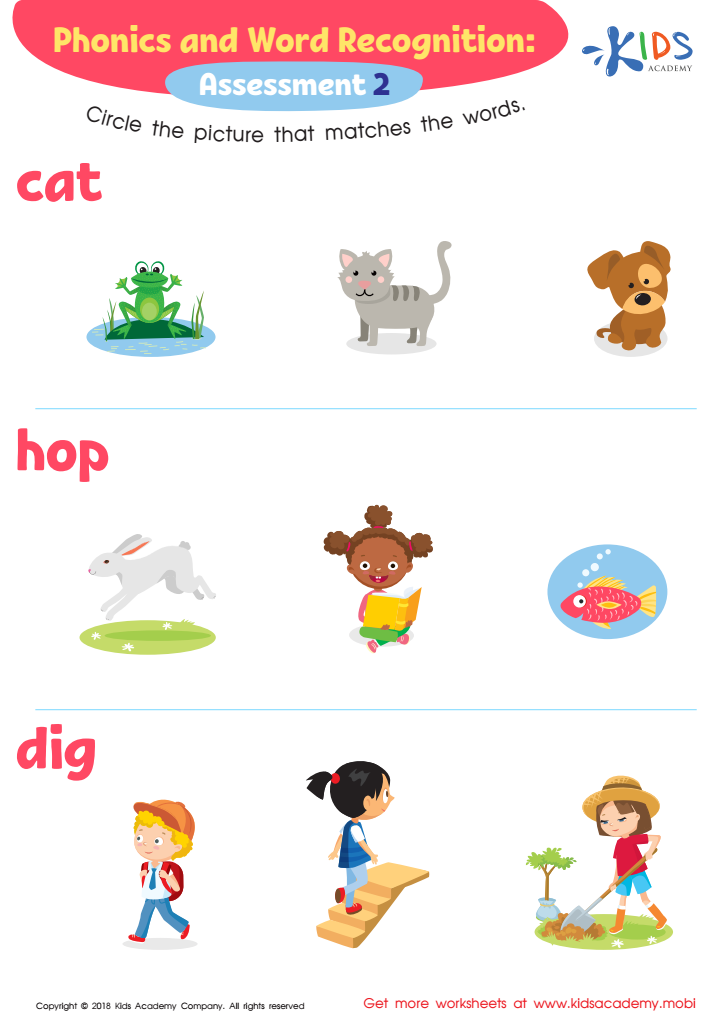
Phonological Awareness: Assessment 2 ELA Worksheet
This free worksheet assesses your emerging reader's ability to decode and match closed-syllable high-frequency words to the appropriate picture. The pictures are cheery and easy to identify, so your child will have fun and find success with decoding and matching.
 Assign to My Students
Phonological Awareness: Assessment 2 ELA Worksheet
Worksheet
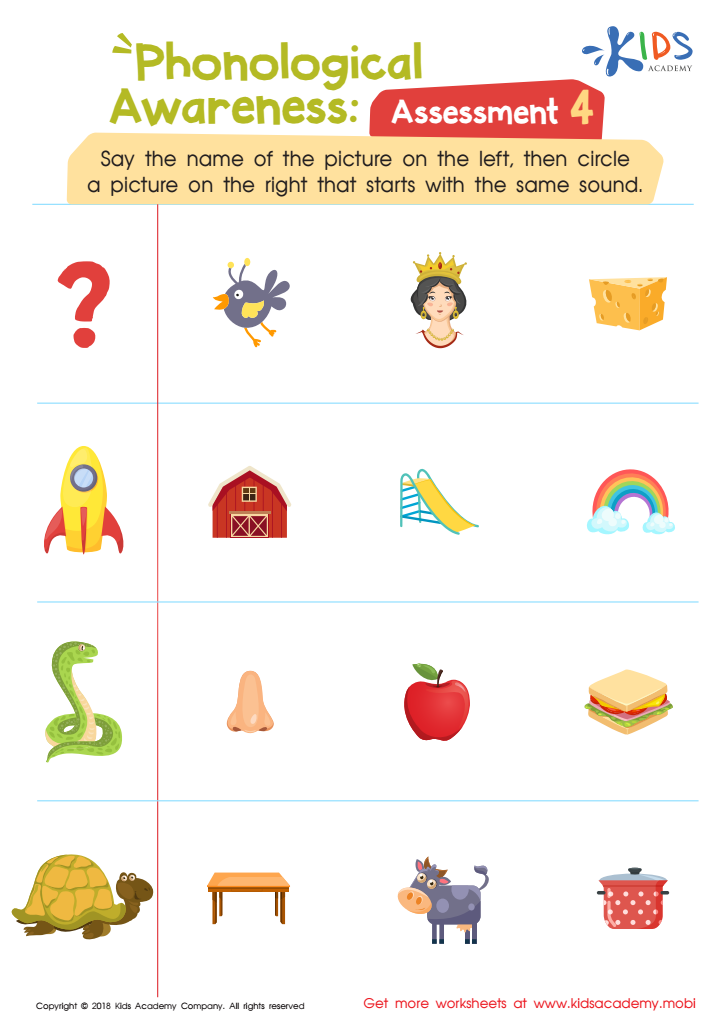
Phonological Awareness: Assessment 4 Worksheet
It can be tricky for young readers to differentiate between sounds in words. Make it fun with this downloadable worksheet! Ask your child to name each picture on the left and match the starting sound with an image on the right. This helps assess their phonics skills and make learning enjoyable.
Phonological Awareness: Assessment 4 Worksheet
Worksheet
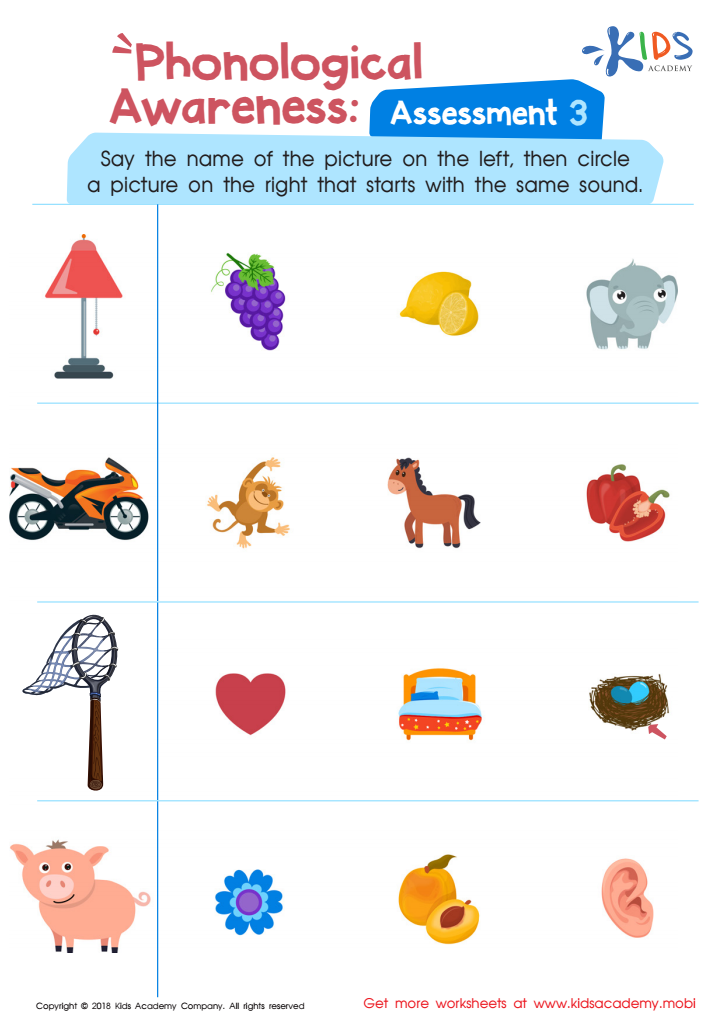
Phonological Awareness: Assessment 3 Worksheet
Test kids' reading readiness with a phonological awareness worksheet! With this PDF exercise, encourage children to name each picture aloud and match left to right. Help them learn to recognize word sounds at the start, middle and end of words. They'll be sure to remember that lamp doesn't sound like elephant!
Phonological Awareness: Assessment 3 Worksheet
Worksheet
Join Kids Academy for Free
Who is primarily going to use this learning content?







Parents and teachers should care about Extra Challenge Phonics activities for Ages 3-6 because they form a crucial foundation for early literacy development. Phonics instruction empowers youngsters to understand the relationship between letters and sounds, enabling them to decode words and develop reading skills that are essential for lifelong learning.
In this critical age range, children's brains are rapidly developing, making them particularly receptive to language skills. Engaging in Extra Challenge Phonics activities can foster a child's ability to blend sounds, segment words, and recognize phonetic patterns. By participating in these activities, children not only enhance their reading proficiency but also improve their vocabulary and comprehension skills, laying the groundwork for academic success.
Moreover, Extra Challenge Phonics activities can be tailored to meet each child's individual learning pace and style, ensuring that all children can participate meaningfully, whether they are advanced or need additional support. This customization prevents frustration and fosters a love for reading.
Ultimately, parents and educators working together to incorporate phonics activities enriches the learning experience, strengthens parent-child or teacher-student bonds, and promotes confidence and independence in young learners, setting them on a path to educational achievement and a lifelong appreciation for literacy.








