
Develop problem-solving skills Math Worksheets for Ages 3-4
3 filtered results
Difficulty Level
Grade
Age
-
From - To
Subject
Activity
Standards
Unlock your child's potential with our "Develop Problem-Solving Skills Math Worksheets for Ages 3-4." Designed by experts, these engaging worksheets introduce foundational math concepts through fun activities. Young learners will practice counting, sorting, and recognizing patterns, helping to build essential problem-solving skills. Perfect for preschoolers, these printable resources make learning enjoyable and interactive, fostering confidence and a love for math from an early age. Whether for classroom use or at-home learning, our worksheets provide a solid foundation for future mathematical success, nurturing young minds in an exciting and educational journey. Explore now and watch your child thrive!
Favorites
With answer key
Interactive
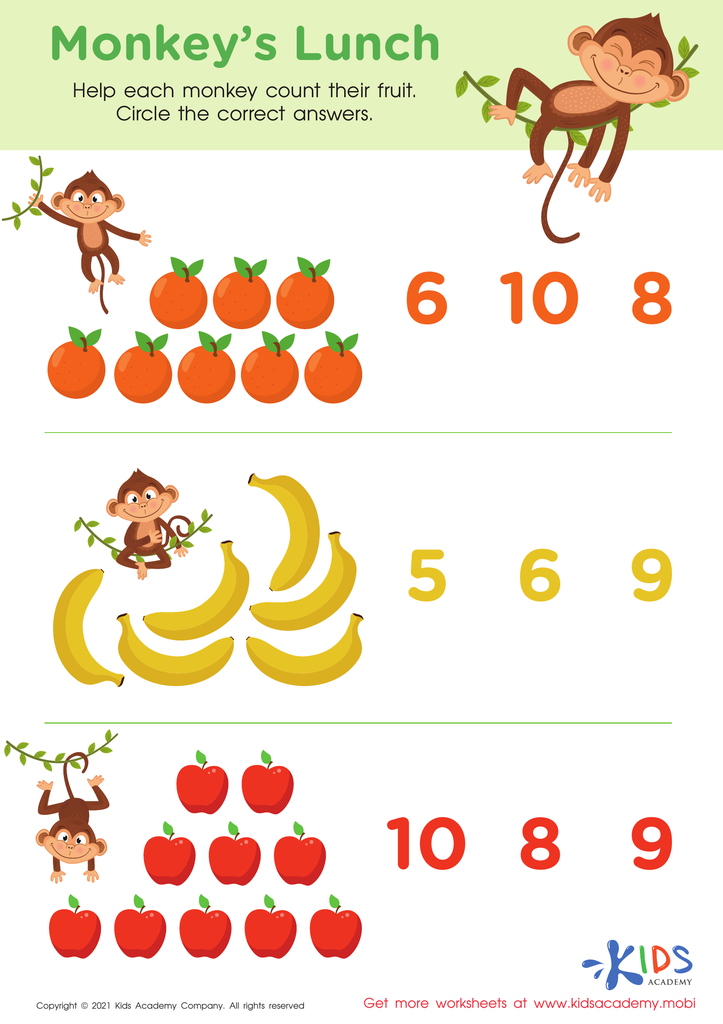
Monkey’s Lunch Worksheet
Download this free worksheet to help your kindergartner perfect their counting skills! Have your child circle the correct answers and count the fruits for the monkeys. It'll seem like fun, but your child is really learning how to count, group objects, and identify numbers.
Monkey’s Lunch Worksheet
Worksheet
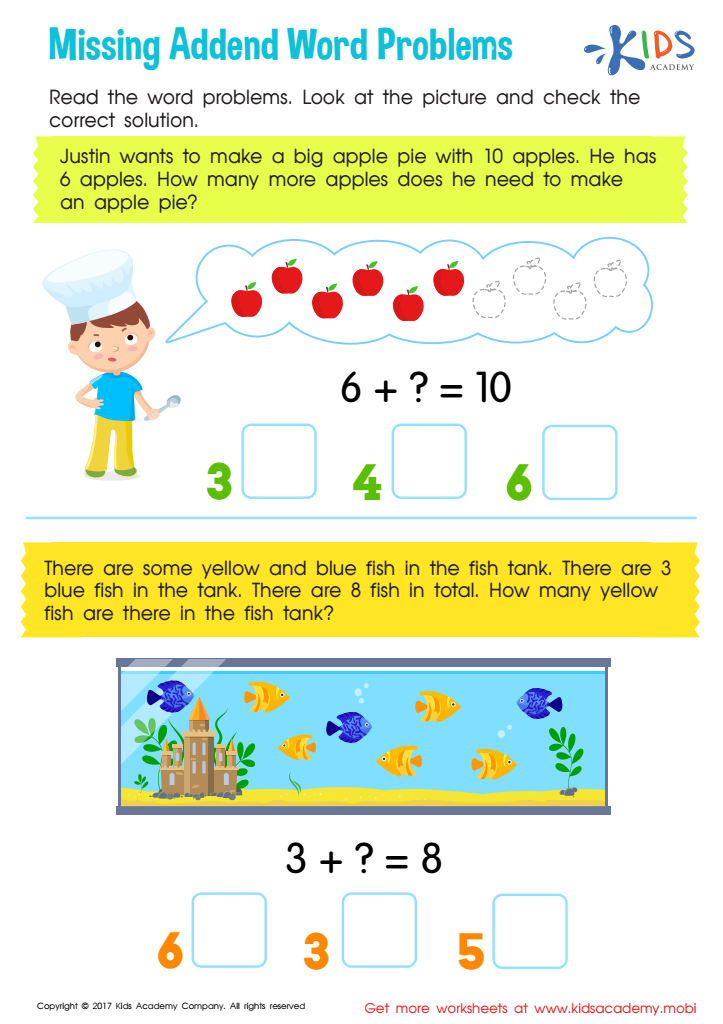
Missing Addend Word Problems Worksheet
Doing many addition and subtraction problems is key for fluency and mastery. Word problems can help kids understand how math works in everyday life. Our math worksheet uses fun scenarios and pictures to teach how to find the missing addend. It's the perfect tool to help kids understand math better!
 Assign to My Students
Missing Addend Word Problems Worksheet
Worksheet
Join Kids Academy for Free
Who is primarily going to use this learning content?








Developing problem-solving skills in math for children aged 3-4 is incredibly crucial for their overall cognitive development. At this young age, children's brains are highly receptive to new information, and engaging them in problem-solving activities lays a strong foundation for future learning.
Firstly, early exposure to problem-solving in math helps enhance children's critical thinking abilities. They learn to analyze, visualize, and approach problems methodically, skills that are valuable beyond mathematics. Secondly, it promotes confidence. When children understand they can find solutions to problems, they start to believe in their capabilities, fostering a growth mindset that’s beneficial throughout life.
Moreover, math problem-solving in early years boosts pattern recognition and logical reasoning, key skills in many other academic fields. It also aids in the development of fine motor skills and hand-eye coordination when using physical objects like blocks or beads for counting.
Lastly, fun and interactive problem-solving activities can instill a love for learning and curiosity about the world. By caring about the development of problem-solving skills in early math, parents and teachers set children up for success academically, socially, and emotionally, nurturing well-rounded individuals ready to face challenges confidently.








