
Fraction Addition Worksheets for Ages 3-6
4 filtered results
Difficulty Level
Grade
Age
-
From - To
Subject
Activity
Standards
At Kids Academy, we offer engaging Fraction Addition Worksheets designed specifically for children ages 3-6. These worksheets provide a fun and interactive way for young learners to grasp the basics of fraction addition through visually appealing activities. Utilizing colorful illustrations and simple equations, our resources encourage early math skills while keeping little minds engaged. Perfect for parents and educators, these worksheets can be easily printed for at-home practice or in-class learning. Foster your child’s mathematical confidence with our thoughtfully crafted fraction addition activities, making learning enjoyable and effective. Join us today to build a strong foundation in early math concepts!
Favorites
With answer key
Interactive
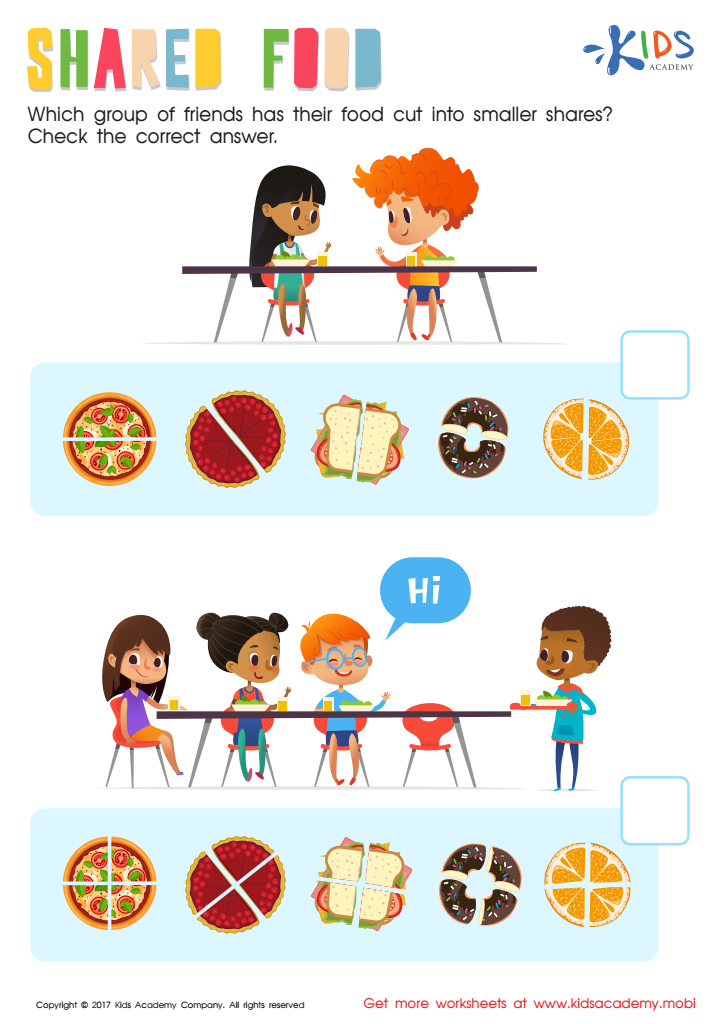
Shared Food Worksheet
In this worksheet, kids learn about sharing and cutting shapes into equal parts. There are two groups of friends: one with two, the other with four. Ask your child which group has their food cut into smaller shares, and help them find the right answer.
 Assign to My Students
Shared Food Worksheet
Worksheet
Join Kids Academy for Free
Who is primarily going to use this learning content?







Teaching young children about fractions, particularly through addition, is essential for laying a solid foundation in mathematics. For ages 3-6, children are in a critical developmental stage where they start to understand fundamental concepts of number sense, spatial awareness, and relationships among quantities. Engaging young learners with fractions fosters early numeracy skills and offers a concrete method to grasp part-whole relationships.
Furthermore, introducing fractions in a playful and age-appropriate manner allows children to explore mathematical ideas through hands-on activities such as sharing snacks, dividing toys, or measuring ingredients. These tangible experiences make learning meaningful and enjoyable, enabling children to connect math with real-life scenarios.
Parents and teachers should care about fraction addition, as it also promotes critical thinking and problem-solving skills. By understanding fractions, children learn to approach complex concepts gradually, boosting their confidence in mathematics early on. Additionally, this understanding cultivates resilience and a growth mindset as they face new challenges. Investing time in teaching fraction addition helps children build a broad mathematical vocabulary and prepares them for higher-level math in elementary school and beyond. Ultimately, it empowers them to become competent, confident learners in their academic journey.








