
Number comparison skills Worksheets for Ages 3-6
3 filtered results
Difficulty Level
Grade
Age
-
From - To
Subject
Activity
Standards
Boost your child's understanding of number comparison with our engaging worksheets designed for ages 3-6. These fun and interactive resources help young learners develop essential math skills by comparing quantities, identifying greater and lesser numbers, and enhancing their critical thinking. Each worksheet is tailored to suit early learners, featuring colorful illustrations and playful activities that make learning enjoyable. Perfect for both home and classroom use, these worksheets empower children to build a strong foundation in number sense. Get started today and watch your child's confidence soar as they master number comparison with ease!
Favorites
With answer key
Interactive
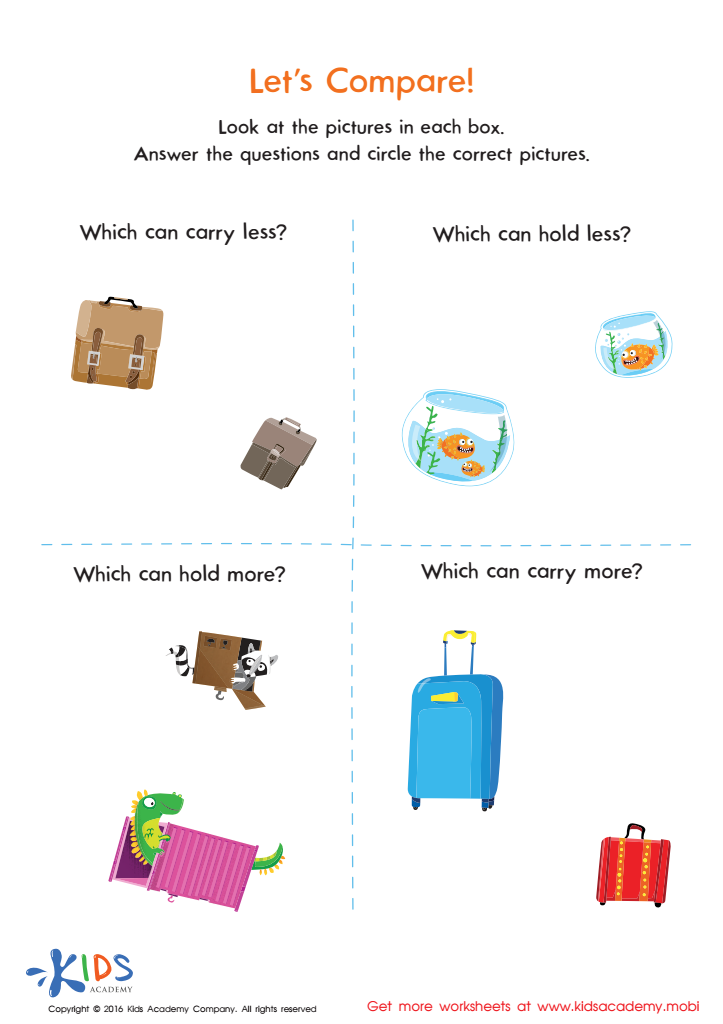
Let's Compare Worksheet: Big or Small
This worksheet will help your child gain an awareness of simple geometry and strengthen cognitive skills. Visualizing objects in 3D and comparing sizes helps to practice solving problems mentally and build analytical skills. Let's Compare worksheet will challenge your child to think hard.
 Assign to My Students
Let's Compare Worksheet: Big or Small
Worksheet
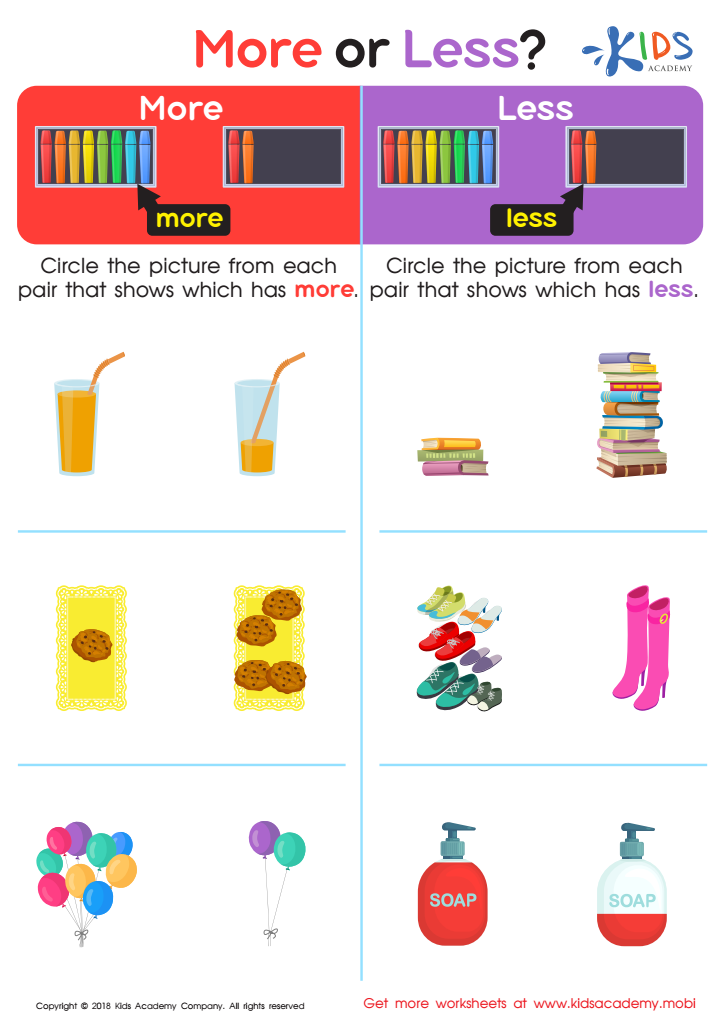
More or Less? Worksheet
Understanding "more or less" can be hard for kids. This PDF uses colorful images to help them learn. By matching the right picture pairs, children can gain a better understanding and strengthen their comparison skills for more complex tasks.
More or Less? Worksheet
Worksheet
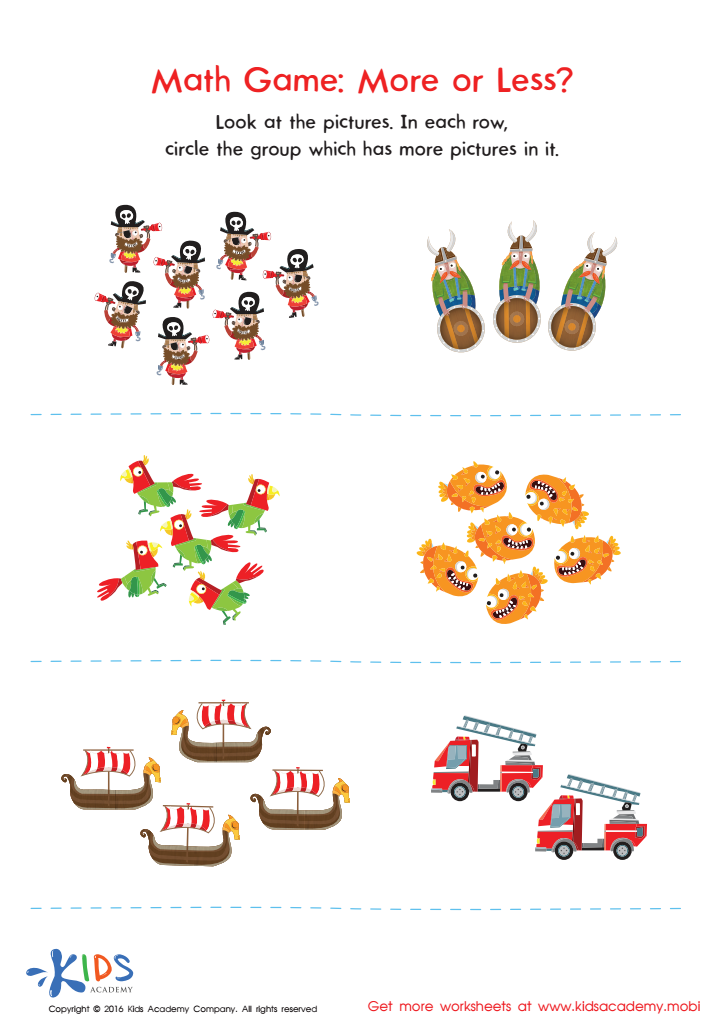
More or Less Worksheet
Counting and understanding quantity are essential skills for kindergarteners. Get your free printable more or less worksheet now!
More or Less Worksheet
Worksheet
Join Kids Academy for Free
Who is primarily going to use this learning content?





.jpg)

Number comparison skills are crucial for children aged 3-6 as they establish foundational mathematical understanding that impacts their academic future. At this early age, children are naturally curious and eager to engage with numbers. Encouraging them to compare quantities, sizes, and values fosters their cognitive development and nurtures critical thinking abilities.
Understanding number comparison is essential not just for math but for everyday problem-solving skills. Children learn to discern which groups of objects are larger or smaller, thereby strengthening their ability to categorize and analyze their environment. These skills serve as precursors to more complex mathematical concepts such as addition, subtraction, and even an introduction to concepts of estimation and measurement.
Moreover, mastering number comparison can boost a child's confidence, as they begin to recognize patterns and relationships within numbers. This foundational skill also plays a significant role in developing their social skills, as sharing and taking turns often require an understanding of quantity. Thus, investing time in helping children cultivate number comparison skills can set them on a path to successful learning and social interactions throughout their educational journey. Teachers and parents play a pivotal role in nurturing this critical ability through engaging activities and positive reinforcement.








