
Understanding opposites Measurement Worksheets for Ages 3-6
3 filtered results
Difficulty Level
Grade
Age
-
From - To
Subject
Activity
Standards
Enhance your child's understanding of measurement and opposites with our engaging worksheets designed for ages 3-6! These fun and educational activities help young learners grasp basic measuring concepts while recognizing and distinguishing opposites like big and small, tall and short, and more. Our age-appropriate worksheets incorporate colorful graphics and plenty of hands-on practice. Perfect for preschool and kindergarten children, these printables support early math skills development, cognitive growth, and comprehensive learning in an enjoyable way. Give your kids a head start in mastering fundamentals with Kids Academy’s curated measurement worksheets. Download, print, and begin the adventure in learning today!
Favorites
With answer key
Interactive
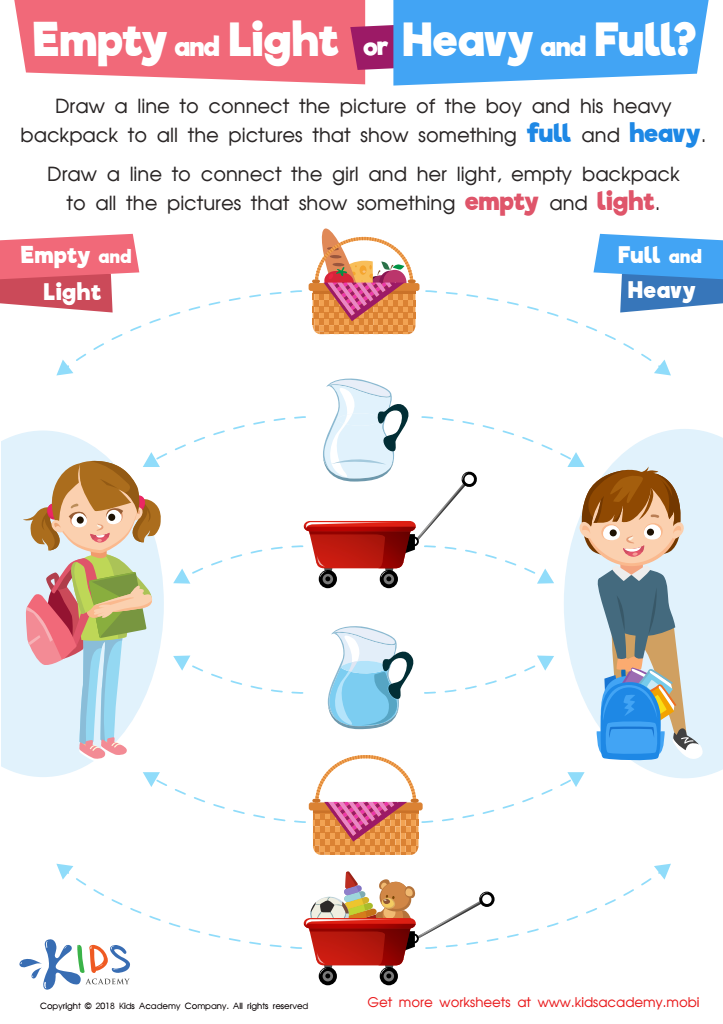
Empty and Light or Heavy and Full? Worksheet
Kids can have trouble understanding measurement, like the differences between heavy and light. This worksheet helps them associate full with heavy and empty with light, using familiar images. Plus, it's a fun way to practice fine motor skills, tracing the lines to connect the pictures.
 Assign to My Students
Empty and Light or Heavy and Full? Worksheet
Worksheet
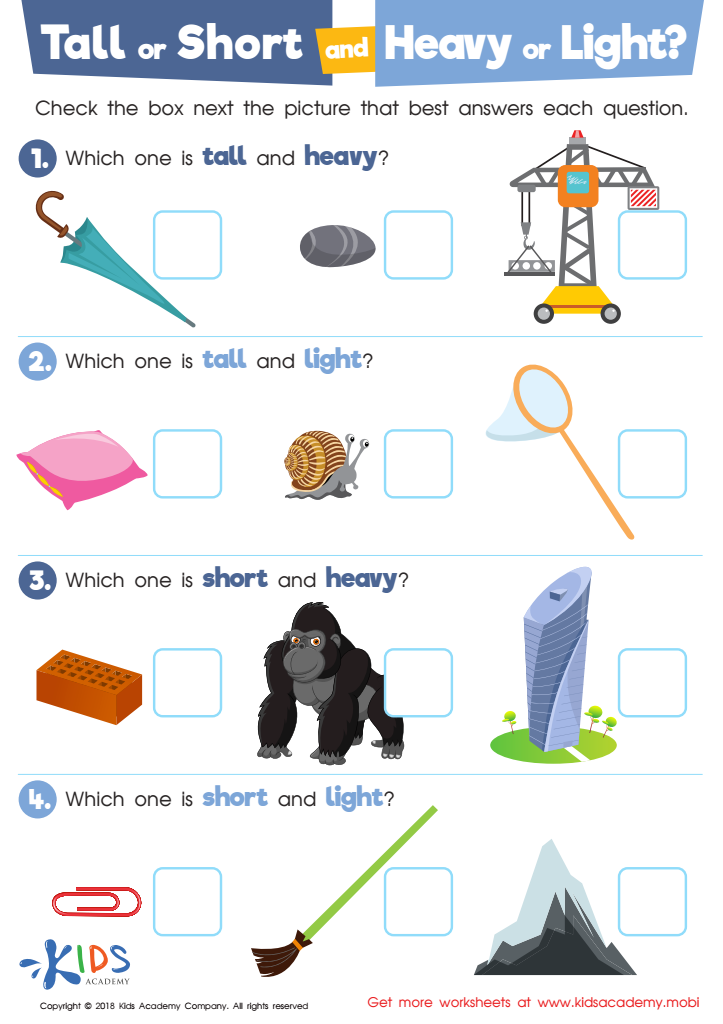
Tall or Short and Heavy or Light? Worksheet
Young children can find basic measurement concepts tricky. This PDF introduces them to the appropriate vocabulary for describing heavy, light, tall and short items, by using familiar pictures. It helps them accurately select which items fit each category.
Tall or Short and Heavy or Light? Worksheet
Worksheet
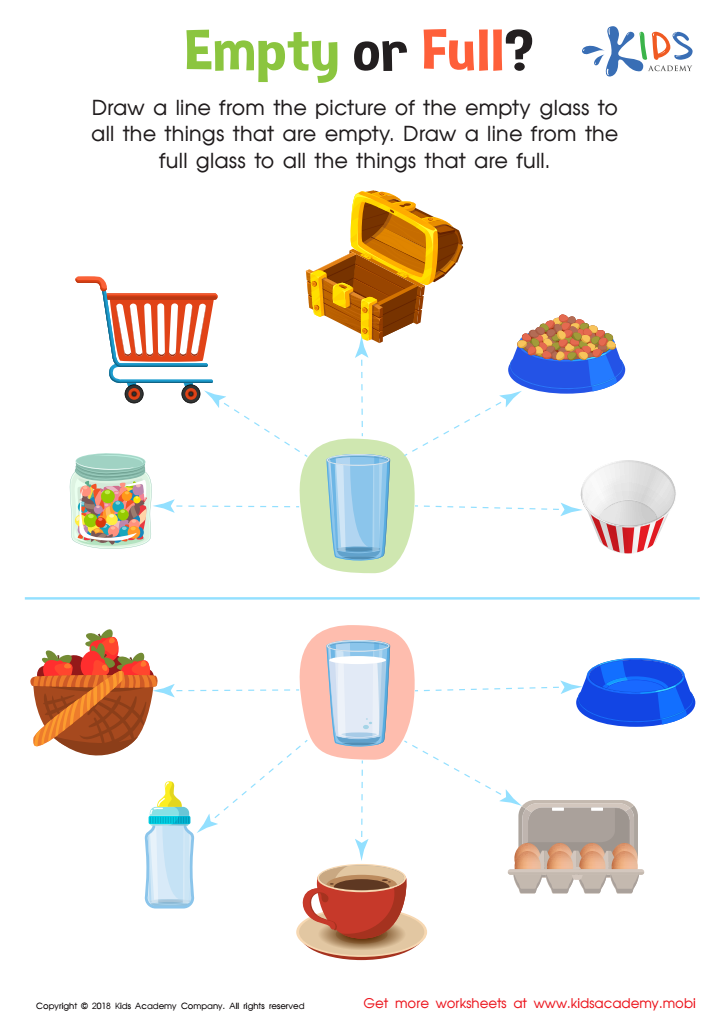
Empty or Full? Worksheet
Let students get to grips with the concepts of empty and full with this PDF worksheet. It uses fun, bright pictures to help them comprehend the difference and also helps develop fine-motor skills with tracing lines. Kids will be proud of themselves as they get answers right!
Empty or Full? Worksheet
Worksheet
Join Kids Academy for Free
Who is primarily going to use this learning content?








Understanding opposites and measurement at an early age is pivotal for children's cognitive and social development. For ages 3-6, developing these concepts lays the groundwork for mathematical and critical thinking skills that are essential for academic success and everyday life.
Firstly, exploring opposites helps young children comprehend differences and relationships. For example, learning about big and small or fast and slow helps them categorize and understand the world around them. Such comprehension fosters better communication skills, enabling them to describe experiences and express themselves effectively.
In terms of measurement, grasping length, weight, and volume introduces children to essential math concepts early on. Activities like comparing the heights of two objects or using a measuring cup to pour quantities teach children precision, sequencing, and spatial awareness. These skills are not only foundational for later mathematics learning but also useful for basic everyday tasks, such as distinguishing between enough or too much food.
Furthermore, comprehending these concepts enhances problem-solving abilities, encouraging analytical and logical reasoning from a young age. Encouragingly, parents and teachers who engage children in hands-on, playful learning activities around opposites and measurement boost their engagement and curiosity, making learning a more enriched, enjoyable experience.
Conclusively, early interaction with these concepts equips children with vital tools for both their current and future educational journeys, fostering competent and confident learners.








