
Understanding greater/less than Worksheets for Ages 3-7
3 filtered results
Difficulty Level
Grade
Age
-
From - To
Subject
Activity
Standards
Explore our expertly crafted "Understanding Greater/Less Than Worksheets" tailored specifically for ages 3-7. These engaging worksheets from Kids Academy foster early math skills, helping young learners grasp fundamental concepts of comparing numbers. Through a variety of fun and interactive activities, children will learn to identify which numbers are greater, less, or equal, setting a solid foundation for future math success. Designed to cater to the developmental stages of young minds, these printables combine playful learning with essential educational outcomes. Prepare your child for a bright mathematical future with our trusted resources. Join today for a delightful learning journey!
Favorites
With answer key
Interactive
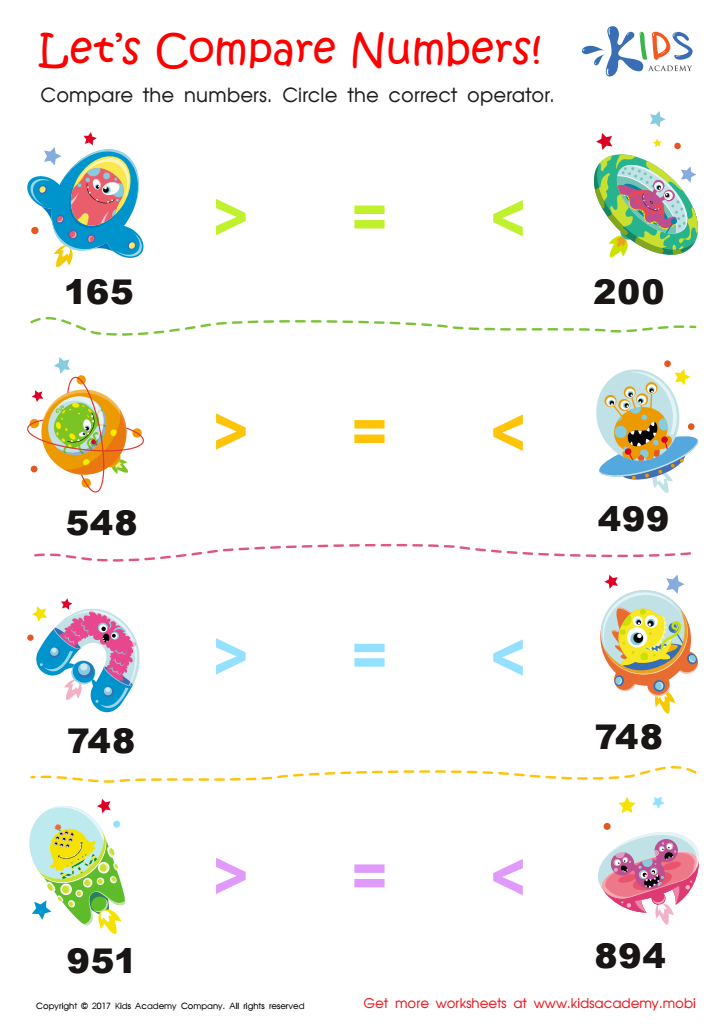
Comparing Numbers Worksheet for 2nd Grade
Alien friends are back to help your child learn to compare numbers using >, < and = symbols. This 2nd grade worksheet will challenge them with larger numbers!
 Assign to My Students
Comparing Numbers Worksheet for 2nd Grade
Worksheet
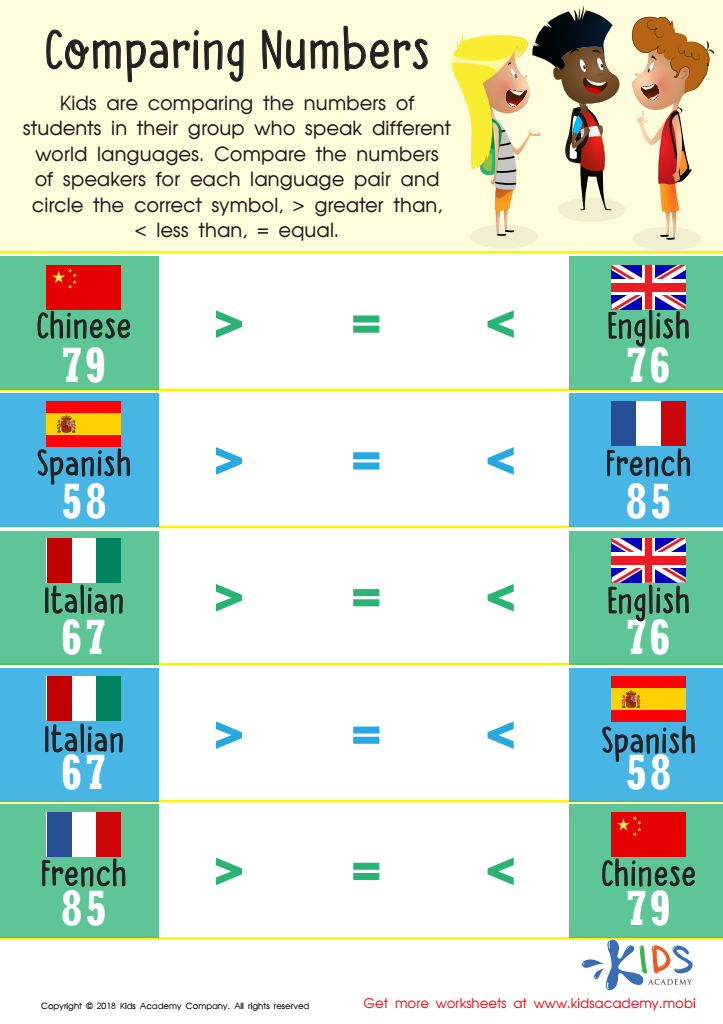
Comparing Numbers Worksheet for 1st Grade
Children can build number sense by exploring the relationship between numbers. This worksheet uses bright international flags to compare numerical groups. Kids will love the cheerful colors and flags from different countries. It encourages them to compare numbers and reinforces their number sense with tens and ones place values.
Comparing Numbers Worksheet for 1st Grade
Worksheet
Join Kids Academy for Free
Who is primarily going to use this learning content?



.jpg)




Understanding the concept of greater than/less than is foundational for young children, ages 3-7, as it lays the groundwork for future mathematical learning and critical thinking skills. At this age, children are developing their number sense - an intuitive understanding of numbers and their relationships. Recognizing whether a number is greater than or less than another number helps them grasp basic math operations like addition and subtraction, which are essential for tackling more complex mathematical problems later on.
For parents and teachers, emphasizing this concept enhances children's cognitive skills, such as problem-solving and logical reasoning. It fosters their ability to compare quantities and make decisions based on numerical information, skills that are applicable in daily life situations. For instance, a child at a store deciding which bag of candies has more pieces or a student figuring out who has more blocks during playtime are real-world applications of this understanding.
Moreover, a solid grasp of greater than/less than promotes confidence in math, making them more willing to engage in and enjoy mathematical activities. Encouraging this understanding through fun, interactive learning experiences, like games and hands-on activities, creates a positive and stimulating learning environment.
By nurturing these initial math skills, parents and teachers help children build a strong mathematical foundation, critical for their academic success and everyday life efficiency.








