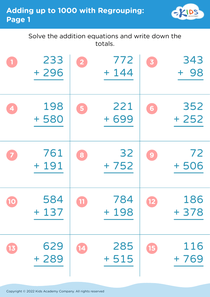
Develop counting skills Adding up to 1000 Without Regrouping Worksheets for Ages 3-7
3 filtered results
-
From - To
Welcome to our "Develop Counting Skills: Adding Up to 1000 Without Regrouping Worksheets" designed for children aged 3-7! These engaging worksheets offer a fun and interactive way for young learners to build essential counting and addition skills. Perfect for early math readiness, the materials encourage hands-on practice through colorful visuals and age-appropriate exercises. Each worksheet focuses on adding numbers up to 1000, allowing children to grasp fundamental concepts without the complexity of regrouping. Empower your child’s early math learning with these expertly crafted resources that foster confidence and proficiency in counting and addition. Start your math journey today!
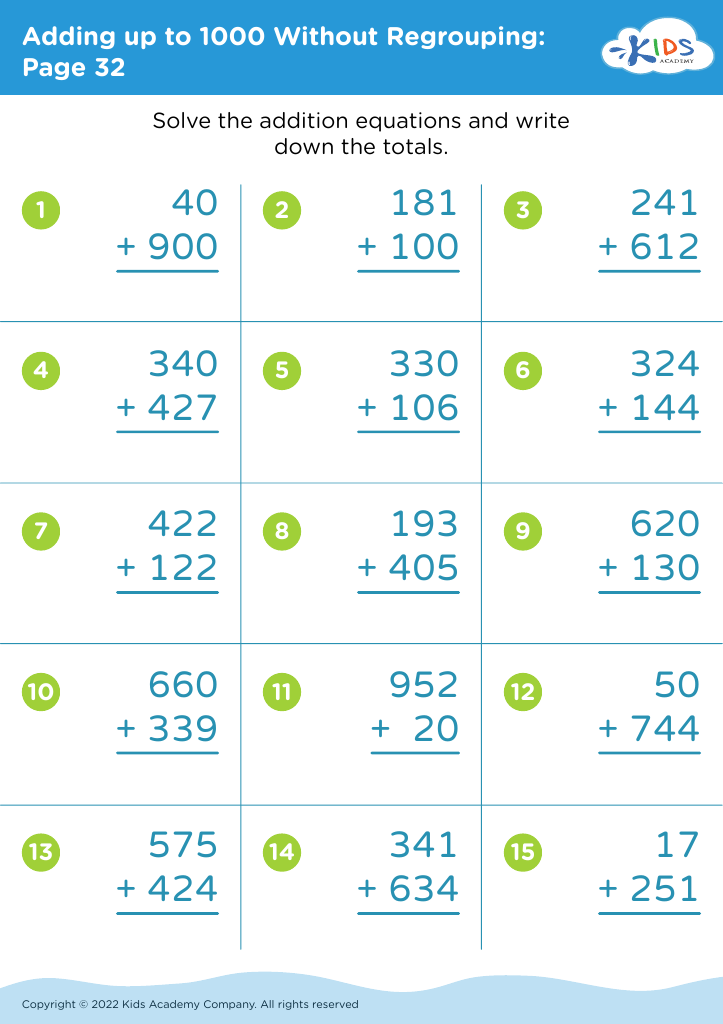
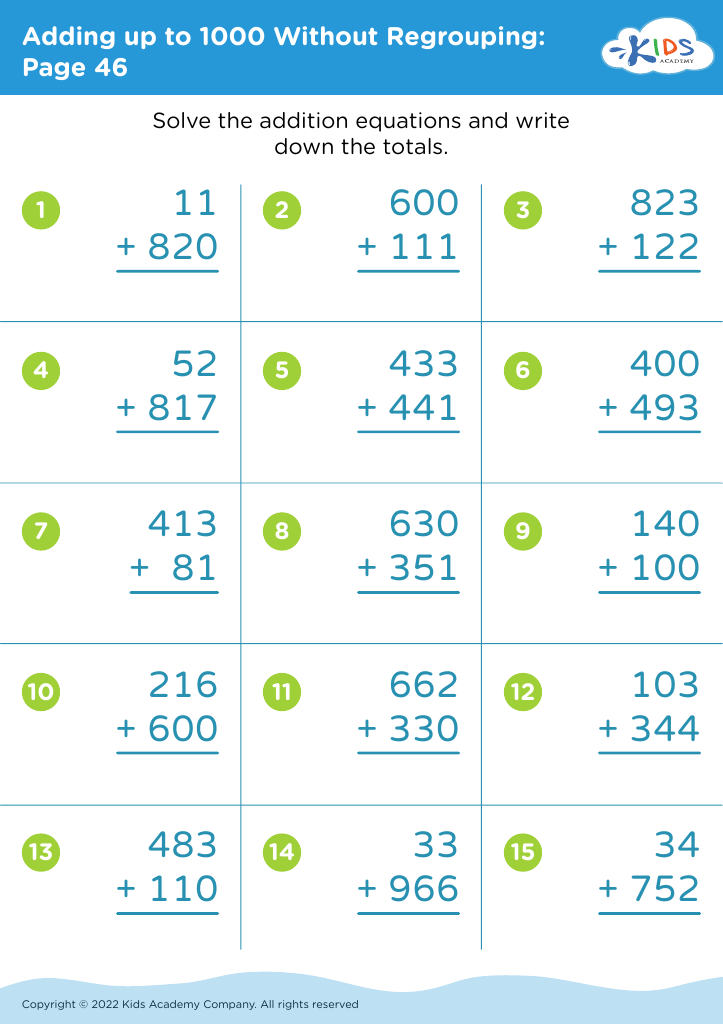
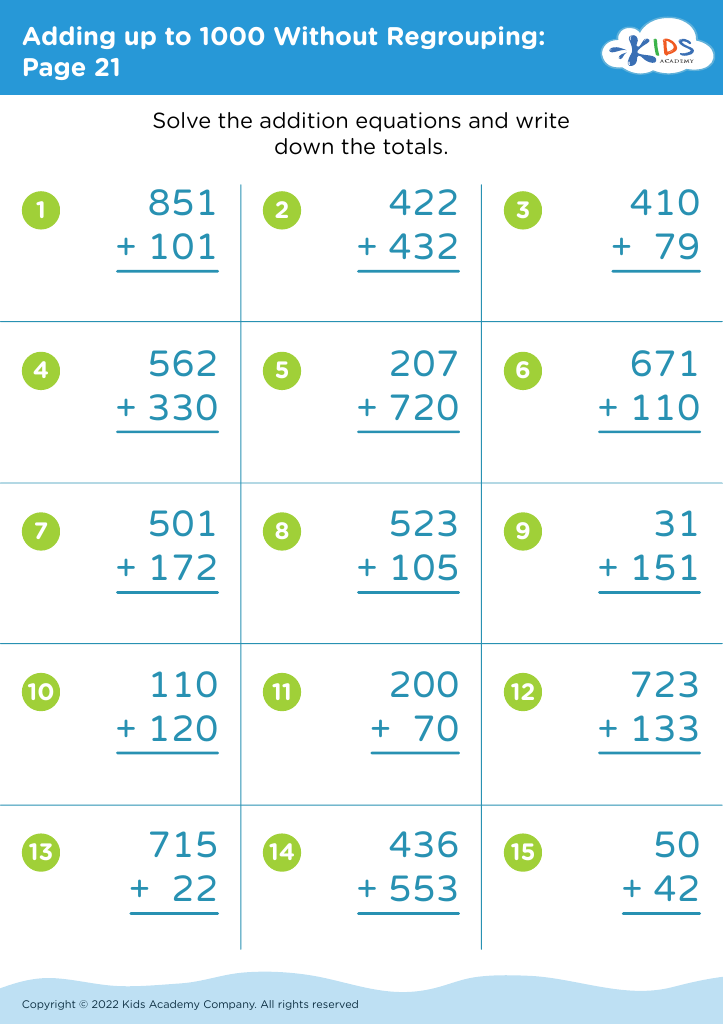


Developing counting skills, particularly the ability to add up to 1000 without regrouping, is essential for children aged 3-7 for several reasons. Firstly, foundational math skills are critical for academic success; they serve as the building blocks for more complex arithmetic and pave the way for future learning experiences. Being comfortable with counting and addition enables young learners to confidently tackle more advanced concepts later, reducing anxiety related to math.
Moreover, understanding numbers up to 1000 broadens children's comprehension of their environment, allowing them to visualize quantities and make comparisons in their daily lives. This cognitive ability fosters critical thinking and problem-solving skills as students learn to analyze data and situations numerically.
Additionally, promoting counting through hands-on activities, songs, and games instills a sense of enjoyment and engagement with math. When children perceive math as fun, they are more likely to develop a positive attitude towards it in the long run.
Lastly, a solid grasp of counting encourages teamwork and collaboration during group activities, as children learn to communicate their thoughts effectively and utilize math in social settings. Overall, investing time in counting skills at an early age lays the groundwork for lifelong success in mathematics and beyond.