Improving counting skills Adding up to 1000 Without Regrouping Worksheets for Ages 3-7
4 filtered results
-
From - To
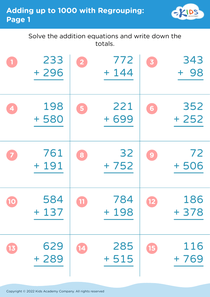
Enhance your child's counting abilities with our "Improving Counting Skills Adding up to 1000 Without Regrouping Worksheets" designed for ages 3-7. These engaging activities are crafted to boost numerical confidence and precision. Children will master addition up to 1000 through structured exercises, vibrant visuals, and simple instructions, ensuring a solid foundation in early math skills. Perfect for classroom or at-home use, the worksheets introduce fun and challenge at an appropriate pace. Watch as your young learner conquers counting and adds numbers seamlessly, building essential math competencies one step at a time. Let's make learning an enjoyable adventure!
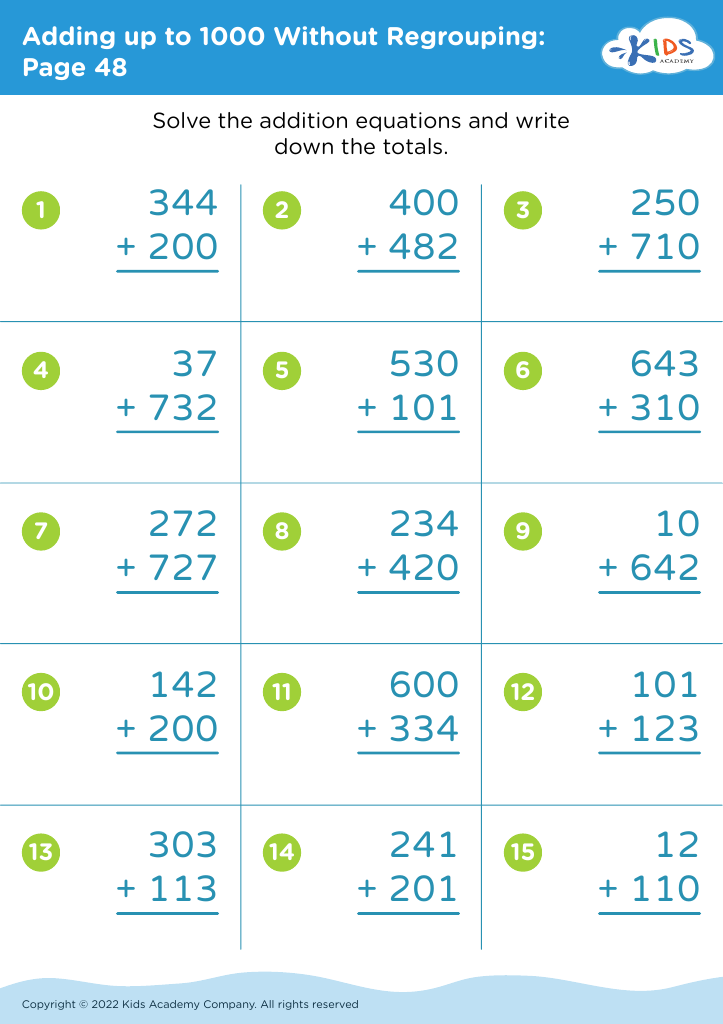
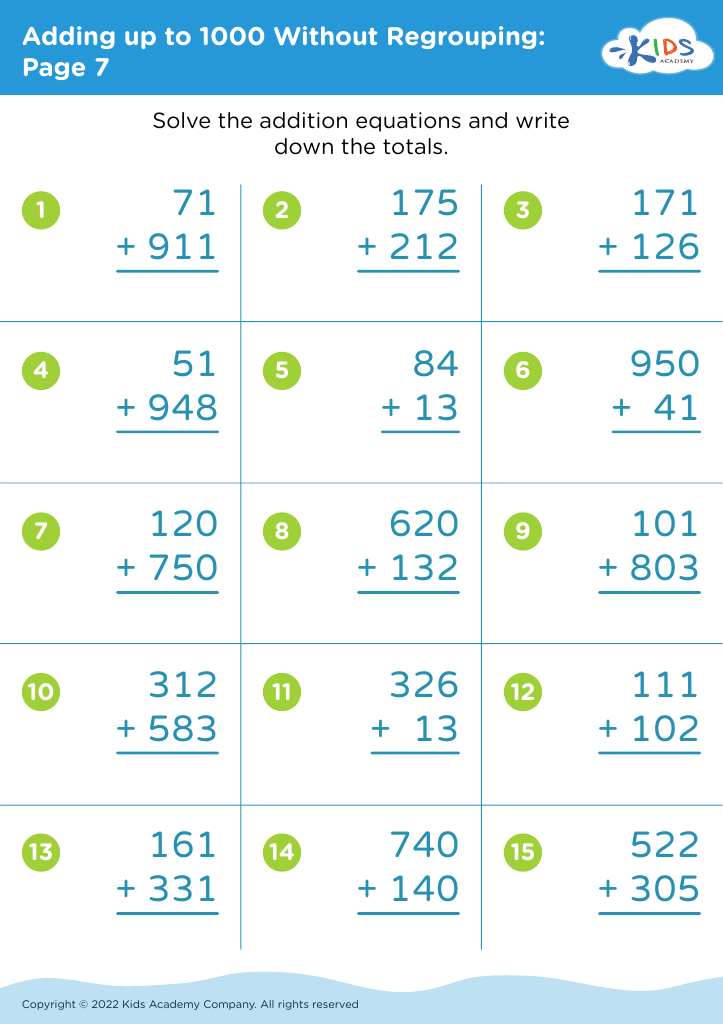
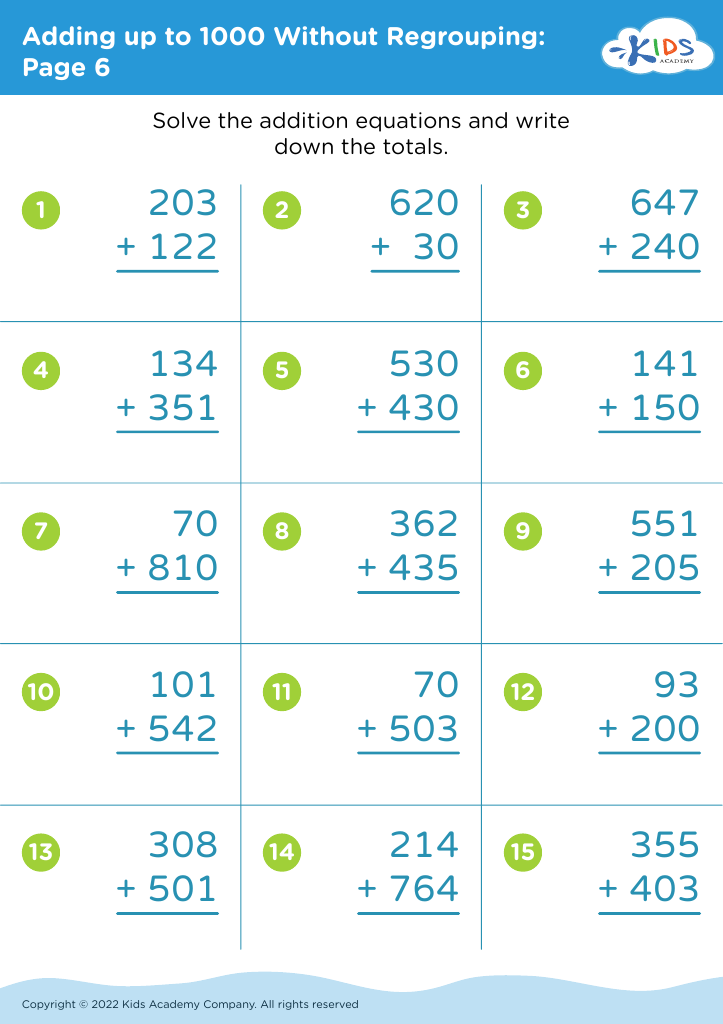
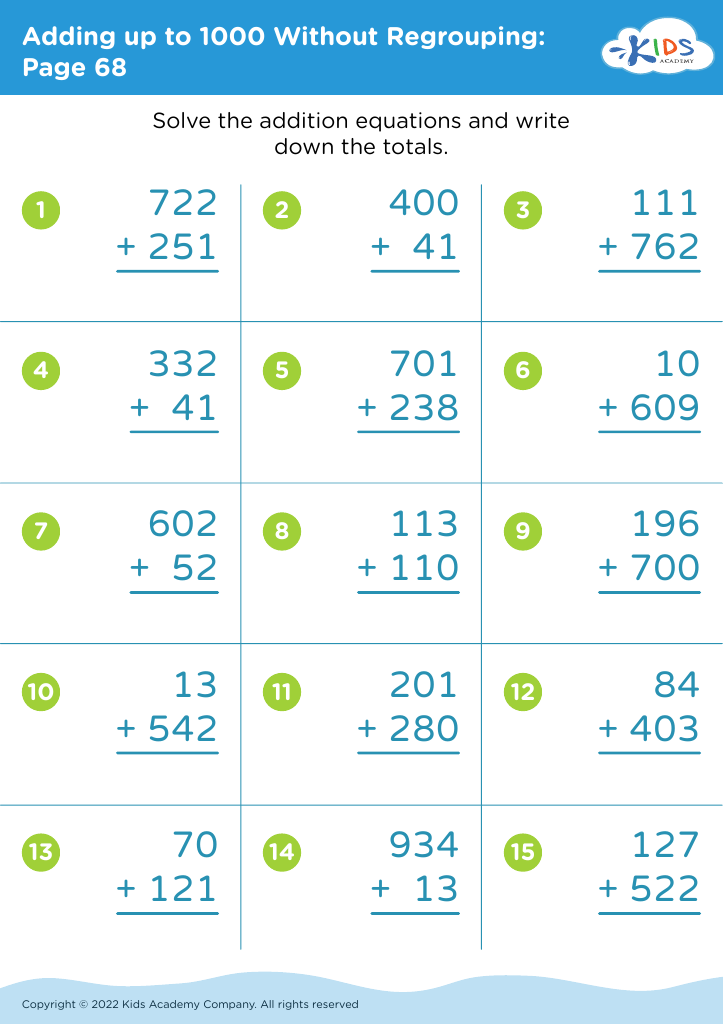


Parents and teachers play a crucial role in a child's early development, and improving counting skills up to 1000 without regrouping for ages 3-7 is essential for building a strong mathematical foundation. At this young age, mastering counting and basic addition helps enhance cognitive development, number sense, and problem-solving skills.
Counting up to 1000 introduces children to larger numbers, fostering an understanding of numerical order. It helps them recognize patterns and relationships within numbers, critical for more complex mathematical concepts they'll encounter in the future. This ability also boosts their confidence and prepares them for higher-level math.
Working without regrouping simplifies the process, enabling children to grasp the concept of place value more easily. This focus on tens and hundreds without the complication of carrying over numbers helps them internalize the basics of addition. Moreover, learning these skills at an early age encourages logical thinking, precision, and concentration.
For parents and teachers, nurturing these skills means actively supporting the child's academic journey, fostering an enjoyable learning environment, and laying the groundwork for future success. Not only does this improve math proficiency, but it also builds a child's self-esteem and enthusiasm for learning, establishing a positive attitude towards education.