Recognizing shapes Adding up to 1000 Without Regrouping Worksheets for Ages 3-7
3 filtered results
-
From - To
Welcome to our engaging "Recognizing Shapes & Adding up to 1000 Without Regrouping Worksheets" designed for children ages 3-7. This collection of printable activities focuses on enhancing shape recognition alongside foundational math skills. Through fun, interactive worksheets, young learners will explore various shapes while practicing addition strategies that do not require regrouping, fostering both cognitive and numerical skills. These materials encourage creativity and critical thinking, making learning enjoyable and effective. Perfect for homeschooling or classroom use, our worksheets will help your child build confidence in math while simultaneously developing their understanding of shapes. Start their learning journey today!
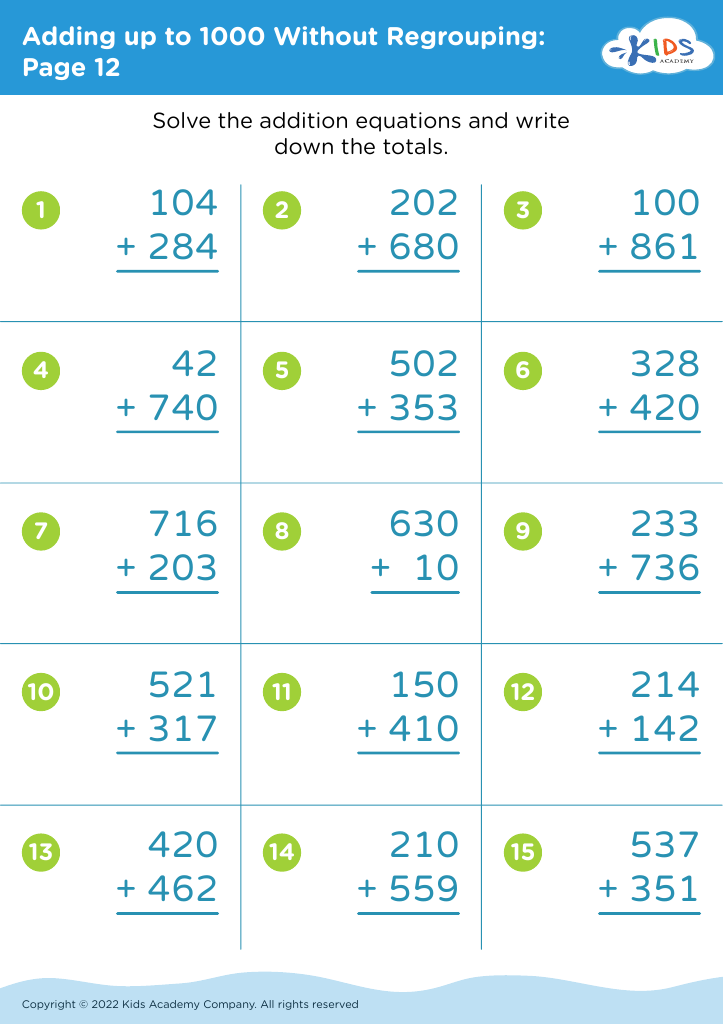
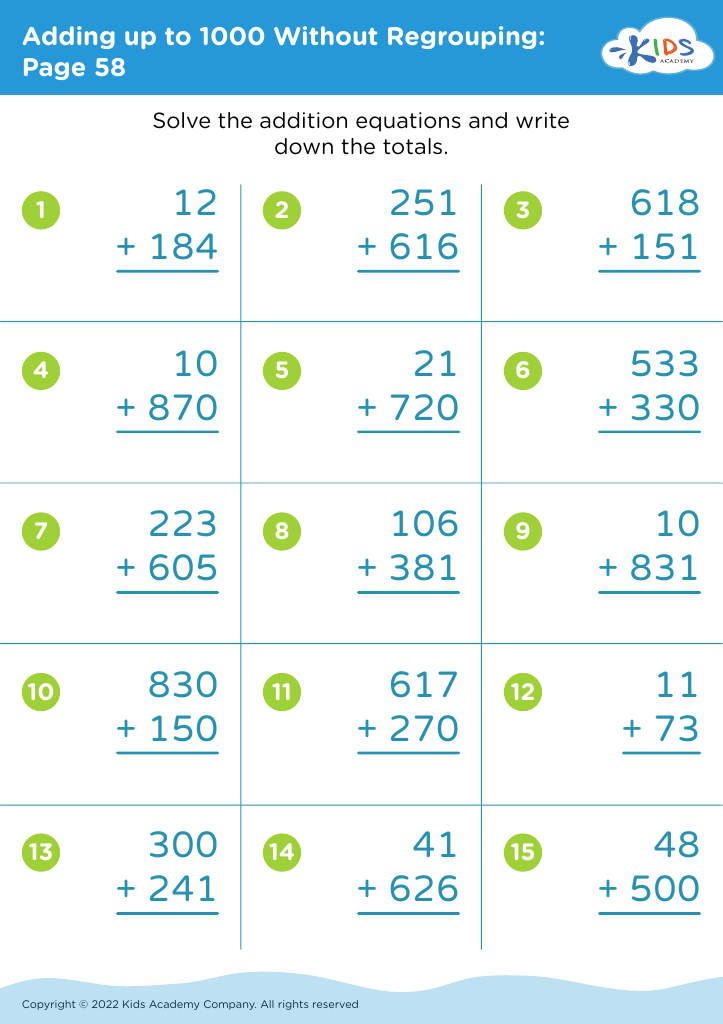
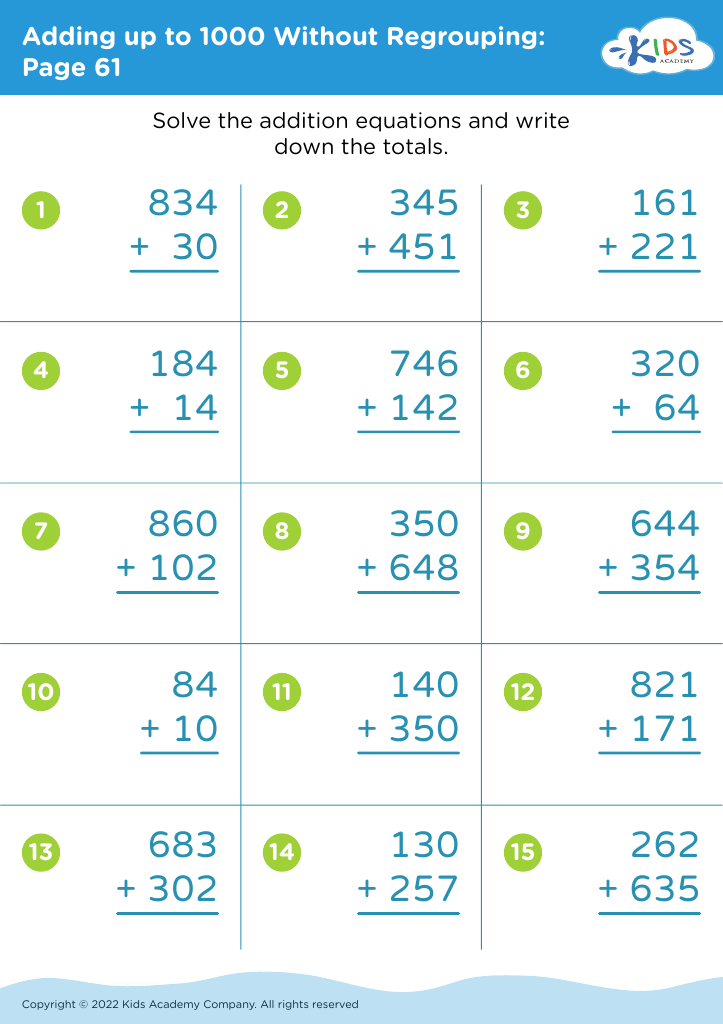


Recognizing shapes and mastering addition without regrouping are fundamental skills for young learners aged 3-7 that have far-reaching benefits as they develop.
Firstly, recognizing shapes lays the groundwork for spatial awareness and geometry; children learn to identify, categorize, and understand the properties of different shapes. This skill enhances their ability to engage in art, construction play, and even real-world problem-solving, promoting critical thinking. Furthermore, shape recognition links directly to literacy in math; children can associate shapes with numbers, fostering mathematical language use.
Secondly, adding up to 1000 without regrouping teaches foundational arithmetic skills. For young children, learning to add numbers up to 1000 encourages mental math and number fluency, contributing positively to their confidence and problem-solving abilities. By focusing on addition without regrouping, children develop a clearer understanding of place value and numerical relationships, areas crucial for future math experiences.
In summary, caring about these skills helps parents and teachers nurture a well-rounded educational experience, laying the essential framework for lifelong learning in mathematics and analytical thinking. By fostering these skills early, we support children's cognitive growth, preparing them for more complex concepts as they progress through their educational journey.