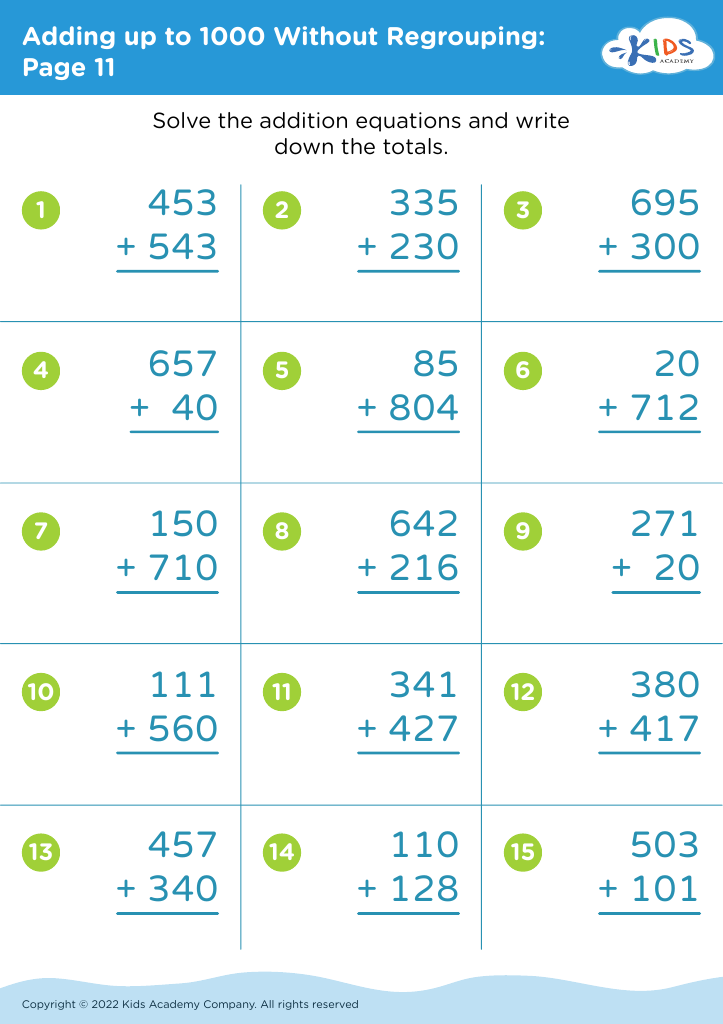
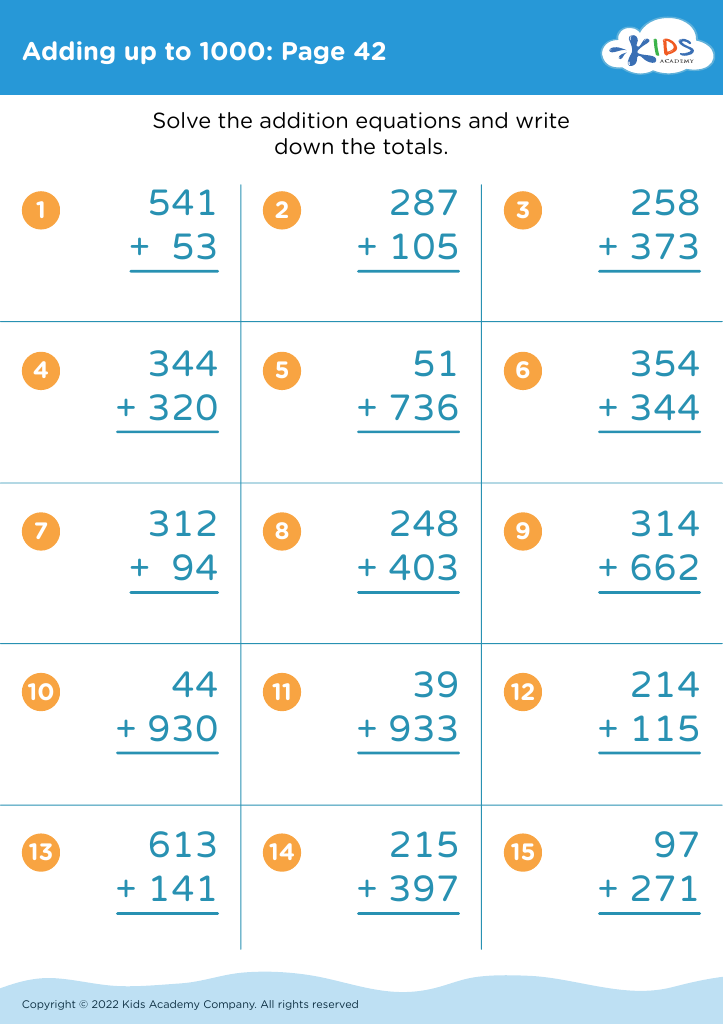




Counting skills, particularly the ability to add up to 1,000, are critical for children aged 3-7 as they provide foundational math knowledge essential for future learning. These skills contribute to cognitive development and logic, helping young learners understand relationships among numbers and how they work together. Mastering counting and basic addition enables children to engage with more complex mathematical concepts, laying the groundwork for subjects like multiplication, division, and ultimately, algebra.
Furthermore, strong counting skills facilitate problem-solving and critical thinking—abilities that transcend mathematics and are valuable in everyday life. Parents and teachers can create a nurturing environment for these essential skills by incorporating counting in play, storytelling, and daily activities, making learning enjoyable and contextual.
Additionally, proficient counting abilities boost confidence in young learners; feeling competent in these skills has a positive impact on their overall academic performance. It reduces math anxiety and encourages persistence in facing challenging tasks, fostering a growth mindset. By supporting children's counting skills, parents and teachers play a pivotal role in shaping not only their mathematical abilities but their lifelong attitudes toward learning and problem-solving.








