Practice subtraction Adding up to 1000 Worksheets for Ages 3-7
3 filtered results
-
From - To
Encourage young learners to master subtraction with our engaging "Practice Subtraction Adding up to 1000 Worksheets" designed for ages 3-7. Our worksheets offer fun, visual, and interactive methods to help children understand and practice subtracting numbers within 1000. Tailored to enhance math skills, these exercises focus on building a strong foundation in arithmetic through colorful illustrations and kid-friendly problems. Ideal for preschoolers and early elementary students, these practice sheets make learning subtraction an enjoyable adventure, setting the stage for future math success. Equip your child with essential skills and confidence in math by integrating these worksheets into their daily study routine.
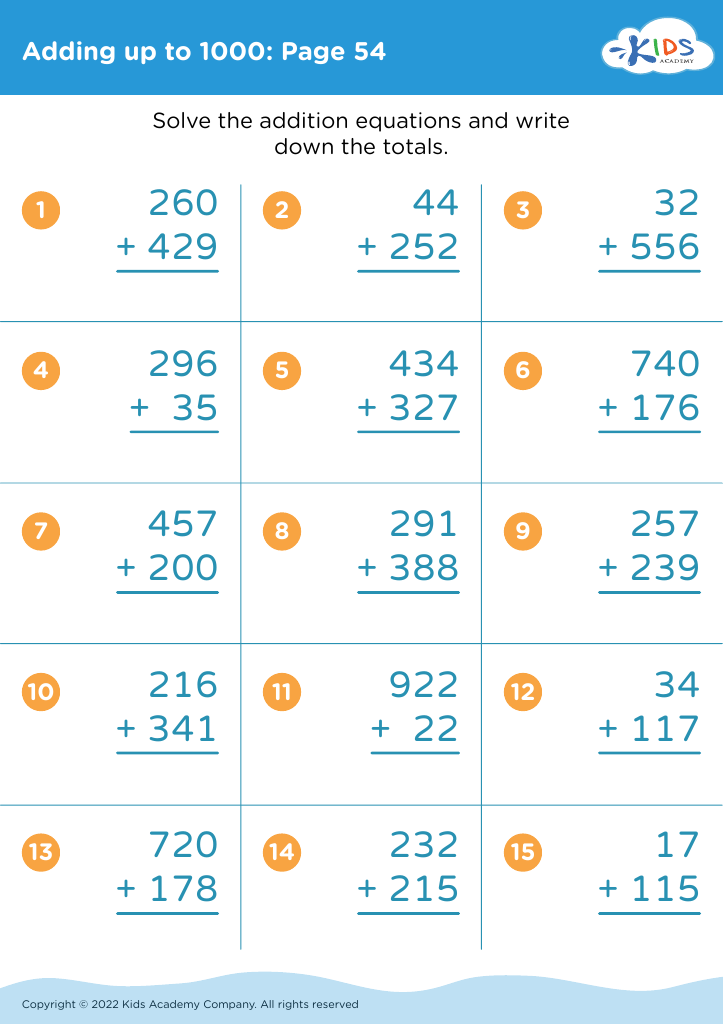
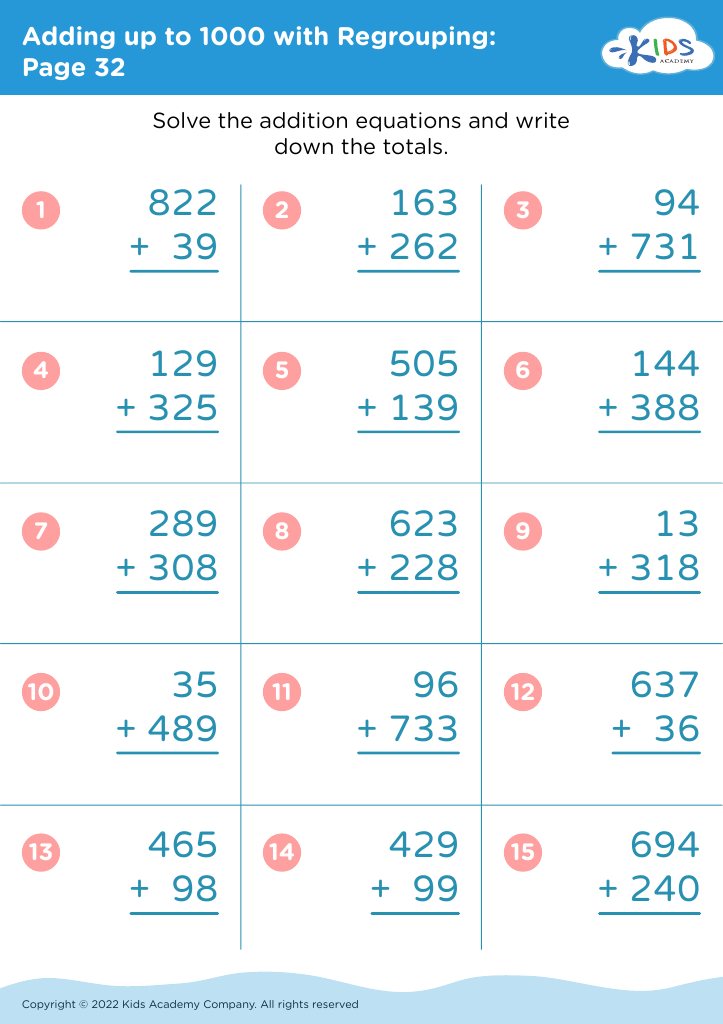
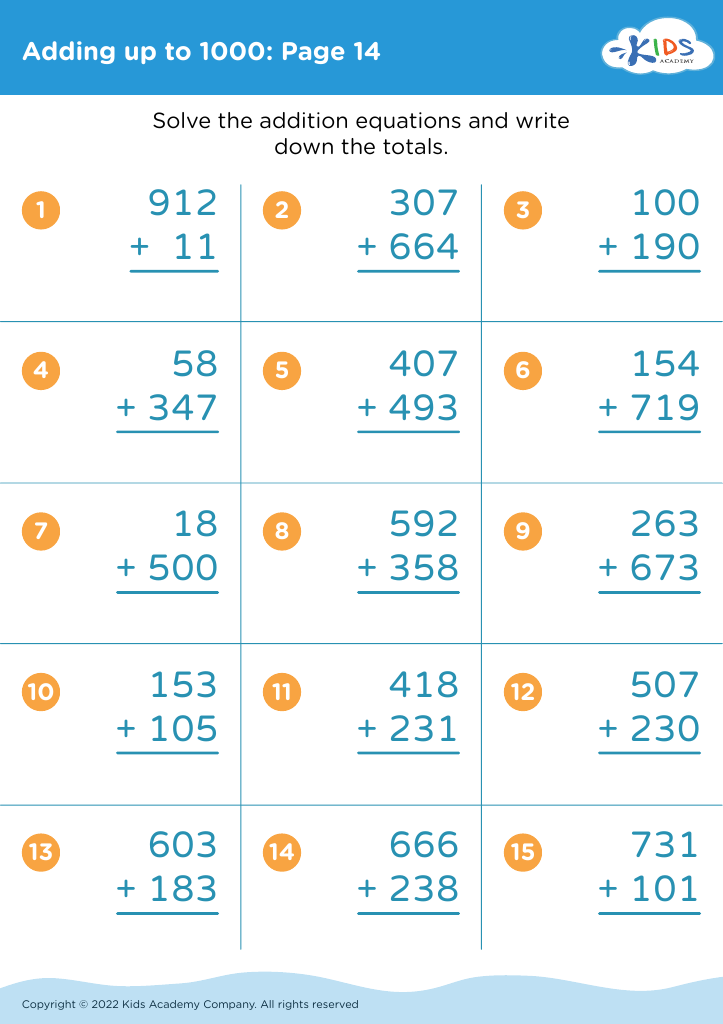



Teaching subtraction and addition up to 1000 to children aged 3-7 is crucial for several reasons. Firstly, these foundational math skills are essential for everyday life, such as handling money and understanding time. Mastery of these concepts at an early age builds confidence and fosters a positive attitude towards math, reducing anxiety and promoting a growth mindset.
Secondly, early proficiency in subtraction and addition paves the way for advanced mathematical concepts. Strong foundational skills enable smoother transitions to more complex operations like multiplication, division, and fractions. This foundational knowledge supports problem-solving abilities and logical thinking, which are valuable across all subjects and in daily life.
Moreover, engaging with numbers and practicing arithmetic enhances cognitive development. Activities involve multi-sensory learning—visual (seeing numbers), auditory (hearing instructions), and kinesthetic (writing calculations)—which strengthens memory and attention to detail. Young learners who practice these skills regularly develop better concentration and perseverance.
Lastly, early math practice fosters parent-child or teacher-student bonding. Doing activities together provides opportunities to praise effort, encourage perseverance, and celebrate success, reinforcing positive learning experiences. Overall, caring about early math education sets the stage for a child's academic success and lifelong problem-solving skills.








