Understand patterns Adding up to 1000 Worksheets for Ages 3-7
3 filtered results
-
From - To
Boost your child's mathematical abilities with our "Understand Patterns Adding up to 1000 Worksheets" tailored for ages 3-7. These engaging and educational worksheets are designed to help young learners recognize and develop pattern-solving skills while performing addition tasks up to 1000. They offer a range of activities that make math fun and approachable, fostering critical thinking and problem-solving abilities. Ideal for both classroom and home use, these worksheets support foundational math concepts, ensuring your child builds strong numerical confidence and pattern recognition, ready to excel in their mathematical journey. Download now to make learning math enjoyable and effective!
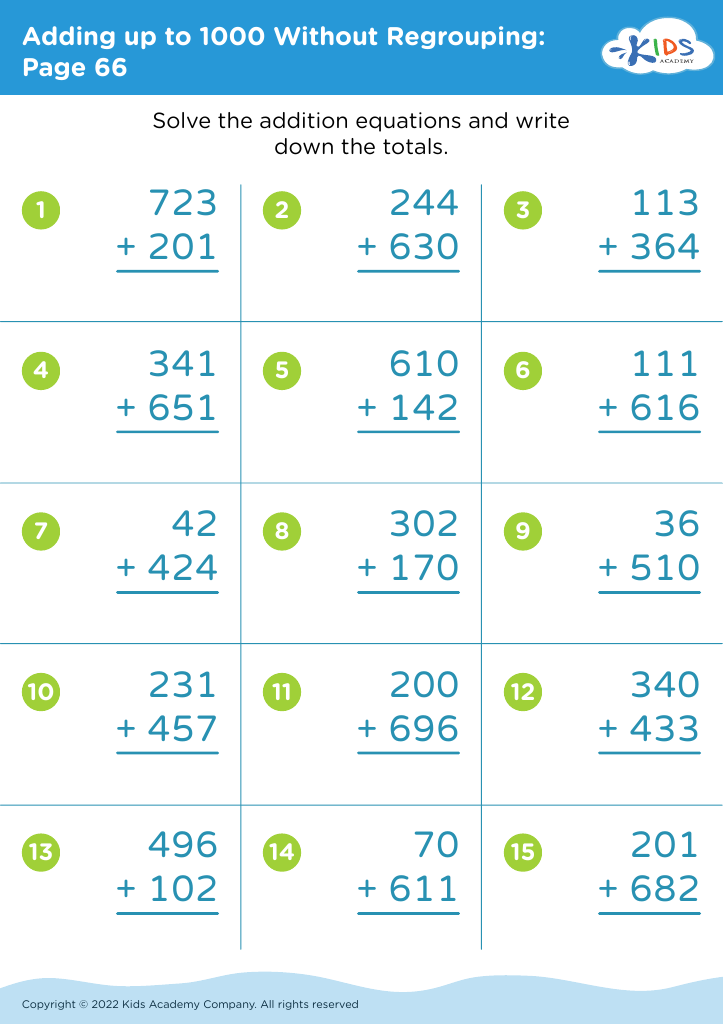
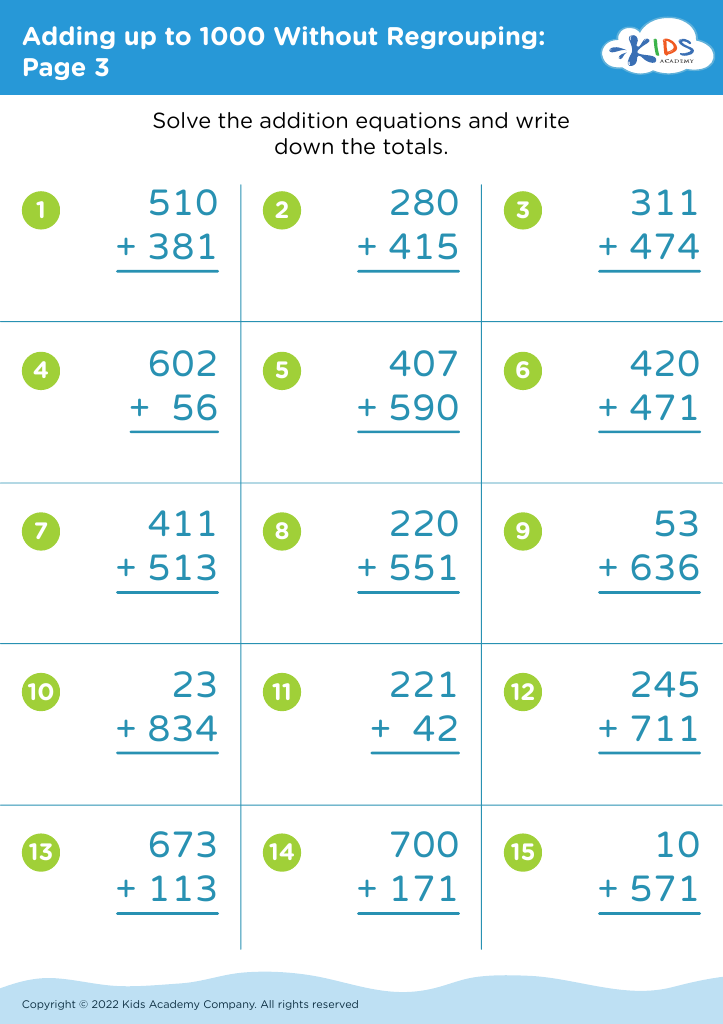
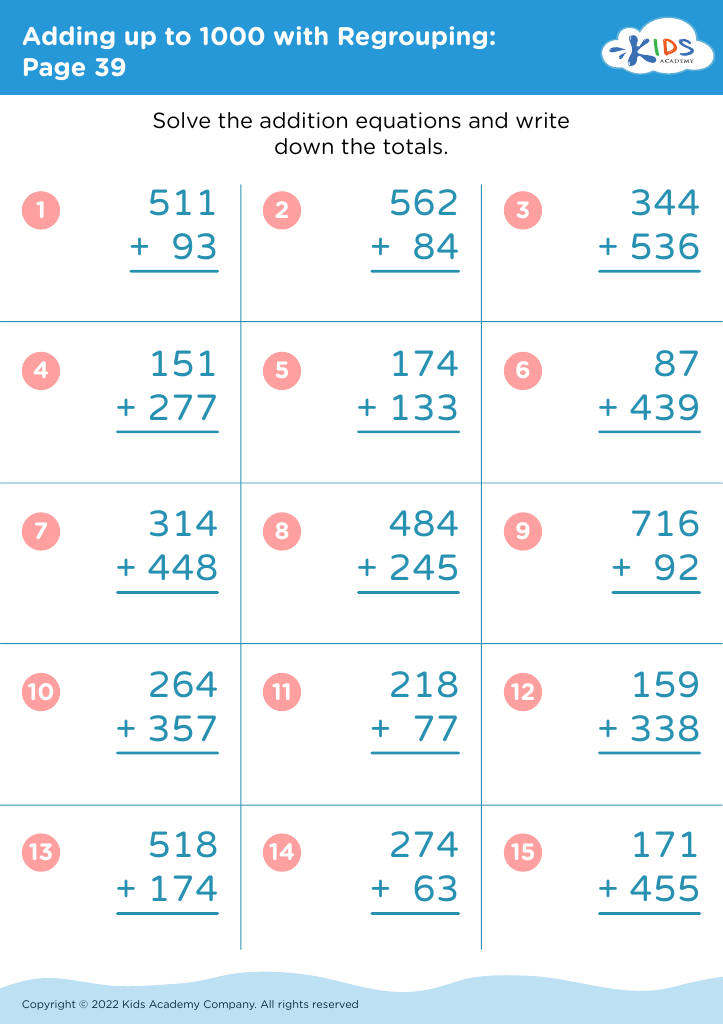



Understanding patterns and adding up to 1,000 at an early age (ages 3-7) lays a vital foundation for future mathematical learning and cognitive development. Early introduction to patterns helps young children recognize and predict sequences, enhancing their logical thinking and problem-solving skills. When children discern patterns, they are essentially learning how to identify regularities and repetitions, which bolsters their ability to make sense of the world around them, a fundamental skill not just in math but in reading and daily life activities as well.
Additionally, exposure to the concept of numbers adding up to 1,000 broadens a child's numerical comprehension beyond simple counting. Although they may not grasp large numbers immediately, early familiarity cultivates numerical flexibility and confidence, encouraging a stronger grasp of arithmetic and mental math skills long-term.
Furthermore, such mathematical engagement can be incredibly empowering for young learners, boosting their self-confidence. It transforms abstract ideas into tangible concepts through hands-on activities such as using blocks, beads, or interactive games. These activities make learning feel like play and keep children engaged and eager to discover more. In turn, early numeracy and pattern recognition lay a robust groundwork for academic success, fostering lifelong abilities in analytical thinking and creativity. Encouraging this learning support from parents and teachers sets children on a promising path toward academic achievement and life skills.








