Understanding quantity Adding up to 1000 Worksheets for Ages 3-7
3 filtered results
-
From - To
Explore our "Understanding Quantity: Adding Up to 1000 Worksheets" designed for children ages 3-7! These engaging worksheets help young learners develop essential counting and addition skills by allowing them to visualize quantities as they practice adding numbers up to 1000. Each worksheet is thoughtfully crafted to foster critical thinking while making math fun and accessible. With colorful illustrations and interactive activities, these resources promote a hands-on approach to grasping concepts of quantity and numerical relationships. Perfect for homeschool environments or classroom settings, these worksheets support early math readiness and build a strong foundation for future mathematical learning. Get started today!
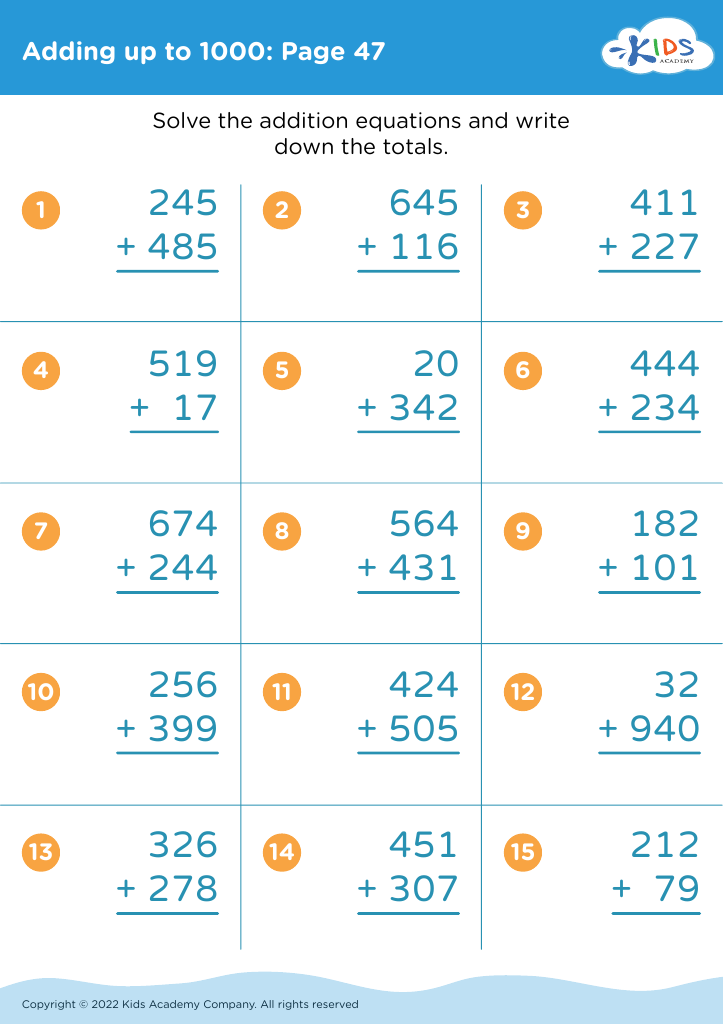
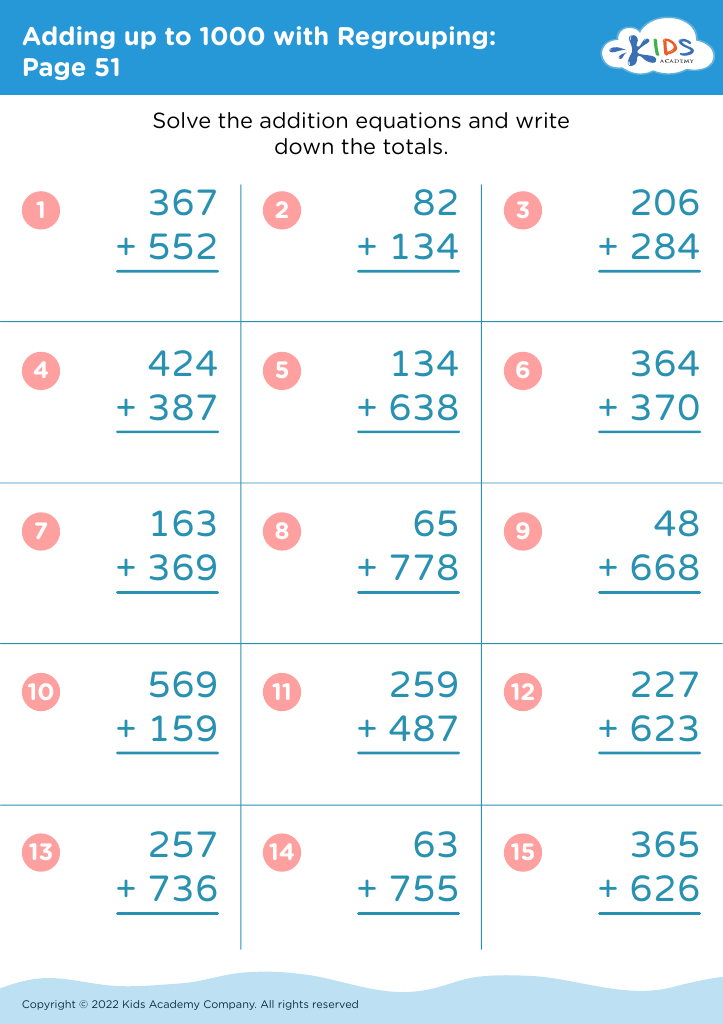
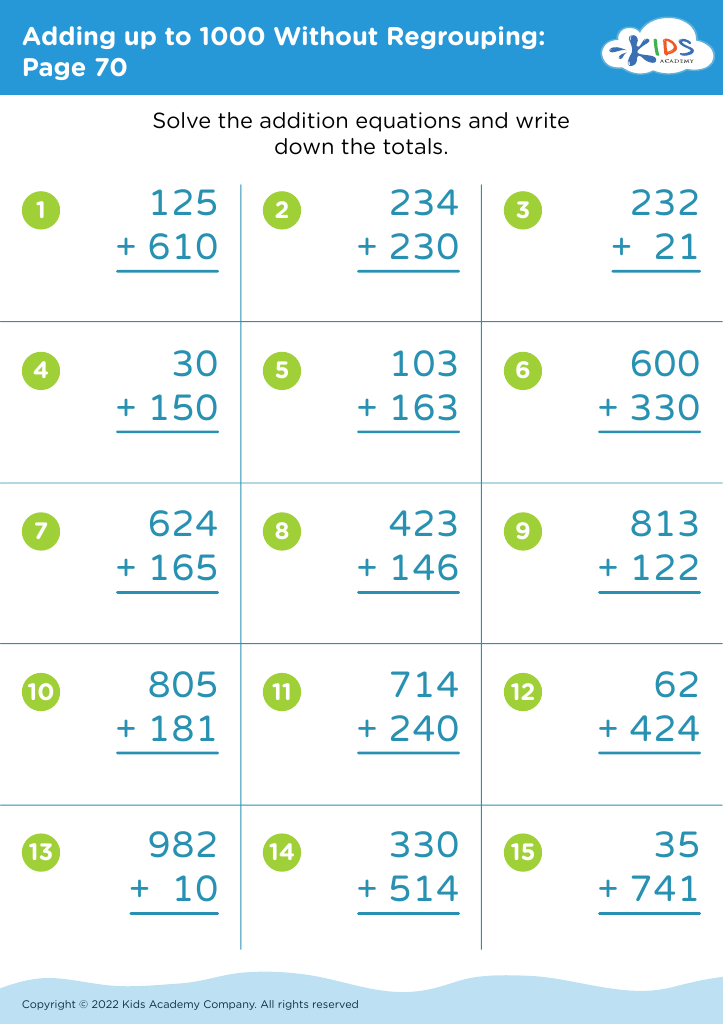



Understanding quantity and the concept of adding up to 1,000 is crucial for children aged 3-7 as it lays the groundwork for foundational math skills. Early grasp of quantity helps young learners develop number sense—the ability to understand, relate, and connect numbers in their everyday life. Recognizing quantities supports vital cognitive and spatial awareness, which enhances problem-solving and logical thinking skills.
Moreover, mastering these concepts fosters confidence and reduces math anxiety. When children learn to manipulate and combine numbers effectively, they become more engaged in mathematical learning, paving the way for academic success in later years. As they begin to associate quantity with tangible objects, such as counting toys or snacks, they strengthen their understanding of numeracy in a hands-on manner.
Teachers and parents should also care about this developmental stage because it facilitates co-learning experiences. Engaging children through fun and relatable activities inspires a love for learning while reinforcing the cultural importance of numbers in everyday life. By prioritizing understanding of quantity and addition, adults help children build essential skills that prepare them not just for higher-level math but also for critical thinking tasks in various real-life situations. Investing in early math education contributes significantly to a child's overall cognitive development.








