Understanding number relationships Adding Up to 5 Worksheets for Ages 3-7
3 filtered results
-
From - To
Unlock your child's mathematical potential with our "Understanding Number Relationships: Adding Up to 5 Worksheets" tailored for ages 3-7. These fun, engaging worksheets are designed to help young learners grasp the critical concept of adding numbers up to 5. Through colorful, interactive exercises and guided activities, children will develop skills in recognizing patterns, understanding number relationships, and basic addition. Perfect for both classroom and home learning, these worksheets provide a solid foundation in early math that will support future academic success. Make math exciting and accessible for your child with our expertly crafted materials.
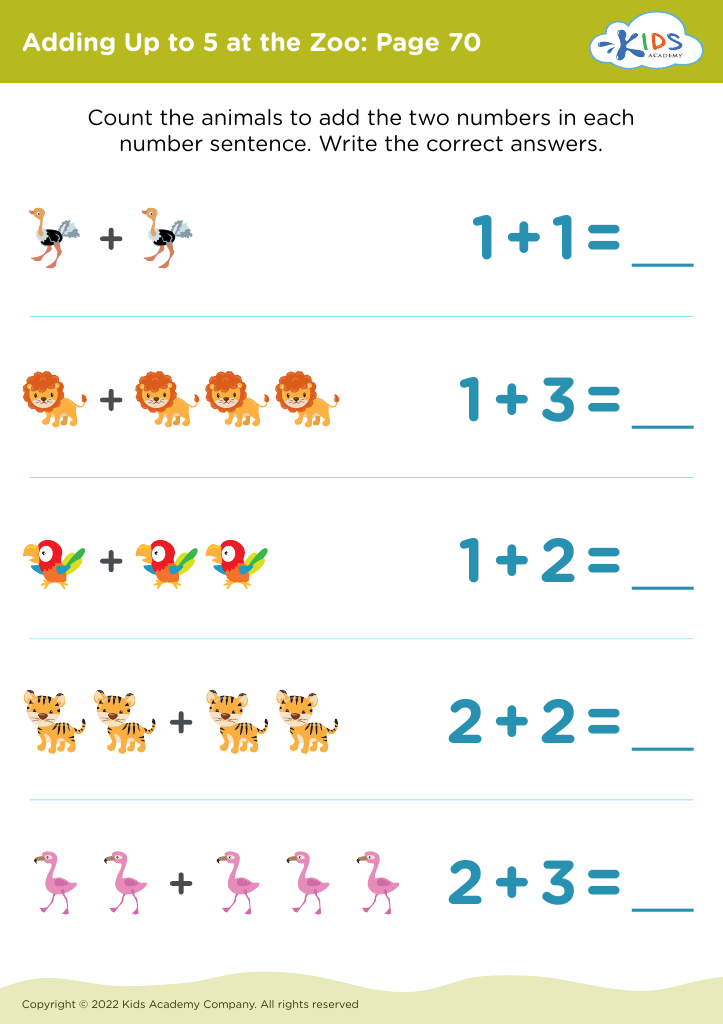
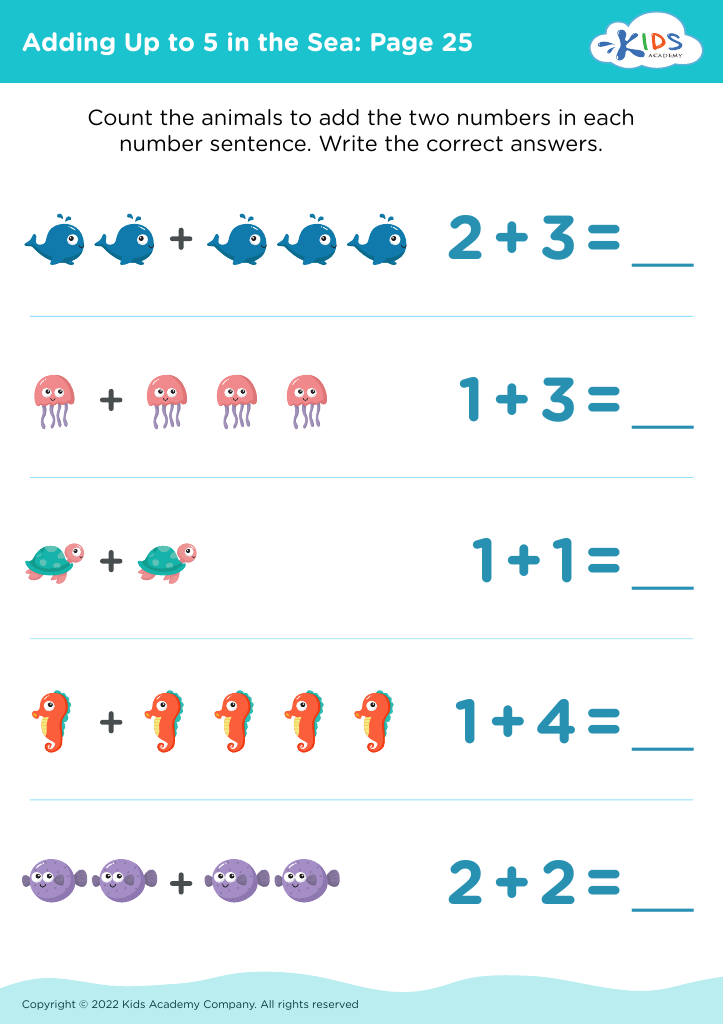
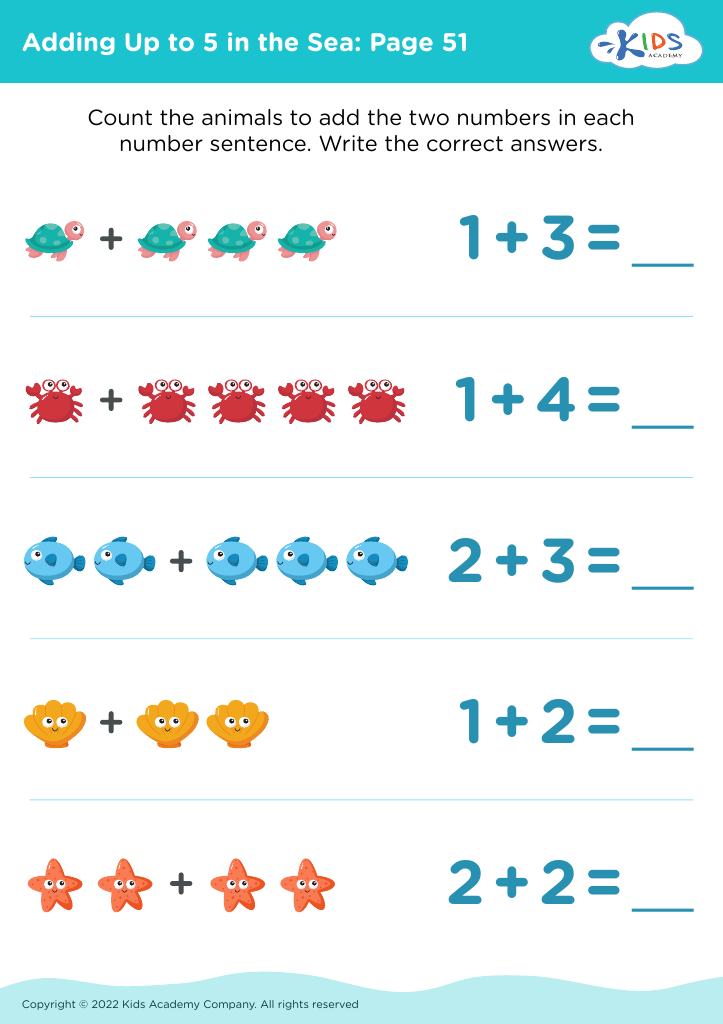








Understanding number relationships that add up to five is foundational for ages 3-7, a crucial developmental period in early childhood education. This competency helps children build crucial number sense, an understanding of how numbers work and relate to each other, which serves as the foundational block for all future math learning.
Firstly, mastering this concept ensures that children begin to think abstractly and move away from mere rote counting. It encourages them to understand addition as combining quantities and fosters mental arithmetic strategies, preparing them for more complex math tasks.
Additionally, this early math skill is closely linked to cognitive development, such as logical reasoning, pattern recognition, and problem-solving abilities—all of which are essential across different disciplines and daily life. It lays the groundwork for future concepts such as addition and subtraction within larger number ranges.
Furthermore, early confidence in basic arithmetic builds overall academic confidence. When children grasp these early math concepts, they are more likely to view themselves as capable learners, motivating them to tackle other academic challenges with a positive mindset.
In essence, for parents and teachers, focusing on number relationships adding up to five establishes a robust numerical foundation, nurtures essential cognitive functions, and develops a child's self-confidence, all critical for lifelong learning and academic success.








