Color Identification Addition & Subtraction Worksheets for Ages 3-7 - Page 2
27 filtered results
-
From - To
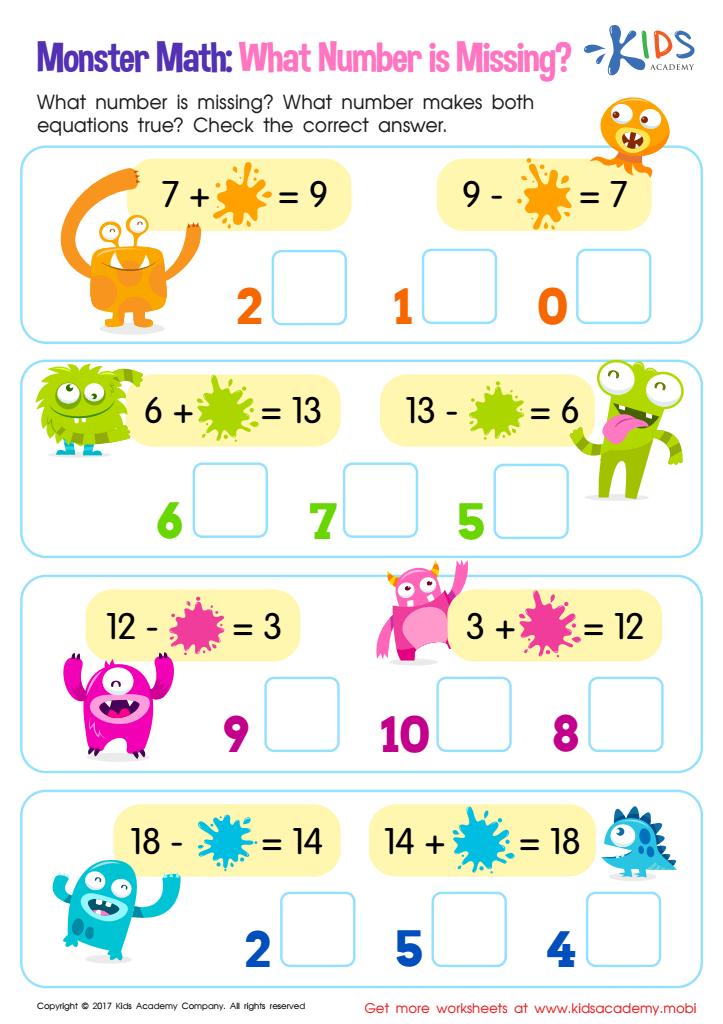
Missing Number: Monster Math Worksheet
 Assign to My Students








Color Identification, Addition, and Subtraction are essential skills for children aged 3-7, serving as foundational components for early math and cognitive development. Understanding colors enhances a child's ability to categorize and recognize patterns, which is crucial for problem-solving. Simultaneously, basic addition and subtraction introduce the concepts of quantity and relationship between numbers, fostering numerical literacy from a young age.
When parents and teachers engage children in color-related math activities, they create a rich learning environment. Through playful, hands-on experiences such as sorting colored objects, counting colored blocks, or using color-coded worksheets, children not only learn to identify colors but also apply them in mathematical contexts. This dual-focus encourages the development of critical thinking and analytical skills.
Moreover, infusing color into math makes learning interactive and enjoyable, maintaining a child’s interest and motivation. It reinforces the real-world applications of math, helping children understand that numbers are not abstract concepts but integral to daily life. By prioritizing color identification along with addition and subtraction, parents and teachers lay the groundwork for a well-rounded education, turning young learners into confident problem solvers who are prepared for future academic challenges.








