
Observation skills Addition & Subtraction Worksheets for Ages 3-7
3 filtered results
Difficulty Level
Grade
Age
-
From - To
Subject
Activity
Standards
Develop your child's arithmetic foundation with our Observation Skills Addition & Subtraction Worksheets, designed for ages 3-7. These engaging worksheets not only enhance basic math skills but also boost critical observation abilities. Children will learn to carefully observe, count, and solve addition and subtraction problems through colorful, fun, and interactive exercises. Perfect for young learners, these worksheets provide a solid conceptual understanding of numbers and arithmetic operations, making math learning enjoyable and effective. Set your child on the path to academic success with activities that foster attention to detail, problem-solving skills, and a love for learning.
Favorites
With answer key
Interactive
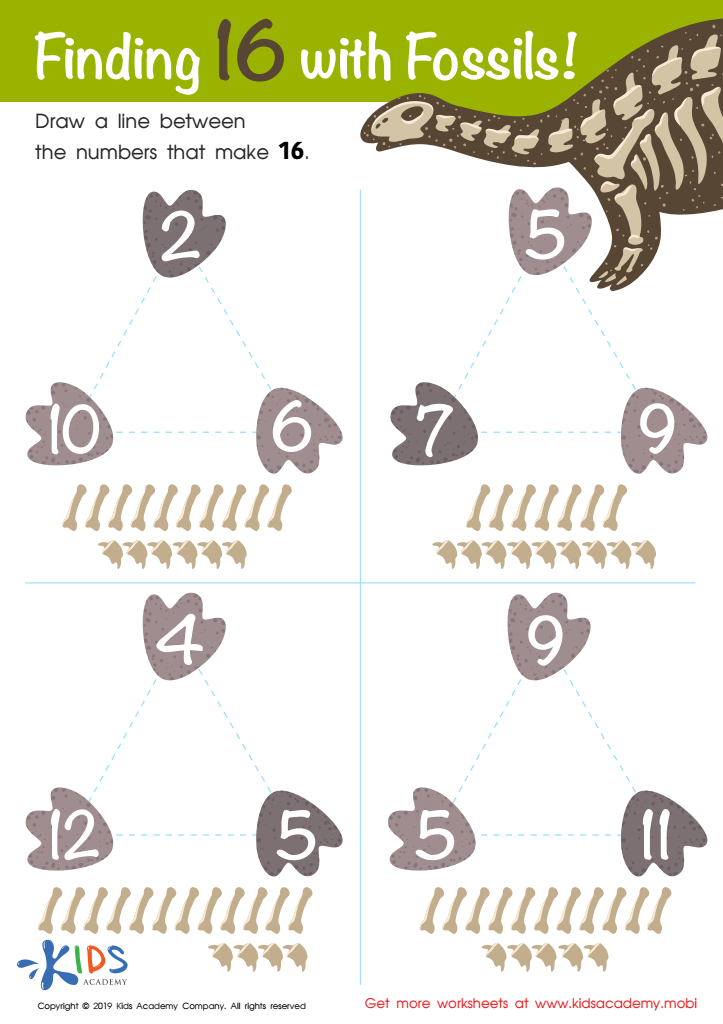
Finding 16 With Fossils Worksheet
Experts hunt for fossils, dig them up, and study them to learn more about past life forms - how they lived, what they looked like, and when they lived. Show kids the picture in this worksheet and point out the fossils. Help them count the bones and draw a line between the numbers that add up to 16 in each triangle.
 Assign to My Students
Finding 16 With Fossils Worksheet
Worksheet
Join Kids Academy for Free
Who is primarily going to use this learning content?








Observation skills are incredibly important for young children aged 3-7 because they are foundational to developing addition and subtraction abilities. At this age, children are learning to understand and interpret the world around them through their senses. Sharpening observational skills helps them notice patterns, differences, quantities, and sequences—all essential for grasping basic mathematical concepts.
For instance, observing groups of objects and counting them forms the baseline for understanding addition (combining groups) and subtraction (removing objects from a group). Visual cues help children understand that numbers represent actual amounts, making math concrete rather than abstract. Moreover, keen observation informs problem-solving skills, as children learn to notice important details that guide them to correct solutions.
Teachers and parents play a critical role by providing environments rich with opportunities to observe, count, sort, and compare. Activities like nature walks, cooking, or playing with building blocks can be used effectively to develop these skills. Engaging in such intentional observational activities not only hones mathematical skills but also boosts cognitive development, attention to detail, and critical thinking.
Consequently, teaching and reinforcing observation skills during early childhood sets a strong foundation for more complex mathematical learning, making it a crucial aspect of educational development for young children.








