
Improve vocabulary Math Worksheets for Ages 3-7
3 filtered results
Difficulty Level
Grade
Age
-
From - To
Subject
Activity
Standards
Boost your child's math vocabulary skills with our "Improve Vocabulary Math Worksheets" designed for ages 3-7. Available at Kids Academy, these engaging worksheets blend fun and learning, focusing on essential math terms. Easily downloadable and printable, they're perfect for at-home practice or classroom use. Support your little learners as they build a strong mathematical foundation, enhancing their comprehension and fluency in basic concepts. Our activities include vibrant visuals and interactive exercises, making it enjoyable for young minds to grasp new words and ideas efficiently. Equip your child with the tools they need to succeed in their early learning journey.
Favorites
With answer key
Interactive
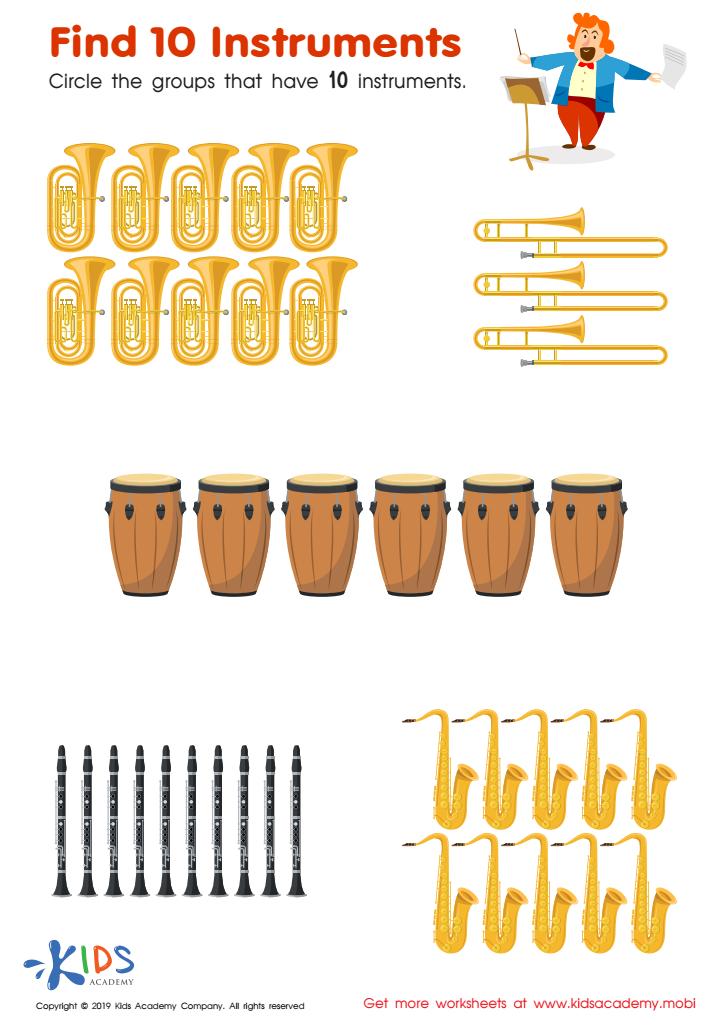
Find 10 Instruments Worksheet
Teach your kids to count with educational DVDs, video games and this worksheet. Show them the picture and help them count the instruments, then circle the groups of 10. It's a great way to practice counting numbers, one of the first things they'll learn.
 Assign to My Students
Find 10 Instruments Worksheet
Worksheet
Join Kids Academy for Free
Who is primarily going to use this learning content?


%20(1).jpg)




Improving vocabulary in math for children ages 3-7 is critically important for their overall educational development. During these formative years, kids are highly receptive to new concepts and languages, including the language of math. Developing a strong math vocabulary early sets a foundation for more advanced mathematical concepts, helping children not only in math but also in developing critical thinking and problem-solving skills.
Parents and teachers should care about this for several reasons. Firstly, a robust math vocabulary enables clearer communication and understanding of math problems and solutions. Words like “add,” “subtract,” “equal,” “more,” and “less” are fundamental to comprehending basic math operations. Secondly, a strong foundation in math vocabulary can boost children’s confidence and interest in math, making it more likely for them to succeed in future math endeavors.
Early exposure to math vocabulary also supports brain development; it encourages cognitive skills such as logical reasoning, pattern recognition, and spatial awareness. Additionally, integrating math vocabulary into daily conversations and learning activities makes math feel less abstract and more practical, preparing children for real-world applications.
In summary, a strong math vocabulary is essential for young learners' academic success and practical life skills, making it a priority for parents and teachers alike.








