Telling time Math Worksheets for Ages 3-7
4 filtered results
-
From - To
Discover a fun and engaging way for young learners to master telling time with our Telling Time Math Worksheets, designed for children ages 3-7. These printable resources from Kids Academy provide interactive and colorful activities that help children learn to read analog and digital clocks, understand time intervals, and recognize daily routines. Perfect for preschoolers and early grade students, these worksheets make learning time concepts enjoyable and accessible. Support your child's early math skills with entertaining exercises that build a strong foundation in time-telling. Explore now and watch your child's confidence grow with each completed worksheet!
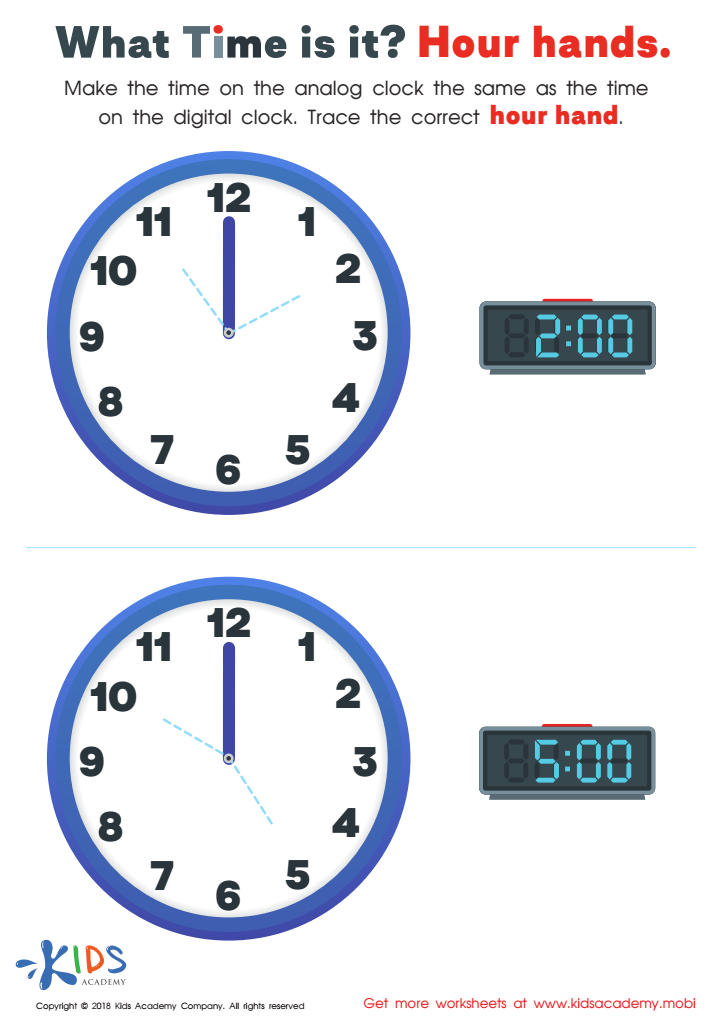
What Time Is it? Hour Hands Worksheet
 Assign to My Students




.jpg)



Telling time is a fundamental skill that plays an important role in a child's early development. Mastering the concept of time helps young children (ages 3-7) establish a sense of structure and routine, which is essential for their daily lives. Parents and teachers should prioritize teaching this skill as it lays the groundwork for numerous cognitive and practical abilities.
For young children, learning to tell time enhances their math skills by familiarizing them with numbers, sequences, and the concept of the passage of time. It also nurtures their ability to understand and apply mathematical operations such as counting, addition, and subtraction. Practically, knowing how to read a clock enables children to manage their schedules and develop good time-management habits, such as knowing when it's time to start an activity, take a break, or transition from one task to another.
Furthermore, being able to tell time fosters independence and responsibility. Children who can read a clock independently can take ownership of their daily routines, which boosts their confidence and self-esteem. It also assists in the development of critical thinking and problem-solving skills—key components of overall academic success.
In summary, parents and teachers should care about teaching children how to tell time because it supports their mathematical foundation, builds critical life skills, and promotes independence and confidence, all of which are crucial for their holistic growth and development.








