Understanding number value Math Worksheets for Ages 3-7
4 filtered results
-
From - To
Introduce your little learners to the world of numbers with our "Understanding Number Value Math Worksheets for Ages 3-7"! These engaging and educational worksheets are designed to help young children grasp the fundamental concept of number values. Through fun activities, kids will learn to compare, match, and symbolize numbers, enhancing their mathematical skills. Perfect for preschoolers and early elementary students, our worksheets make learning enjoyable and interactive. Give your child a strong foundation in mathematics and watch them thrive! Discover our collection at Kids Academy and start building essential math skills today.
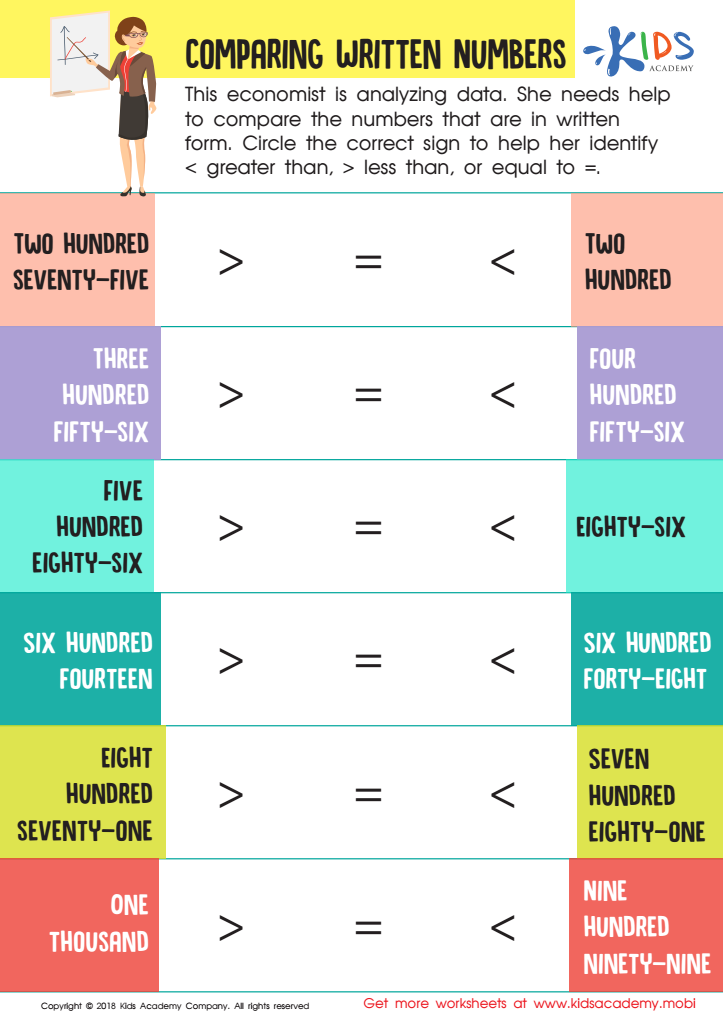
Comparing Written Numbers Worksheet
 Assign to My Students





.jpg)


Understanding number value is crucial for young children as it lays the foundation for all future mathematical learning and everyday life skills. For ages 3-7, grasping the concept of number value goes beyond mere counting. It involves recognizing what numbers represent, such as understanding that the numeral "5" means five objects, not just that it comes after "4" and before "6."
When parents and teachers help children understand number value, they foster early numeracy skills that are essential for problem-solving and logical thinking. This early math proficiency naturally extends to more advanced concepts like addition, subtraction, and eventually multiplication and division. It also enhances cognitive development by promoting pattern recognition, spatial awareness, and memory.
Educational efforts in understanding number value create a strong math foundation that can boost academic confidence and interest in school. Children with solid early math skills often perform better not just in mathematics, but also across other subjects. Moreover, practical applications of number sense in day-to-day activities, like sharing toys or understanding time, underscore its importance.
Neglecting these skills during these formative years can lead to math anxiety and a lack of confidence in handling more complex mathematical tasks later in life. Therefore, teachers and parents should prioritize activities and practices that help children understand number value early on.








