
Encourage attention to detail Worksheets for Ages 3-8
3 filtered results
Difficulty Level
Grade
Age
-
From - To
Subject
Activity
Standards
Encourage attention to detail with our engaging worksheets designed for children ages 3-8. Our expertly crafted activities help young learners develop crucial observation and analytical skills while having fun. Whether spotting the differences or solving puzzles, each worksheet is tailored to inspire curiosity and meticulousness. Ideal for parents and educators, these printables support cognitive development and enhance focus, fostering a solid foundation for future learning. Make detailed learning enjoyable with Kids Academy's attention to detail worksheets - a perfect tool for nurturing young, inquisitive minds. Visit us online to explore our colorful variety of interactive exercises today!
Favorites
With answer key
Interactive
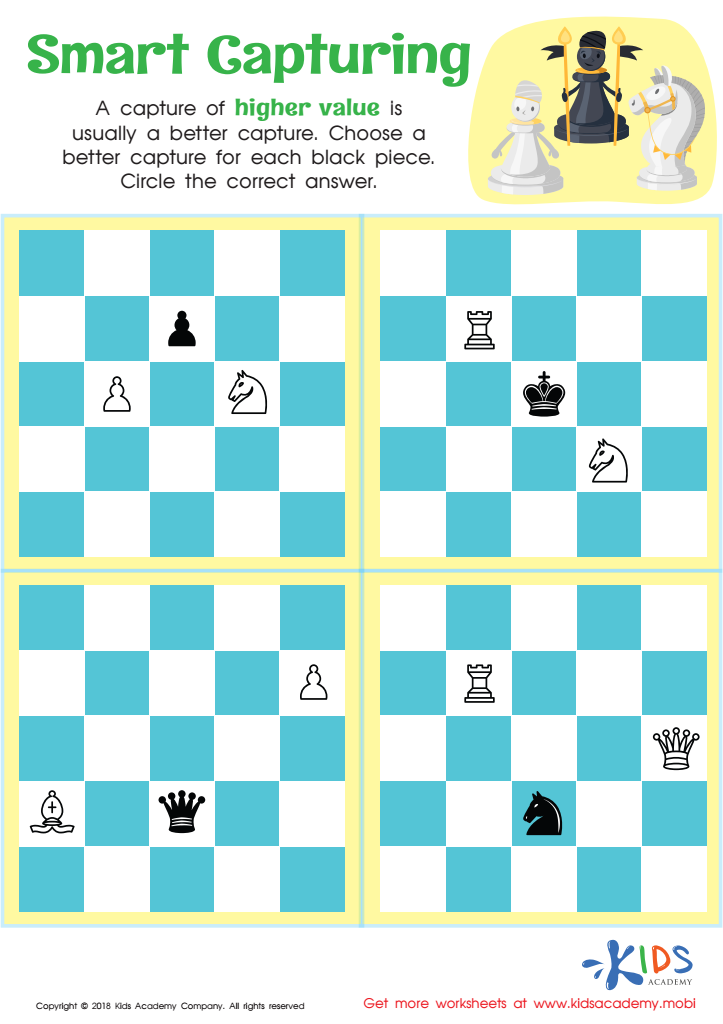
Smart Capturing Worksheet
Chess is a game of strategy and calculation. When presented with two captures, a player should always go for the one that yields the highest value. For example, taking a knight over a pawn. In this worksheet, your children will choose the best capture for each black piece. Ask them to circle the correct answers. (80 words)
 Assign to My Students
Smart Capturing Worksheet
Worksheet
Join Kids Academy for Free
Who is primarily going to use this learning content?








Encouraging attention to detail in children aged 3-8 is crucial for their cognitive and social development. At this early stage, children's brains are extremely pliable and receptive to new stimuli. Teaching attention to detail helps enhance their memory and fine motor skills as they learn to notice and recall specific attributes in their surroundings and activities. These skills directly support reading and writing development, as recognizing letters and numbers involves detailed observation.
Attention to detail also promotes problem-solving skills. When children learn to focus on the minutiae of a task, such as arranging blocks by size or color, they develop critical thinking abilities. This analytical skill set is transferable to more complex tasks and situations, such as math puzzles or scientific explorations.
Moreover, fostering this ability can significantly impact a child's self-awareness and self-esteem. Successfully completing tasks that require careful attention builds confidence and patience. It teaches the value of persistence and the idea that putting effort into small details can culminate in greater achievements.
Socially, children who can pay attention to the details in their interactions—like facial expressions and tone of voice—are often more empathetic and effective communicators. In summary, nurturing attention to detail equips children with a wide range of cognitive, academic, and social skills that form the foundation of lifelong learning and personal development.








