
Enhance fine motor skills Worksheets for Ages 3-8
6 filtered results
Difficulty Level
Grade
Age
-
From - To
Subject
Activity
Standards
Discover a range of engaging worksheets designed to enhance fine motor skills for children ages 3-8. These carefully crafted activities focus on developing hand-eye coordination, dexterity, and precision through fun hands-on tasks. From tracing shapes to cutting and pasting, each worksheet aims to make learning enjoyable while building essential skills that lay the foundation for future academic success. Perfect for home or classroom use, our worksheets cater to various learning styles and help young learners gain confidence in their abilities. Empower your child's growth and set them on the path to success with our stimulating fine motor skills worksheets today!
Favorites
With answer key
Interactive
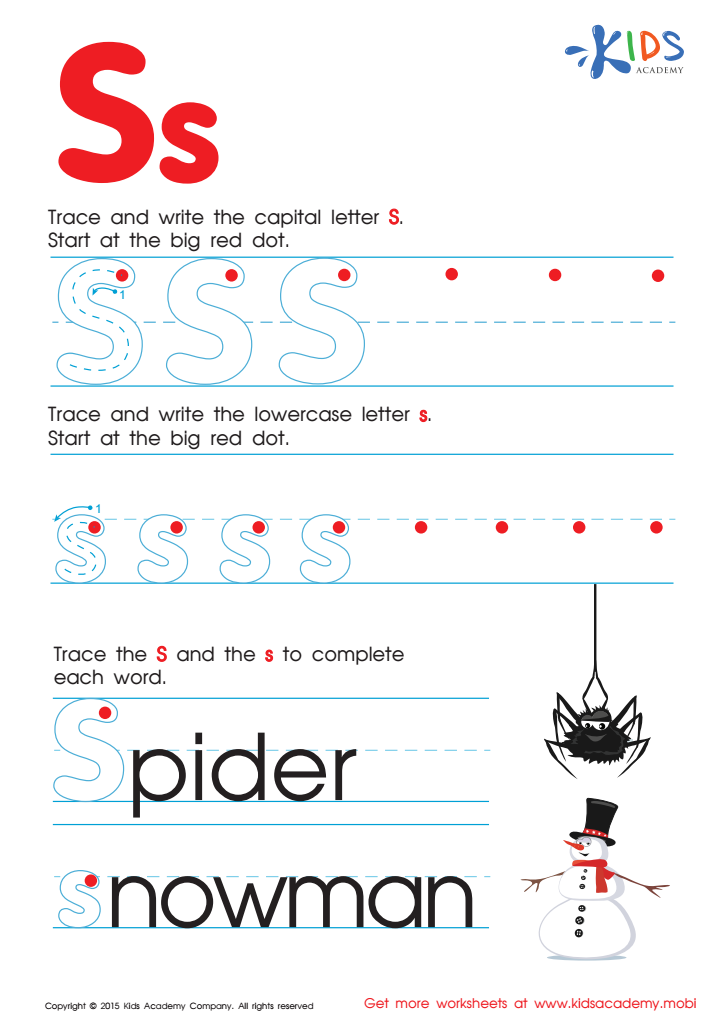
Letter S Tracing Page
Trace and write the capital and lowercase "S" on this ABC worksheet for kindergarten. Start with the big red dot and be careful. When you finish, help the spider and snowman in the pictures restore their words with the capital and lowercase letters. Continue learning the alphabet with Kids Academy.
 Assign to My Students
Letter S Tracing Page
Worksheet

Join Kids Academy for Free
Who is primarily going to use this learning content?








Enhancing fine motor skills in children aged 3-8 is crucial for their overall development and future success. Fine motor skills involve the use of small muscles in hands and fingers, enabling children to perform tasks like writing, fastening buttons, and manipulating small objects. Fostering these skills paves the way for academic readiness, especially in tasks requiring hand-eye coordination, such as drawing and writing. As children become more proficient, they gain confidence in their abilities to accomplish daily tasks independently.
Additionally, fine motor development plays a significant role in cognitive growth. Engaging in activities that promote hand dexterity encourages problem-solving, creativity, and concentration. These are foundational skills that support academic learning across various subjects.
Moreover, advocating for fine motor skills nurtures social interaction as children participate in group activities requiring sharing and cooperative play. Parents and teachers are integral in creating enriching environments that offer opportunities for fine motor practice through arts and crafts, games, and hands-on activities.
By prioritizing fine motor skill development, caregivers not only prepare children for school readiness but also contribute to their emotional and social wellbeing, laying a strong foundation for lifelong learning and success.








