
Knowledge reinforcement Worksheets for Ages 3-8
3 filtered results
Difficulty Level
Grade
Age
-
From - To
Subject
Activity
Standards
Welcome to our Knowledge Reinforcement Worksheets for Ages 3-8, designed to bolster young learners' comprehension and retention of essential concepts. Our engaging worksheets cover various subjects, including math, reading, and basic science, providing fun activities that make learning enjoyable. Tailored for preschool and early elementary students, these worksheets develop critical thinking and problem-solving skills while reinforcing foundational knowledge. Ideal for both classroom settings and at-home practice, each printable activity is created to spark curiosity and support cognitive growth. Explore our diverse selection of colorful, interactive worksheets to help your child thrive academically and build a strong knowledge base for future success!
Favorites
With answer key
Interactive
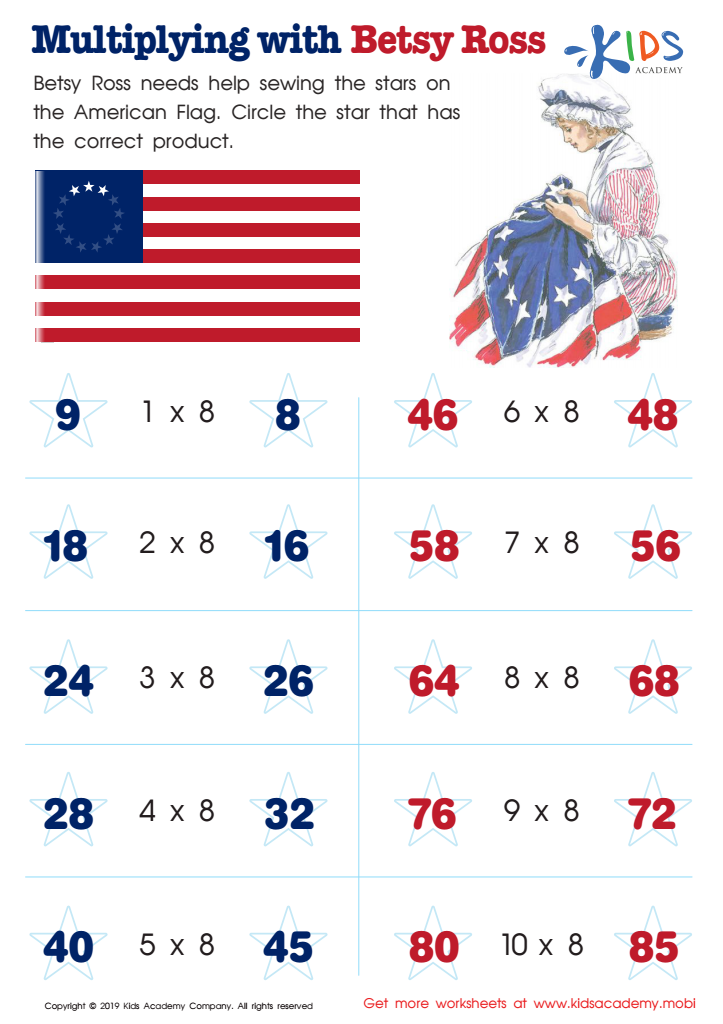
Multiplying with Betsy Ross Worksheet
Before getting into the worksheet, have your students take a quick history lesson on Betsy Ross. Ask them if they know her role in American history. On the printout, ask your kids to identify what Betsy Ross is doing - sewing the stars on the American Flag. Have them circle the star that has the correct pattern.
 Assign to My Students
Multiplying with Betsy Ross Worksheet
Worksheet
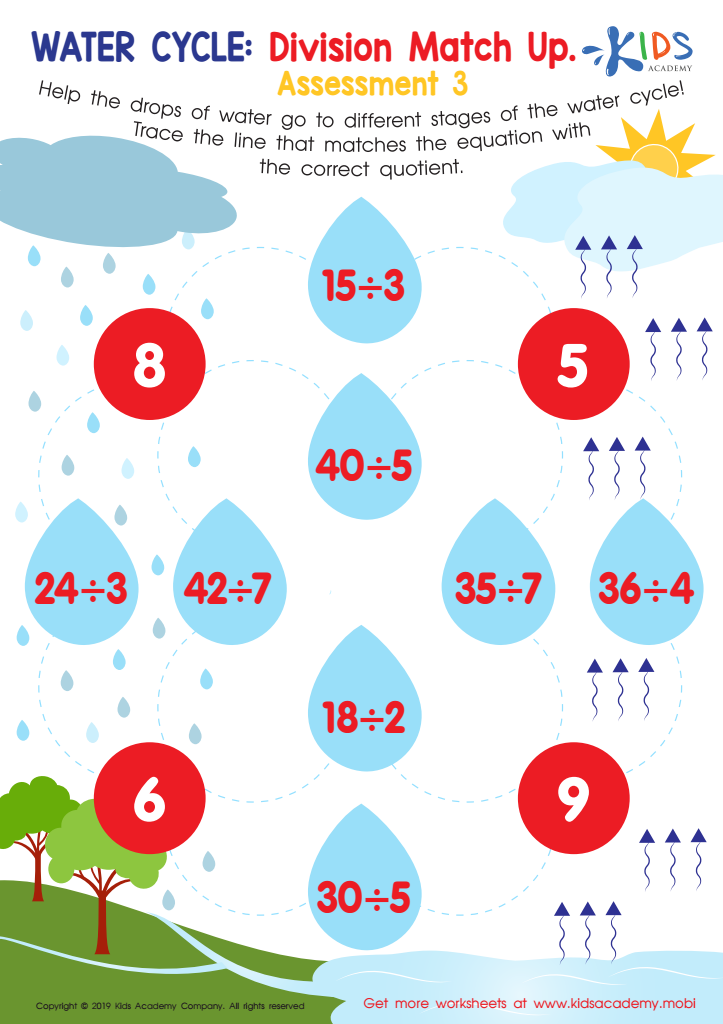
Water Cycle Division Match Up Assessment 3 Worksheet
Division is more fun than schoolwork with this assessment! Traceable lines let kids match equations to quotients, helping them build automaticity and giving you an easy way to see their progress.
Water Cycle Division Match Up Assessment 3 Worksheet
Worksheet
Join Kids Academy for Free
Who is primarily going to use this learning content?








Knowledge reinforcement for children aged 3-8 is crucial for several reasons, making it a priority for both parents and teachers. First, during these formative years, children's brains are developing rapidly, and they are particularly receptive to new information. Reinforcing knowledge helps solidify learning, ensuring that concepts and skills become firmly rooted. This leads to greater retention and a stronger foundation for more complex learning in the future.
Furthermore, consistent reinforcement encourages curiosity and a love for learning. Children who engage in activities that review what they've learned are more likely to connect ideas and explore topics deeper. Reinforcement also achieves foresight; as kids grasp basic concepts such as numbers, letters, and social cues, they prepare for ongoing education, easing their transition into higher grades.
Additionally, regular reinforcement interacts positively with self-esteem. When children display mastery over learned concepts, their confidence grows, fostering motivation to tackle new challenges. By collaborating in this learning process, parents and teachers cultivate a nurturing environment where children feel supported.
Ultimately, emphasizing knowledge reinforcement empowers children to harness their potential, promoting lifelong learning and academic resilience while laying the groundwork for future success.








