Sorting and categorizing Worksheets for Ages 3-8
3 filtered results
-
From - To
Discover our engaging "Sorting and Categorizing Worksheets for Ages 3-8," designed to enhance early learning skills through fun activities. These worksheets assist children in developing critical thinking by sorting objects, identifying similarities and differences, and organizing items by attributes. Aimed at preschool and early elementary students, each printable offers vibrant illustrations and interactive tasks that captivate young minds. Parents and educators can easily incorporate these materials into their learning routines, fostering essential skills in an enjoyable way. Empower your child's learning journey with resources that promote curiosity, creativity, and cognitive growth. Explore our collection today and watch them thrive!
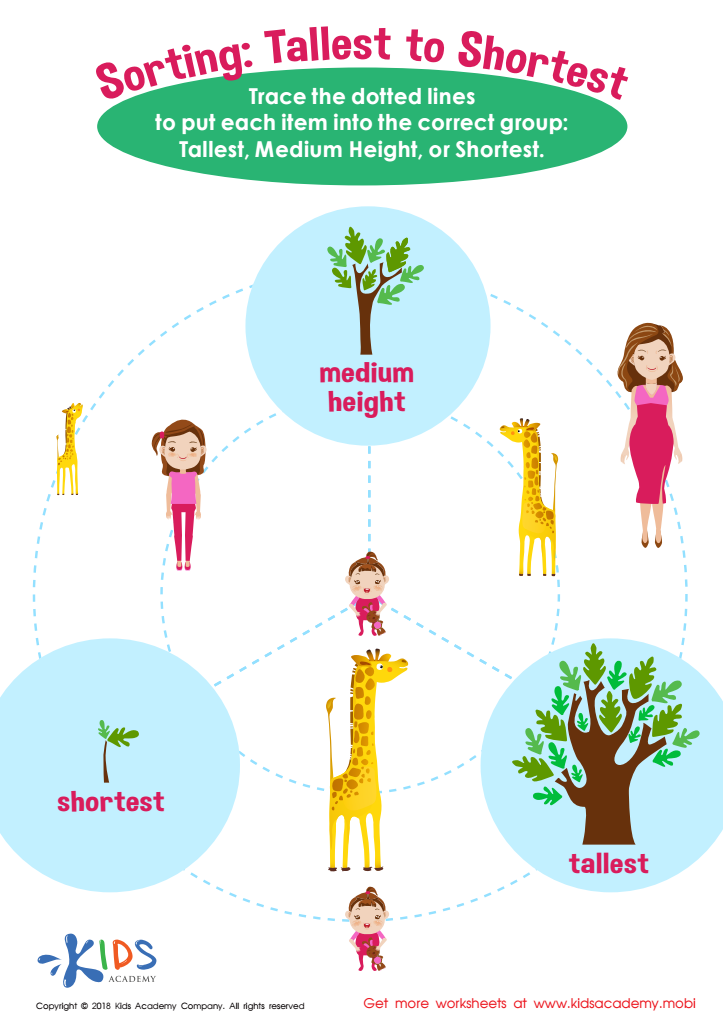
Sorting: Tallest to Shortest Worksheet
 Assign to My Students








Sorting and categorizing are essential developmental skills for children aged 3-8 that foster critical thinking and problem-solving abilities. By encouraging these skills, parents and teachers help children make sense of the world around them. Sorting involves grouping items based on shared attributes, like size, color, or type, enabling children to recognize similarities and differences, which enhances their cognitive development.
Engaging in sorting activities lays the foundation for mathematical concepts such as classification, counting, and pattern recognition. For instance, when children separate objects into categories, they practice logistical reasoning that will aid their understanding of math later on. Additionally, these activities enhance language skills as children learn to describe and articulate characteristics and categories.
From a social-emotional perspective, sorting can build confidence and encourage cooperation during playful group activities. As children work together to collaborate and categorize, they enhance their communication skills and build social connections.
Furthermore, sorting serves as an essential precursor to more complex knowledge structures, problem-solving tasks, and analytical thinking. By prioritizing these early skills, parents and teachers invest in children's long-term educational success and nurturing lifelong learners.








