Telling time Worksheets for Ages 3-8
4 filtered results
-
From - To
Discover engaging and educational "Telling Time Worksheets for Ages 3-8," designed to make learning time fun and easy! Our carefully crafted worksheets help young learners master reading clocks, understanding hours and minutes, and developing essential time-telling skills. Vibrant illustrations and interactive exercises keep kids intrigued while gradually increasing in difficulty to foster growth. Perfect for home or classroom use, these printable resources provide a strong foundation in time management, encouraging punctuality and planning skills from an early age. Give your child a head start in learning time with our expertly designed worksheets!
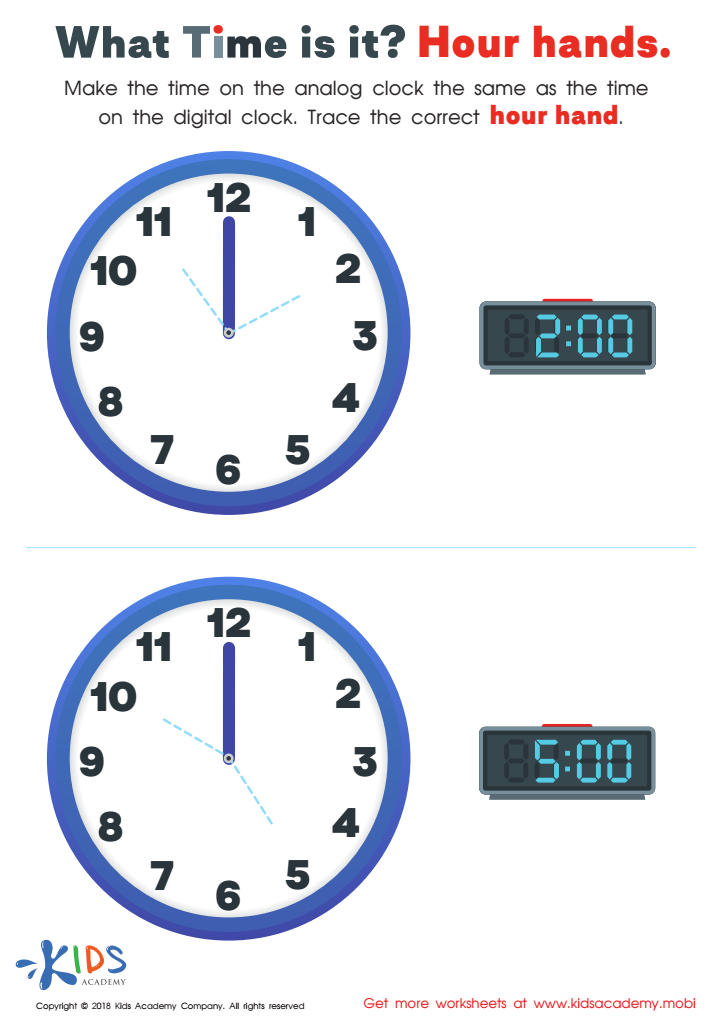
What Time Is it? Hour Hands Worksheet
 Assign to My Students







Telling time is a fundamental skill that plays a crucial role in a child's daily life and overall development. For children aged 3-8, understanding time helps establish a sense of routine and structure, which is vital for their emotional and psychological well-being. By knowing when activities start and end, children learn to manage their expectations and develop a sense of responsibility.
Additionally, the ability to tell time is closely linked with math skills. Understanding concepts such as hours, minutes, and seconds, and the ability to read a clock, reinforces numerical recognition and basic arithmetic. This fosters cognitive development and enhances problem-solving capabilities.
Moreover, learning to tell time promotes independence. When children can read the clock, they can take more control over their daily activities, from knowing when to start homework to understanding meal or playtimes without constant supervision.
Parents and teachers play a critical role during the early, formative years, and by paying attention to teaching this essential skill, they lay a foundation for lifelong punctuality and time management. This one skill can significantly boost a child's confidence and preparedness, impacting both their academic performance and social interactions positively. Therefore, ensuring that a child aged 3-8 can tell time is not just about reading clocks—it's about enabling them with skills essential for future success.








