Understanding ordinal numbers Worksheets for Ages 3-8
3 filtered results
-
From - To
Welcome to our "Understanding Ordinal Numbers Worksheets" for ages 3-8! These engaging and interactive worksheets are designed to help young learners grasp the concept of ordinal numbers, essential for their mathematical foundation. Our resources make learning fun through colorful activities that teach kids to recognize and use ordinal terms like first, second, and third. Perfect for home or classroom use, these worksheets enhance counting skills and cognitive development while promoting early numeracy. Start your child's journey to mastering ordinal numbers today and watch them gain confidence in their math abilities! Explore our printable worksheets and ignite a love for learning.
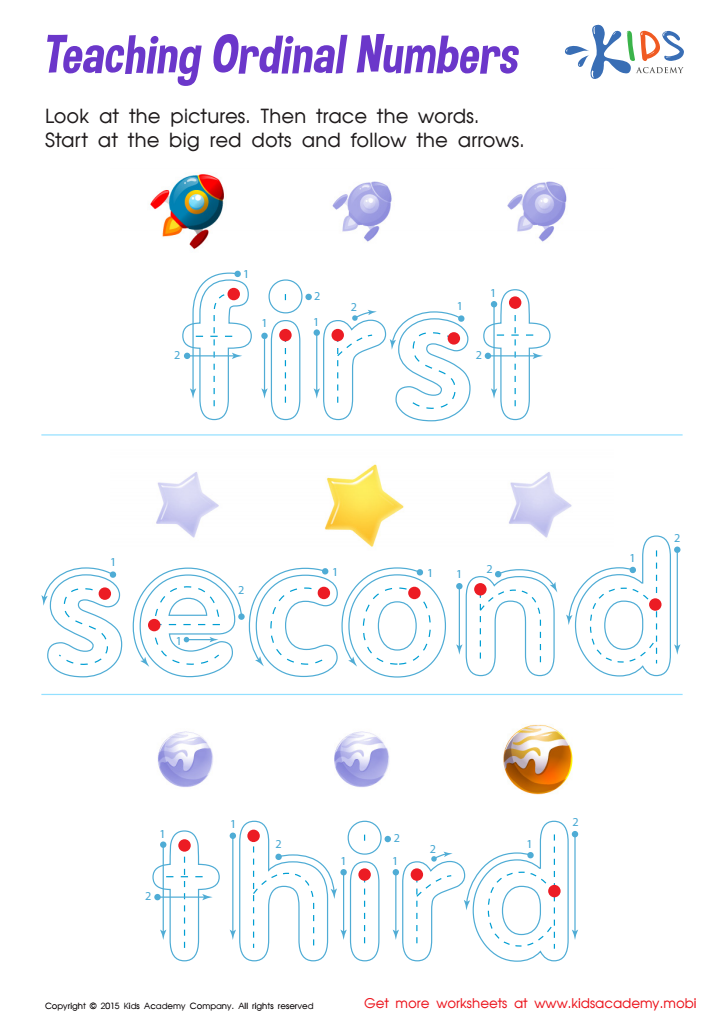
Ordinal Numbers: Teaching Ordinal Numbers Printable
 Assign to My Students
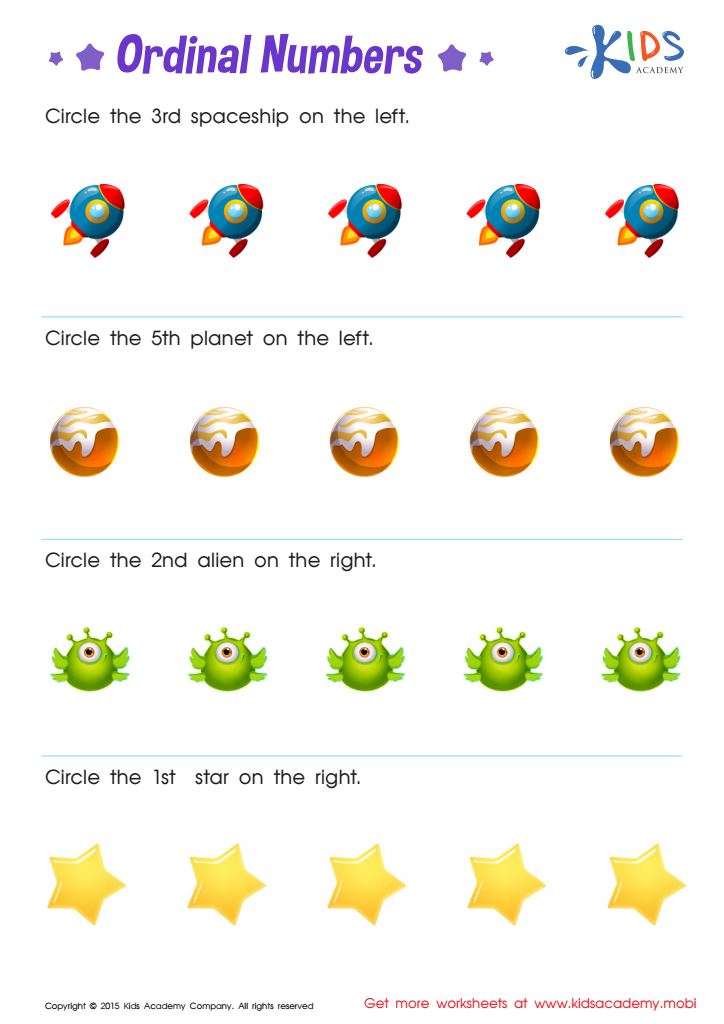
Ordinal Numbers: Space Ordinals Worksheet








Understanding ordinal numbers is crucial for children aged 3-8 as it lays the groundwork for essential mathematical concepts and everyday functioning. Ordinal numbers—like first, second, and third—help children understand sequences and positions, which are foundational for skills in reading, writing, and logical reasoning.
For instance, when children learn ordinal numbers, they can describe the order of their peers in a race, arrange their favorite toys, or comprehend directions in a game. This understanding also translates into critical social skills, such as recognizing their place in a game or when lining up for activities, promoting fairness and cooperation.
Moreover, grasping ordinal concepts supports higher-level mathematical learning, such as counting, basic operations, and even future subjects like fractions and probability. It fosters more profound cognitive skills, including categorization and comparison, which are integral to problem-solving.
For parents and teachers, nurturing an early understanding of ordinal numbers equips children with the tools needed for academic success while enhancing their confidence and independence. Incorporating engaging activities that emphasize ordinal numbers—like sorting games or using visual aids—can make learning interactive and enjoyable, benefiting children at this formative stage in their development.








