Understanding patterns Adding up to 100 Without Regrouping Worksheets for Ages 3-8
3 filtered results
-
From - To
Welcome to our "Understanding Patterns: Adding Up to 100 Without Regrouping" worksheets, designed specifically for children aged 3-8. These engaging resources help young learners grasp foundational math concepts through pattern recognition and addition exercises. By avoiding regrouping, children build confidence as they practice combining numbers in a fun, stress-free way. Our worksheets promote critical thinking and enhance number sense, making math relatable and enjoyable. With vibrant designs and age-appropriate challenges, kids will love exploring patterns while developing essential skills. Perfect for classroom use or at-home practice, our materials ensure a solid educational experience for your budding mathematicians! Explore today!
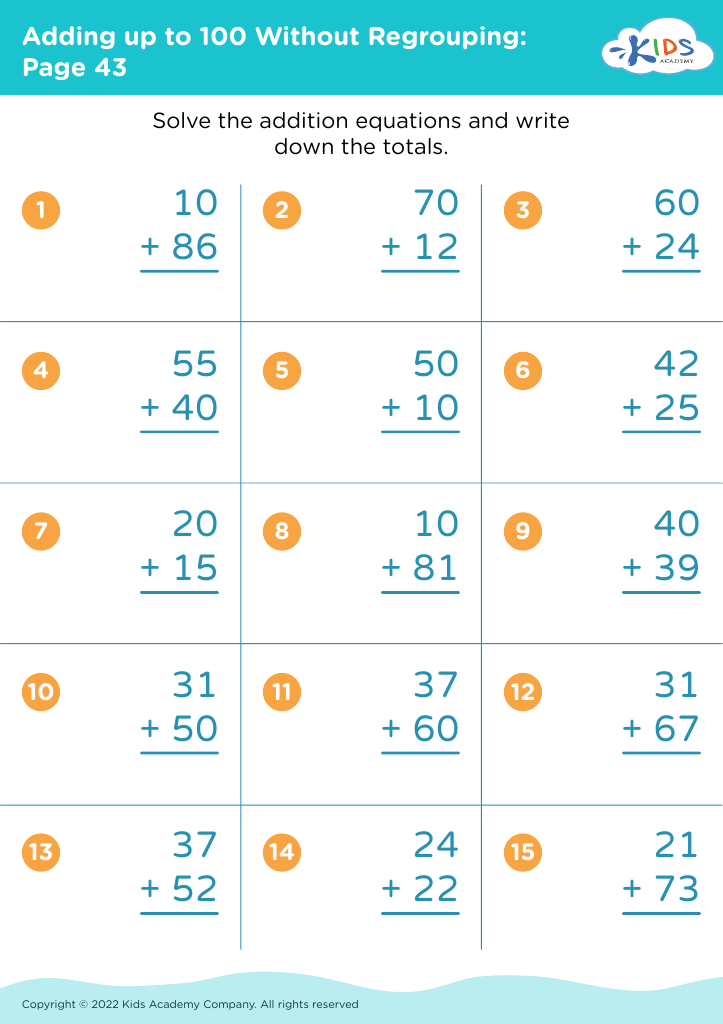
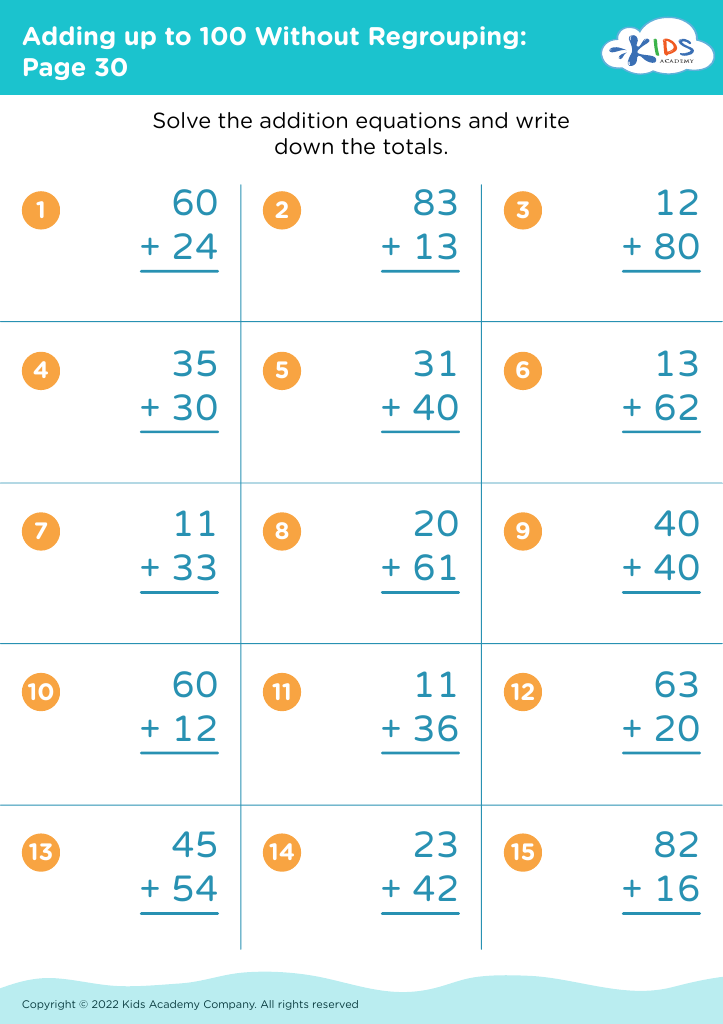
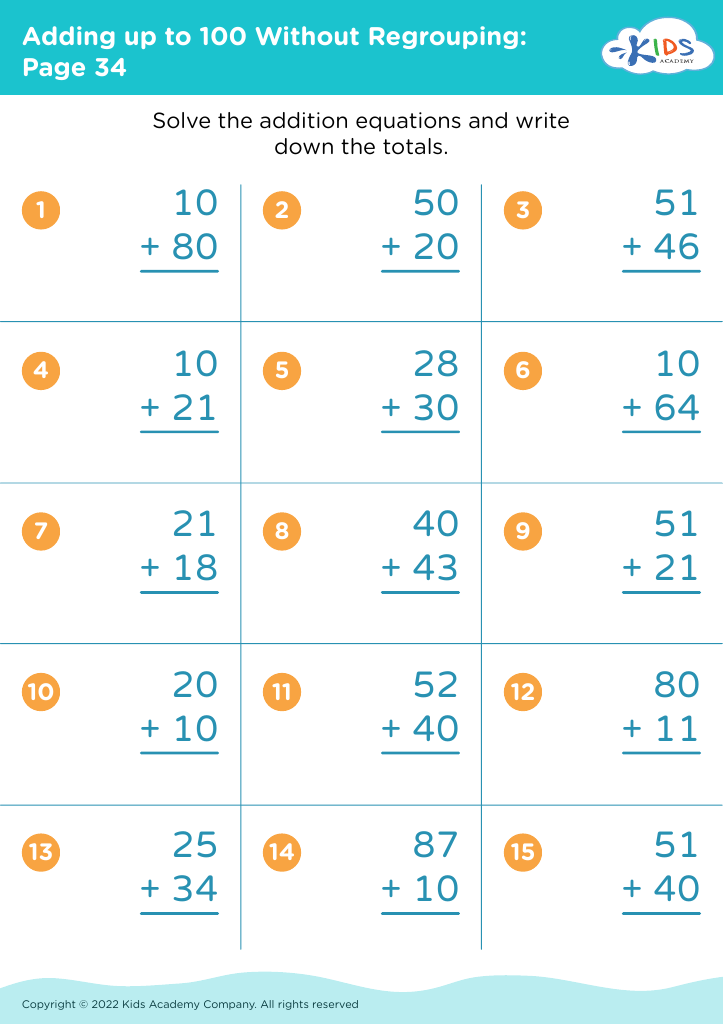




Understanding patterns and adding up to 100 without regrouping is essential for young learners, specifically for children aged 3-8. At this developmental stage, children are naturally curious and eager to discover relationships in numbers, making it the perfect time to introduce these concepts. Recognizing patterns helps children develop critical thinking and problem-solving skills, which are foundational for their overall academic growth.
For parents and teachers, fostering these skills can promote a strong number sense, enabling children to grasp more complex mathematical operations later on. When children understand how numbers combine to form 100, they can gain confidence in their mathematical abilities, reducing anxiety around math as they progress through school. Furthermore, establishing a solid foundation in understanding numbers encourages children to immediately recognize the significance of mathematical rules, sequences, and relationships in everyday life.
Involving young learners in pattern recognition and addition exercises can also strengthen their cognitive development, enhancing both memory and concentration. By implementing these learning activities into home or classroom settings, parents and teachers create an engaging environment that nurtures a positive attitude towards math and fosters lifelong learning. Thus, focusing on these skills is vital for shaping well-rounded, confident learners.