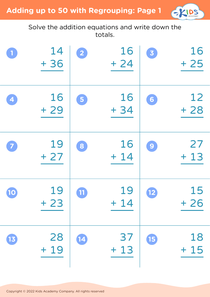
Counting practice Adding up to 50 Without Regrouping Worksheets for Ages 3-8
5 filtered results
-
From - To
Enhance your child's math skills with our engaging "Counting Practice Adding Up to 50 Without Regrouping Worksheets" designed for ages 3-8. These worksheets provide a fun and interactive way for young learners to grasp basic addition concepts while developing their counting abilities. Perfect for home or classroom use, these activities offer clear visualization and step-by-step practice that fosters confidence in mathematics. Children will enjoy the variety of colorful exercises that help them add numbers up to 50 without complex regrouping, ensuring a solid foundation in arithmetic. Start your child's math journey today with our comprehensive and entertaining worksheets!
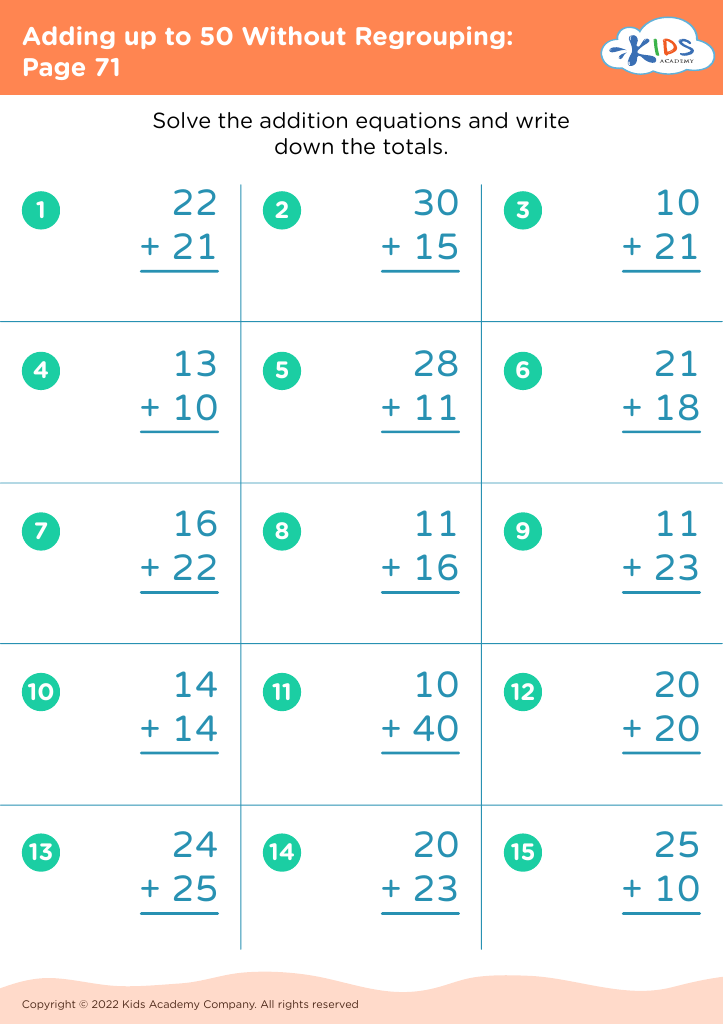
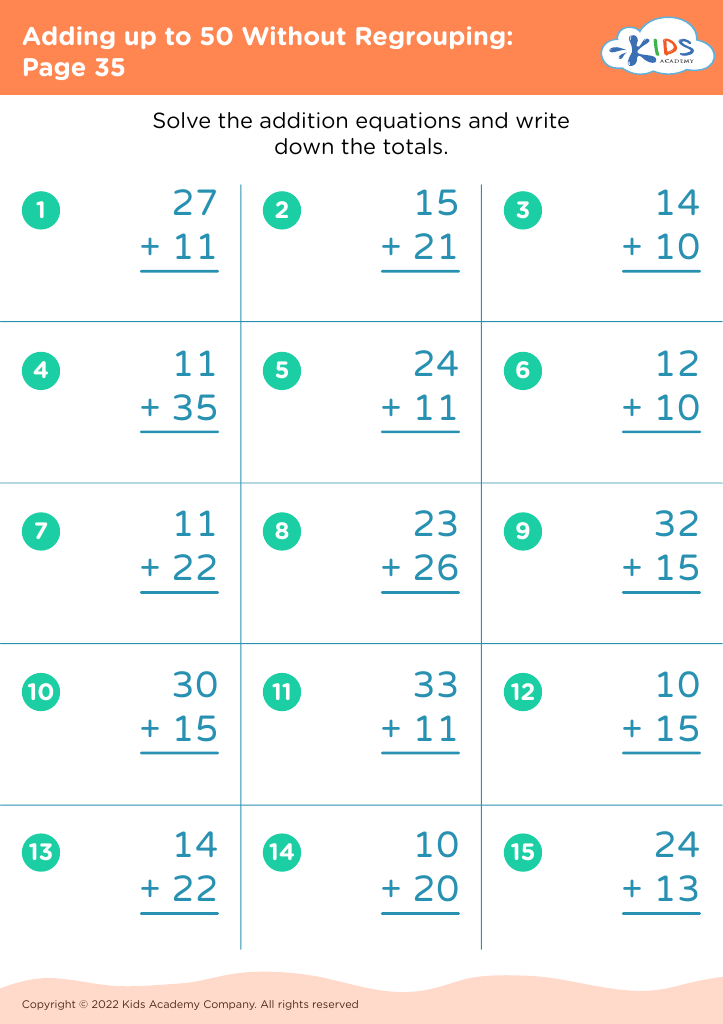
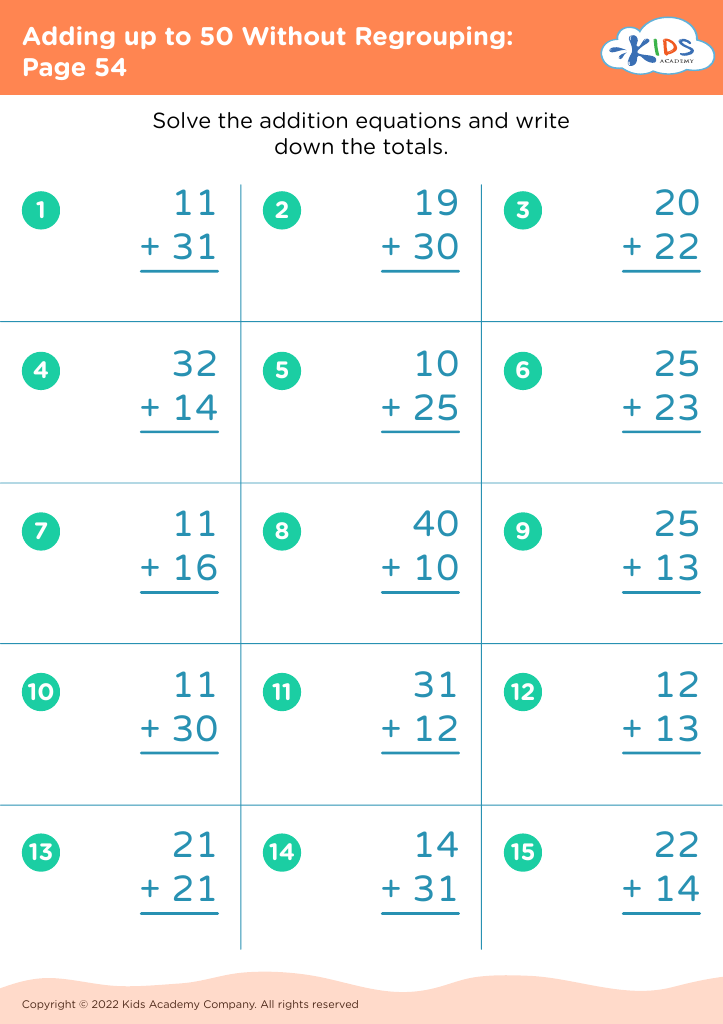
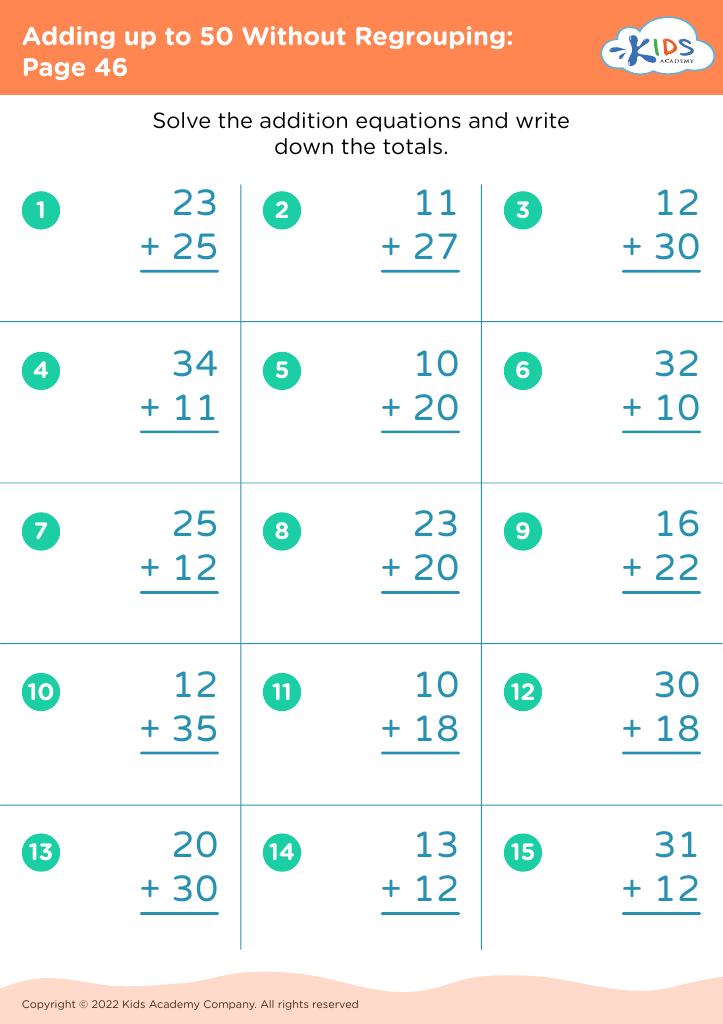
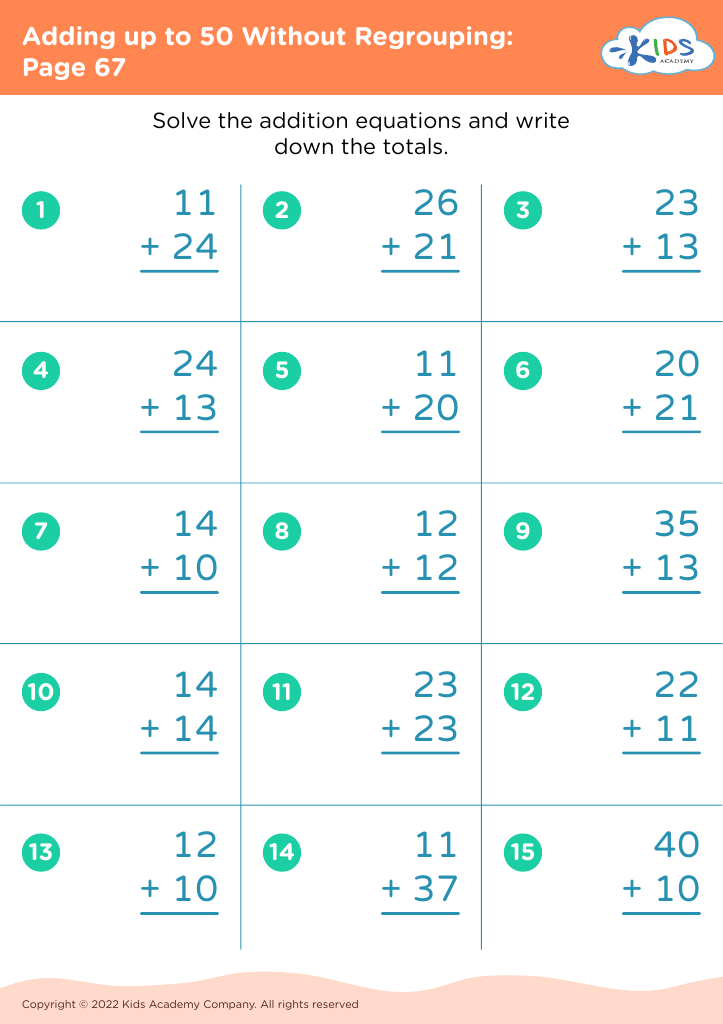


Counting practice, specifically adding up to 50 without regrouping, is crucial for young learners aged 3-8 as it lays the foundation for their mathematical understanding. During these formative years, children develop critical number sense, which encompasses their ability to understand quantities, recognize numerical relationships, and perform basic arithmetic operations. By focusing on simple addition without regrouping, children can build confidence in their abilities, improve their mental math skills, and increase their overall comfort with numbers.
Additionally, mastering addition enables children to tackle more complex mathematical concepts later on, such as subtraction and multiplication. Engaging with counting and addition through playful activities and real-life scenarios can make learning enjoyable and relatable. Parents and teachers play a vital role in creating a supportive environment that encourages practice and open dialogue about numbers.
Moreover, statistics show that early math skills are strongly linked to later academic success. Investing time in counting practice not only enhances numerical proficiency but also promotes cognitive development and problem-solving skills. Therefore, it is essential for parents and teachers to prioritize such foundational activities to ensure that every child has the necessary skills they need to thrive in their educational journey.