Decision making skills Addition & Subtraction Worksheets for Ages 3-8
3 filtered results
-
From - To
Boost your child’s decision-making skills with our specially designed Addition & Subtraction Worksheets for ages 3-8. These engaging worksheets enhance critical thinking by encouraging young learners to make informed choices as they solve math problems. Suitable for preschool to early elementary, each activity seamlessly combines fun and learning, providing a solid foundation in basic arithmetic while developing essential cognitive abilities. With colorful illustrations and age-appropriate challenges, your child will gain confidence in both math and everyday decision-making. Discover a world where education meets excitement—help your child master math while making smart choices!
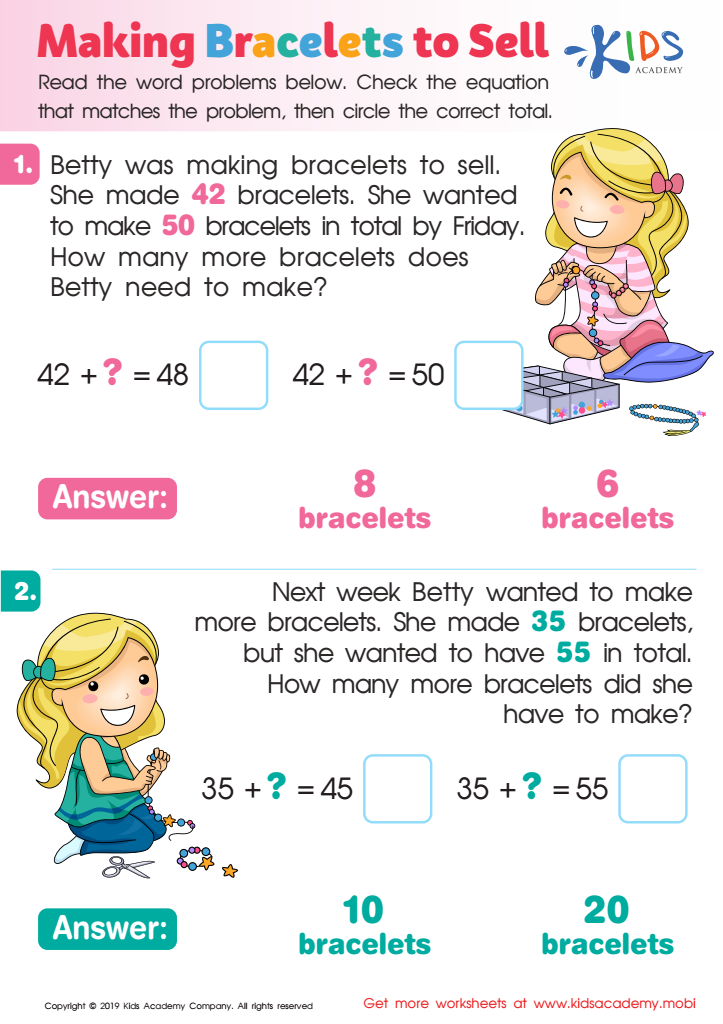
Making Bracelets to Sell Worksheet
 Assign to My Students
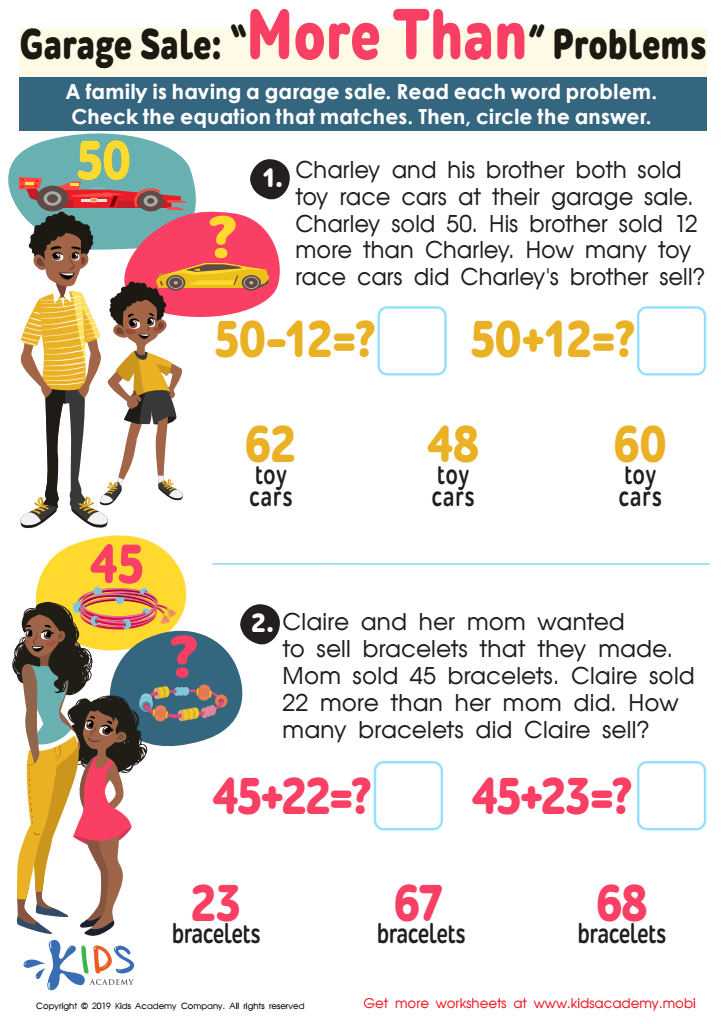
Garage Sale - More yhan Worksheet








Decision-making skills and arithmetic proficiency—such as addition and subtraction—play pivotal roles in early childhood development, laying crucial foundations for later academic and life success. For children ages 3 to 8, these skills are intertwined and essential for fostering cognitive and social growth.
Firstly, decision-making abilities empower young children to navigate daily challenges. Choices, ranging from selecting toys to deciding how to solve problems, help children develop independence, critical thinking, and problem-solving skills. In practice, making decisions involves weighing options and considering outcomes, instilling a sense of responsibility and confidence.
Similarly, understanding addition and subtraction is fundamental for mathematical literacy. Early arithmetic skills sharpen mental math abilities and underpin future math concepts, enhancing logical thinking. Simple addition and subtraction exercises teach children how to quantify, compare, and analyze, which are essential for comprehending more complex mathematical concepts later on.
More importantly, integrating arithmetic into everyday decision-making scenarios contextualizes learning, making it engaging and relevant. For example, deciding how many apples to buy and calculating the total number after eating some offers practical applications for these skills.
Thus, parents and teachers should focus on these areas to nurture well-rounded intellectual growth, equipping children with the analytical and decision-making skills required for lifelong learning and personal development.








