
Mental math development Addition & Subtraction Worksheets for Ages 3-8
3 filtered results
Difficulty Level
Grade
Age
-
From - To
Subject
Activity
Standards
Develop your child's math skills with our engaging and educational Mental Math Development Addition & Subtraction Worksheets for Ages 3-8. Designed to challenge and excite, these worksheets help young learners build strong mathematical foundations while improving their mental math abilities. Each activity encourages kids to think critically and solve problems quickly, promoting confidence in their addition and subtraction skills. Perfect for classroom or home use, our worksheets support various learning styles and keep children motivated through fun and interactive exercises. Help your child master mental math and excel in their math journey with Kids Academy's expertly crafted resources.
Favorites
With answer key
Interactive
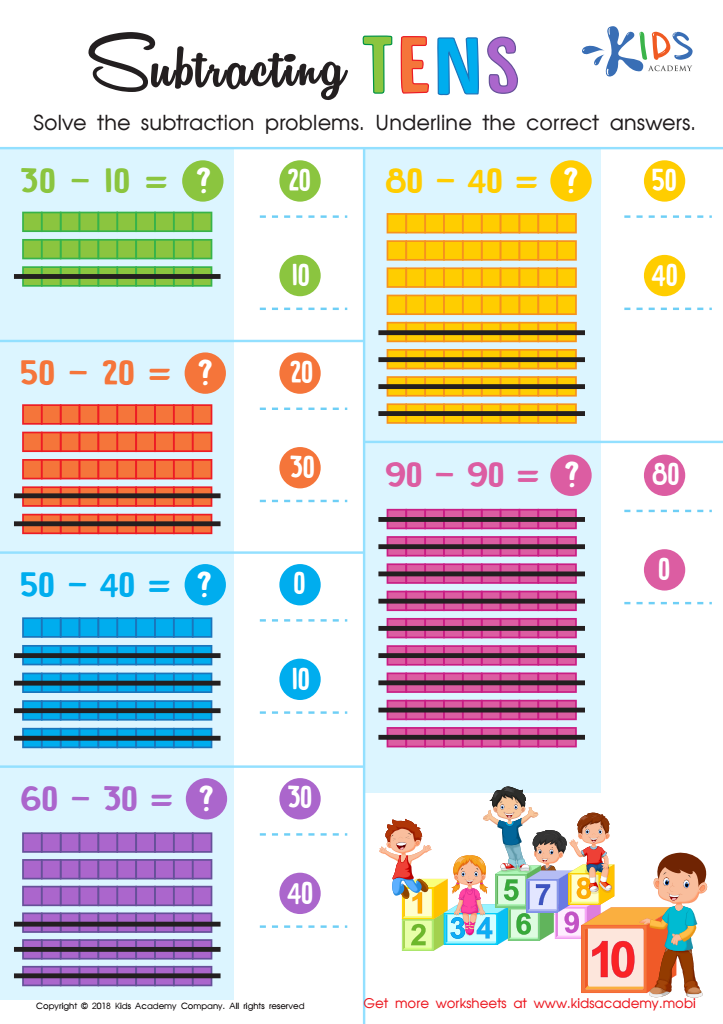
Subtracting Tens Worksheet
Base ten blocks enable kids to make practical math connections and develop number sense. This free worksheet, using bright-colored tens blocks, helps children learn to skip count and subtract. It lays a strong foundation for upcoming higher level math problems.
 Assign to My Students
Subtracting Tens Worksheet
Worksheet
Join Kids Academy for Free
Who is primarily going to use this learning content?








Mental math development, especially in fundamental operations like addition and subtraction, is crucial for children aged 3-8 for several reasons. Firstly, it establishes a strong mathematical foundation. Early familiarity with numbers and calculations boosts their confidence and prepares them for more complex math concepts in later years.
Engaging in mental math promotes cognitive development. It sharpens memory, enhances problem-solving abilities, and improves logical thinking, all of which are essential skills across various subjects and activities. These exercises help children develop mental agility, enabling them to process information quickly and make decisions efficiently.
For parents and teachers, fostering a love for mental math can transform a child's attitude toward learning. When children see progress and experience success in math, it breeds a sense of achievement and motivates them to tackle more challenging tasks. Fun, engaging ways to teach mental math, such as games and hands-on activities, can make learning enjoyable and relevant, which is critical during these formative years.
Moreover, strong math skills are linked to better academic performance overall. Early proficiency in math lays the groundwork for academic success in elementary school and beyond, making teachers’ and parents’ emphasis on these fundamental skills a valuable investment in a child’s future. Hence, paying attention to mental math development in addition and subtraction creates a supportive, stimulating environment that fosters lifelong learning and intellectual growth.








