Improve calculation skills Addition Worksheets for Ages 3-8
4 filtered results
-
From - To
Enhance your child's math abilities with our "Improve Calculation Skills: Addition Worksheets for Ages 3-8." Designed specifically for young learners, these engaging worksheets make mastering addition fun and interactive. Tailored for preschool and early elementary students, they feature colorful illustrations and age-appropriate exercises that capture attention while building confidence in basic math skills. From simple one-digit addition to more complex problems, each worksheet fosters critical thinking and problem-solving abilities. Perfect for home or classroom use, these resources empower children to develop a strong foundational understanding of addition. Download now to unlock a world of math exploration and pave the way for future success!
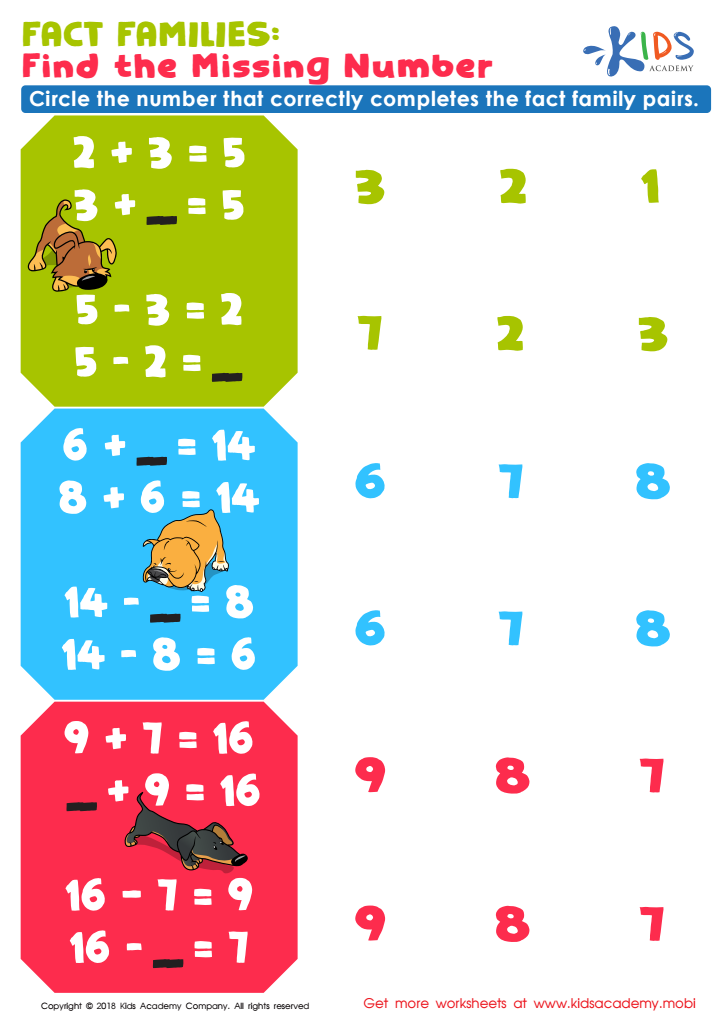
Fact Families: Find Missing Number Worksheet
 Assign to My Students








Parents and teachers should prioritize improving addition skills for children aged 3-8 because these foundational math abilities set the stage for future academic success. Early childhood is a critical period for cognitive development; introducing children to basic addition concepts encourages logical thinking and problem-solving skills. Proficiency in addition not only bolsters a child’s confidence but also makes learning more enjoyable.
Addition skills are linked to various aspects of daily life and essential for mastering more complex mathematics in later years. For example, children need to understand addition for telling time, handling money, and even for reading graphs or charts. Furthermore, strong calculation skills can alleviate math anxiety, fostering a positive attitude towards learning.
By focusing on addition, educators and parents can create engaging, interactive activities that promote learning through play. This approach can help children develop a sound understanding of numbers and relationships, enhancing their ability to make connections between different mathematical concepts. Ultimately, building robust addition skills establishes a strong framework for numerical literacy and equips children with vital competencies serving them throughout their educational journeys and into adulthood. Thus, nurturing these skills early on is essential for holistic development and lifelong learning.








