
Pattern identification Addition Worksheets for Ages 3-8
3 filtered results
Difficulty Level
Grade
Age
-
From - To
Subject
Activity
Standards
Discover our engaging Pattern Identification Addition Worksheets designed for children ages 3-8! These worksheets help young learners recognize patterns while developing their addition skills through fun and interactive exercises. By integrating colorful graphics and imaginative themes, we make math approachable and enjoyable. Each worksheet is crafted to enhance cognitive skills and promote critical thinking, enabling children to identify and extend patterns as they solve addition problems. Perfect for home or classroom use, our resources support early math learning and set a strong foundation for future success. Join us in making math exciting with our hands-on, educational worksheets that inspire curiosity and growth!
Favorites
With answer key
Interactive
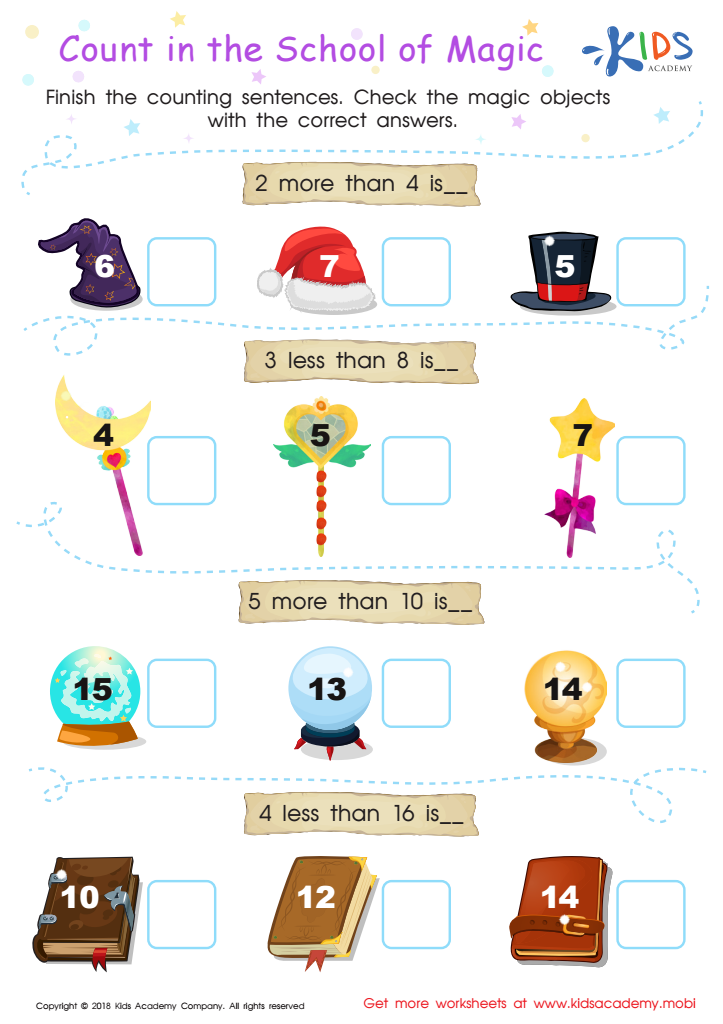
Count in the School of Magic Worksheet
Your math learners can explore the School of Magic with this worksheet. They'll read equations with addition and subtraction numbers under 20, count back and forth to find the answer, then complete the counting sentences. Fun pictures and easy accuracy make it an enjoyable and successful learning experience.
 Assign to My Students
Count in the School of Magic Worksheet
Worksheet
Join Kids Academy for Free
Who is primarily going to use this learning content?








Pattern identification and addition are foundational skills for young children aged 3-8 that significantly contribute to their overall mathematical development. Understanding patterns helps children recognize sequences, which is critical for problem-solving and logical reasoning. These skills foster cognitive growth by encouraging prediction and inference, essential tools for learning across all disciplines.
Addition, on the other hand, is a key building block for future mathematics. It introduces children to the concept of quantities and reinforces their understanding of numbers and relationships. When combined with pattern identification, addition becomes more engaging, as children begin to see numerical relationships in everyday life, such as counting objects or recognizing repeated events.
For parents and teachers, fostering these skills during early childhood sets the stage for lifelong learning. Children who confidently handle patterns and basic addition are more likely to excel in later math concepts, minimizing future academic struggles. Moreover, these practices develop critical thinking and promote a growth mindset, essential for educational success. Emphasizing pattern identification and addition during formative years nurtures an environment where children feel capable and motivated, making math an enjoyable and integral part of their learning journey.








