
Learning subtraction Math Worksheets for Ages 3-8
3 filtered results
Difficulty Level
Grade
Age
-
From - To
Subject
Activity
Standards
Explore our engaging Subtraction Math Worksheets designed specifically for children ages 3-8! These interactive and fun worksheets help young learners grasp the fundamentals of subtraction through colorful illustrations and age-appropriate exercises. Perfect for both home and classroom use, our materials encourage critical thinking and problem-solving skills. With a variety of activities ranging from count-and-subtract to picture-based exercises, children will strengthen their arithmetic abilities while enjoying the learning process. Printable and easy to use, our worksheets allow for flexible learning opportunities. Start your child's math journey today with our exciting subtraction resources and watch their confidence grow!
Favorites
With answer key
Interactive
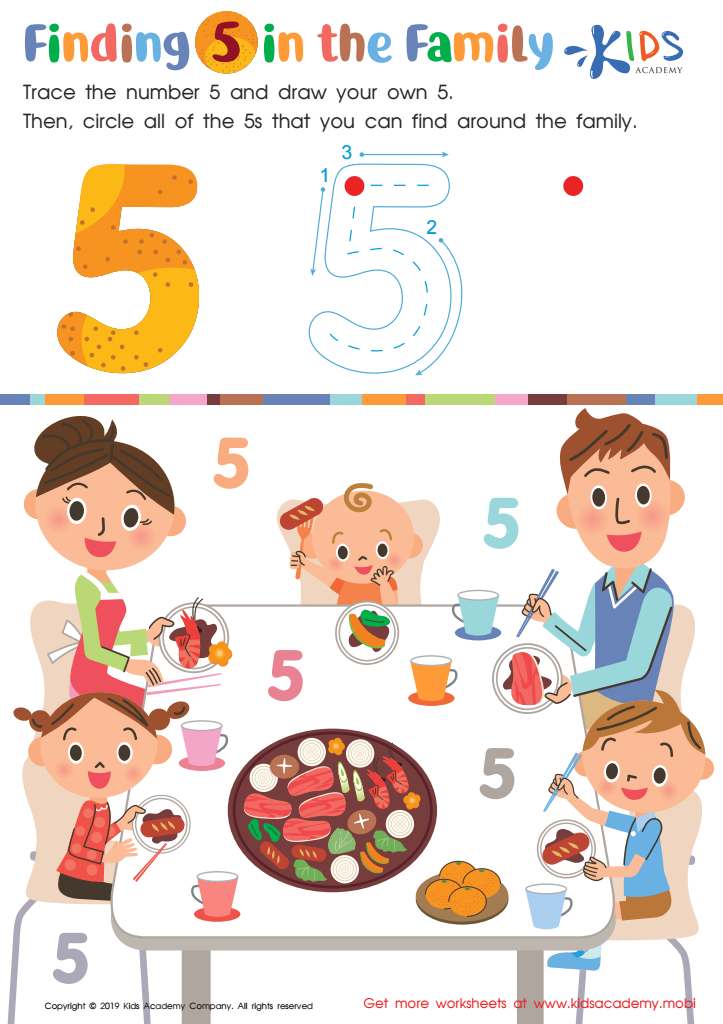
Finding 5 in the Family Worksheet
This worksheet helps kids identify and write the number 5. Ask what the family is doing and who the family members are. Help them trace and draw the 5, then have them circle all 5s in the picture.
 Assign to My Students
Finding 5 in the Family Worksheet
Worksheet
Join Kids Academy for Free
Who is primarily going to use this learning content?






Learning subtraction is crucial for children aged 3 to 8 as it forms a foundational skill necessary for their overall mathematical understanding. At this age, children are developing their cognitive abilities, making it an opportune time to introduce mathematical concepts. Mastering subtraction helps children grasp the concept of taking away, which not only enhances their number sense but also promotes problem-solving skills that are essential in everyday life.
Moreover, subtraction encourages the development of critical thinking. By engaging with subtraction, children learn to analyze situations, make predictions, and assess outcomes, which are valuable skills beyond math. Furthermore, a strong grasp of subtraction aids in building confidence in math, reducing math anxiety as they progress to more complex concepts. It also lays the groundwork for understanding inverse operations, which are vital as they advance to multiplication and division later on.
Finally, involving parents and teachers in teaching subtraction fosters a collaborative learning environment. When adults engage with children in playful and interactive ways to practice subtraction, it nurtures a love of learning and strengthens that crucial parent-child or teacher-student bond. Thus, investing time in teaching subtraction is beneficial for children's cognitive and emotional development.








