Understanding Quantities Math Worksheets for Ages 3-8 - Page 3
50 filtered results
-
From - To
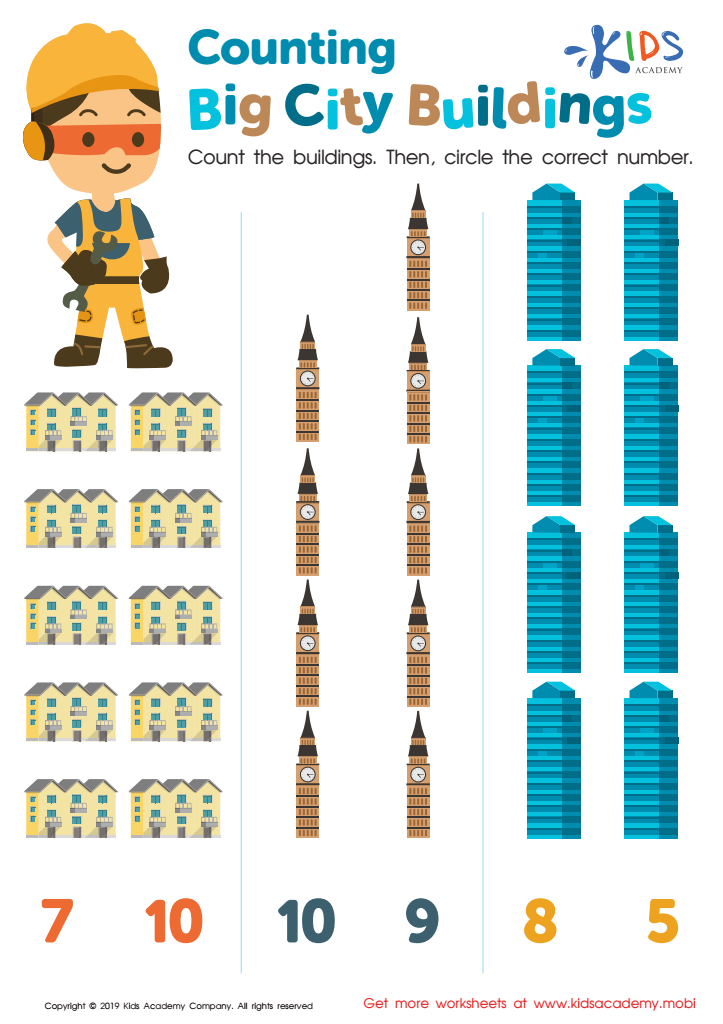
Counting Big City Buildings Worksheet
 Assign to My Students







Understanding quantities is a crucial foundational skill in early mathematics education for children ages 3-8. This understanding is not just about recognizing numbers; it involves comprehending the concept of "how many" and developing the ability to manipulate those quantities through counting, addition, and subtraction. Parents and teachers should care about fostering this skill for several reasons.
Firstly, mastering quantities enhances cognitive development. Children who engage with quantity-related activities improve their critical thinking, problem-solving abilities, and spatial awareness. It sets the stage for more complex mathematical concepts later on, such as measurement, fractions, and basic algebra.
Secondly, understanding quantities lays the groundwork for everyday skills essential for life. Children learn to compare amounts, understand pricing, and measure ingredients, which are vital in real-world situations. This knowledge supports their capacity to become financially savvy and independent later in life.
Additionally, fostering a strong quantitative foundation can build a child's confidence and love for math. Engaging students in fun, interactive activities related to quantities can make learning enjoyable and less intimidating.
Ultimately, fostering a robust understanding of quantities equips children with not only academic skills but also critical life skills, paving the way for their overall success.








