
Understanding measurement units Measurement Worksheets for Ages 3-8
3 filtered results
Difficulty Level
Grade
Age
-
From - To
Subject
Activity
Standards
Unlock a world of learning with our "Understanding Measurement Units" worksheets, perfect for children ages 3-8! Created to develop critical math skills through engaging and fun activities, these worksheets help young learners master the basics of measuring various objects. Focusing on essential concepts like length, weight, and volume, the worksheets provide clear, age-appropriate challenges that foster a solid understanding. Each worksheet is thoughtfully designed to keep kids focused while making learning both enjoyable and meaningful. Give your child the tools to succeed in math with our comprehensive measurement units worksheets, available exclusively at Kids Academy.
Favorites
With answer key
Interactive
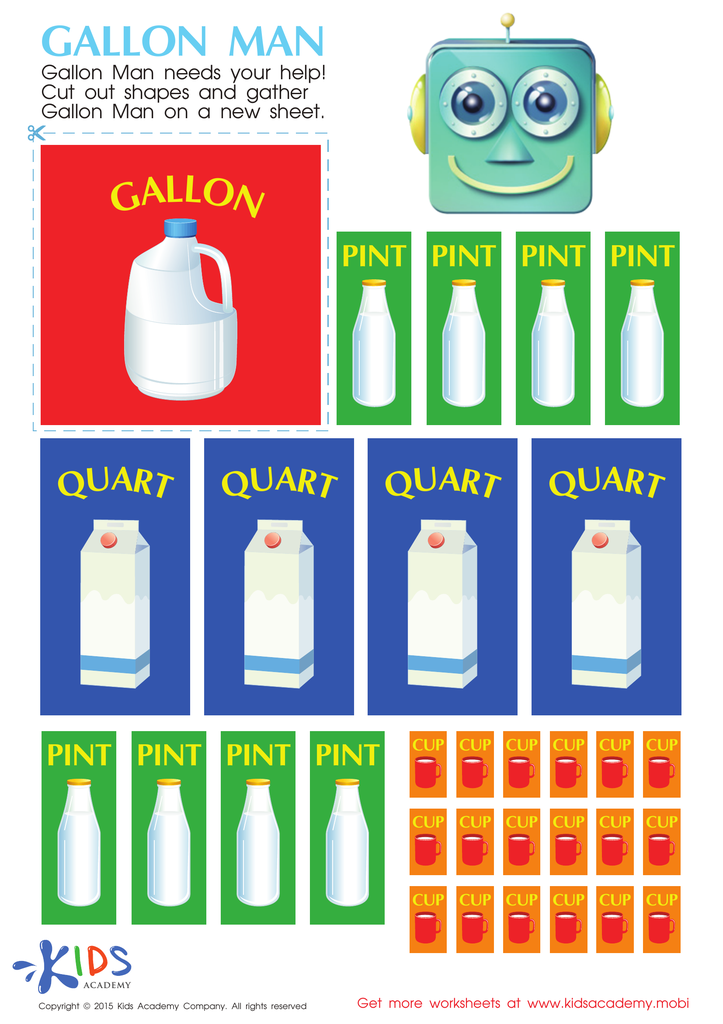
Cups, Pints and Quarts With Gallon Man Worksheet
Measurement in cups, pints, quarts and gallons has never been this fun!
Cups, Pints and Quarts With Gallon Man Worksheet
Worksheet
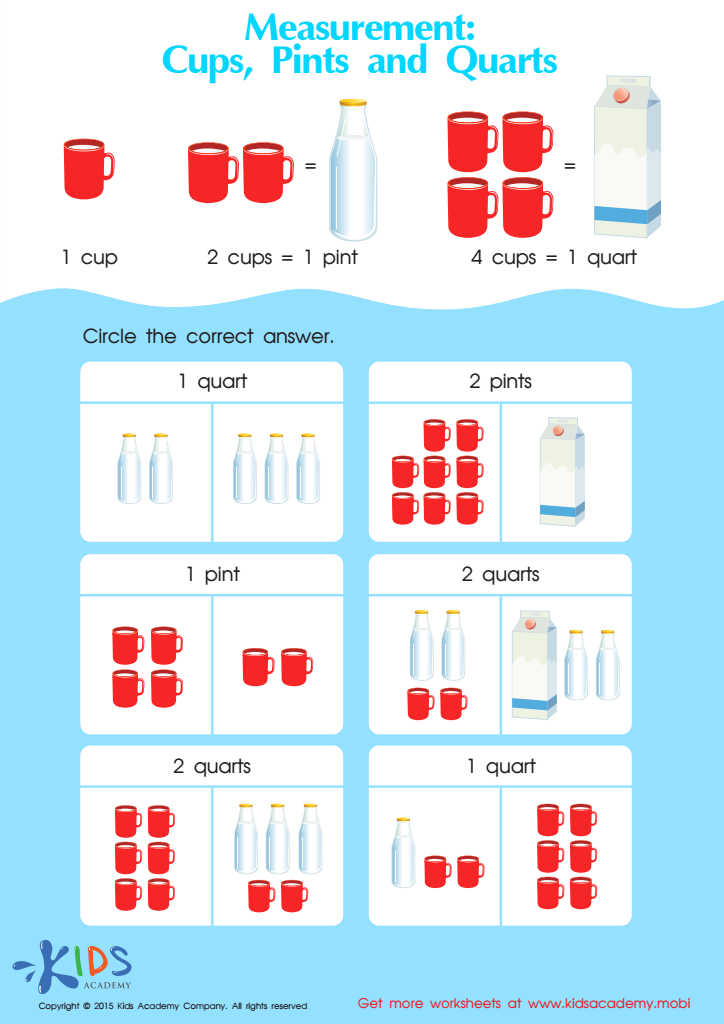
Cups, Pints and Quarts Worksheet
Let your kids explore the world of math with our worksheet! Have them count cups, pints and quarts in pictures and circle the right answer. Get even more free printable math worksheets for kindergarten on our website. Come on, join the adventure!
 Assign to My Students
Cups, Pints and Quarts Worksheet
Worksheet
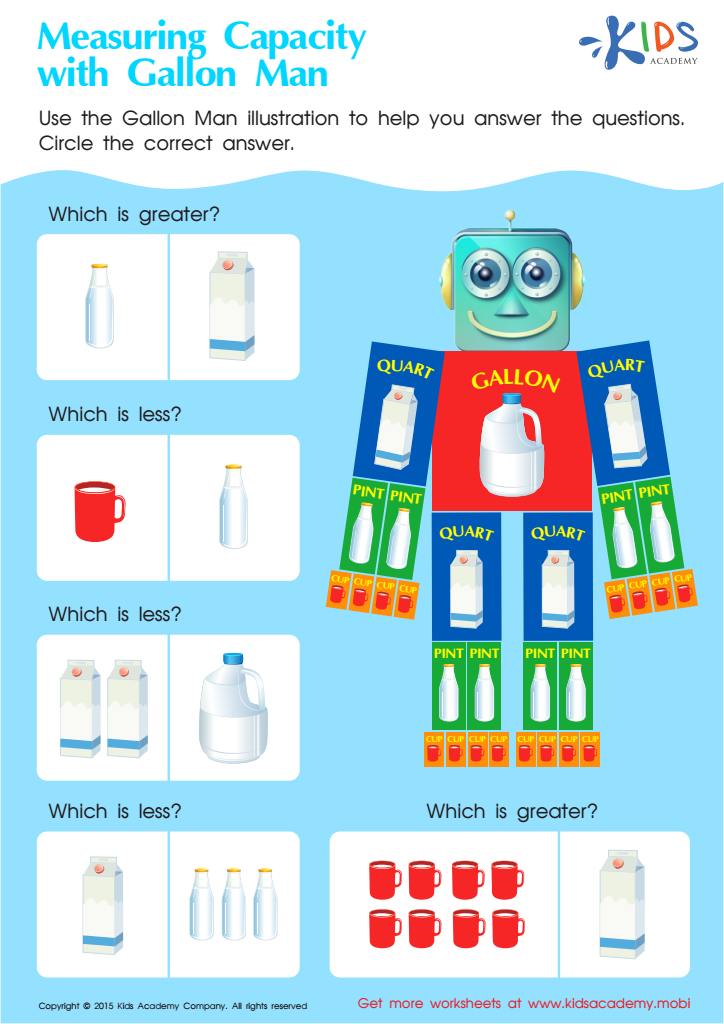
Measurement: Measuring Capacity with Gallon Man Worksheet
Check out Gallon Man to practice measuring capacity with cups, pints, quarts, and gallons. Our worksheet has questions with answers checked against Gallon Man. For more practice, visit our site for free printable math worksheets for kindergarten and learn math with fun!
Measurement: Measuring Capacity with Gallon Man Worksheet
Worksheet
Join Kids Academy for Free
Who is primarily going to use this learning content?







Understanding measurement units is crucial for young children, aged 3-8, as it lays the foundation for essential life skills and future academic success. Measurement skills form a core part of early mathematics education, helping children grasp concepts related to size, length, weight, and volume. When parents and teachers invest in teaching these concepts, they enable children to develop critical thinking and problem-solving skills.
At this developmental stage, children are naturally curious and constantly explore their world. By understanding measurement, they can describe and compare objects, thereby enhancing their observational skills and vocabulary. For instance, recognizing that one toy is longer or heavier than another helps build comparative language skills and mathematical understanding.
Moreover, competence in measurement is practical and necessary for everyday tasks such as cooking, understanding time, and navigating spaces. Children use these skills during play, in the classroom, and at home. For example, building with blocks or comparing quantities of ingredients in a recipe involves understanding measurements.
Additionally, early exposure to these concepts prepares children for more complex studies in science, technology, engineering, and mathematics (STEM). It promotes a growth mindset by showing them they can understand and manipulate their environment. Therefore, prioritizing measurement learning from a young age is pivotal in fostering confident, competent, and capable learners.








