Our "Fine Motor Skills Development Cursive Letters Worksheets for Ages 3-8" offer engaging activities designed to enhance handwriting proficiency in young learners. Carefully crafted, these worksheets aid in the development of crucial fine motor skills by guiding children through the formation of beautiful cursive letters. Each worksheet provides step-by-step tracing exercises that are both fun and educational. Perfect for classroom settings or at-home practice, these resources support children in gaining confidence and precision in their writing abilities, setting a strong foundation for future academic success. Ignite your child’s learning journey with our expertly designed cursive letter worksheets!

Check out this FREE Trial Lesson on Cursive Letters for age 3-8!

P

Favorites
With answer key
Interactive
  • 3-8
  • Fine motor skills development
  • Cursive Letters
Cursive ABCs: Lowercase d

Cursive ABCs: Lowercase d

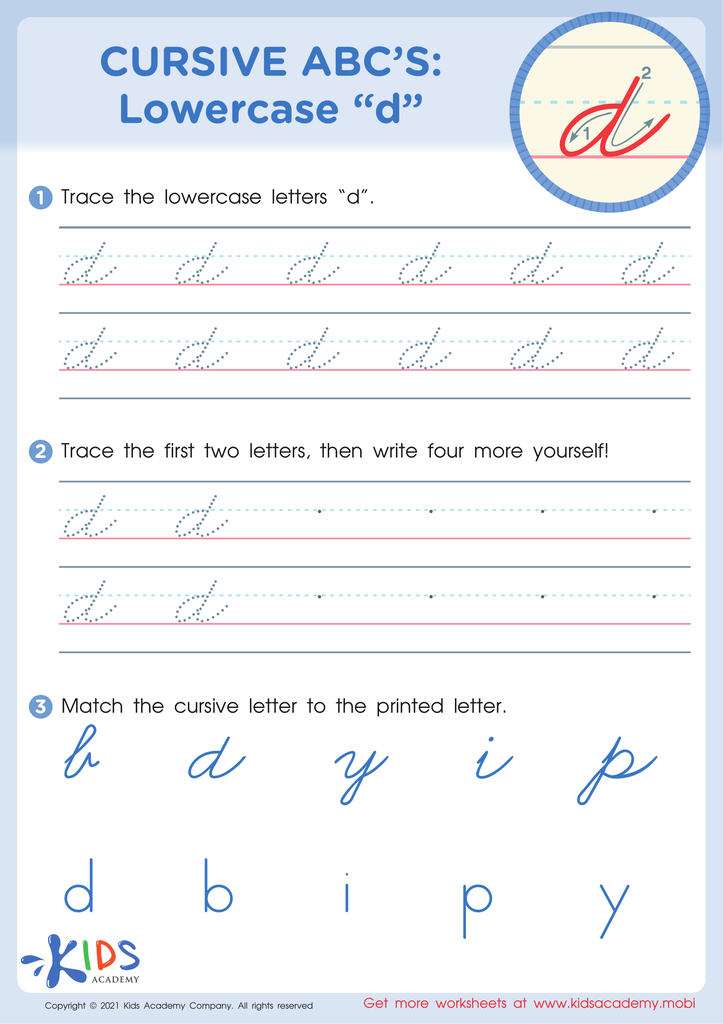
To make learning fun, introduce colorful worksheets! These help young learners perfect their cursive lowercase 'd'. By the end, they'll be better at writing and identifying the letter. It's an easy and enjoyable exercise for kids!
Cursive ABCs: Lowercase d
Worksheet
Cursive ABCs: Lowercase a

Cursive ABCs: Lowercase a

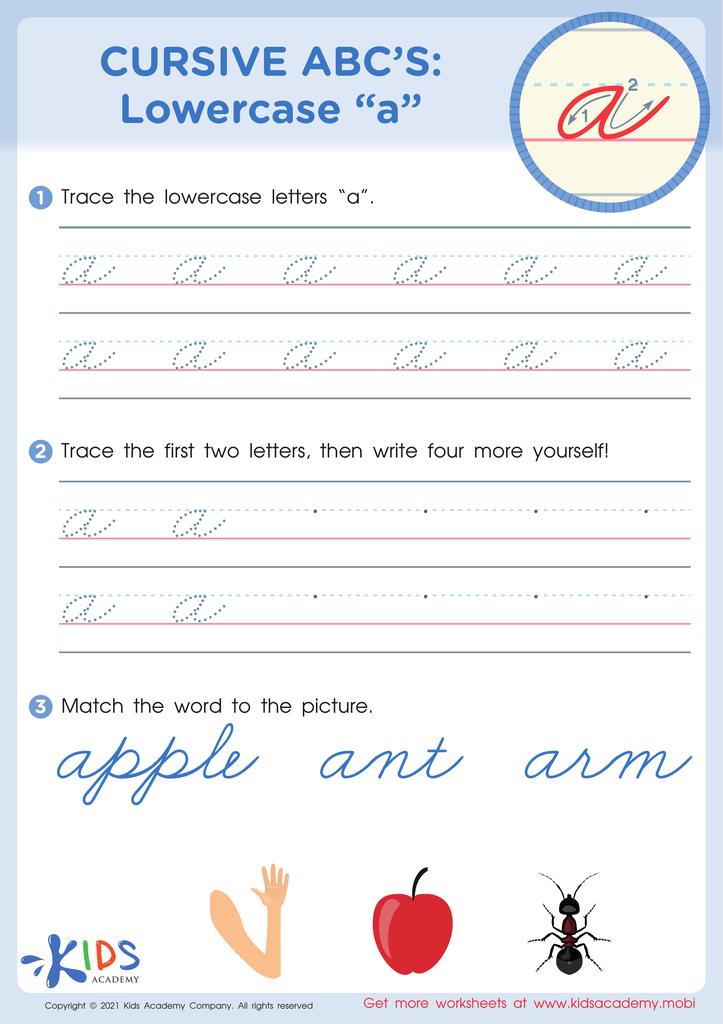
Help your children learn to write cursive letters with these free tracing sheets. They'll practice their handwriting, develop printing skills and build vocabulary. By tracing the lowercase letter “a” multiple times, they'll learn how it's formed and be ready to write it on their own. The colorful pictures at the bottom of each page also offer new words beginning with the letter 'a'.
Cursive ABCs: Lowercase a
Worksheet
Cursive ABCs: Lowercase f

Cursive ABCs: Lowercase f

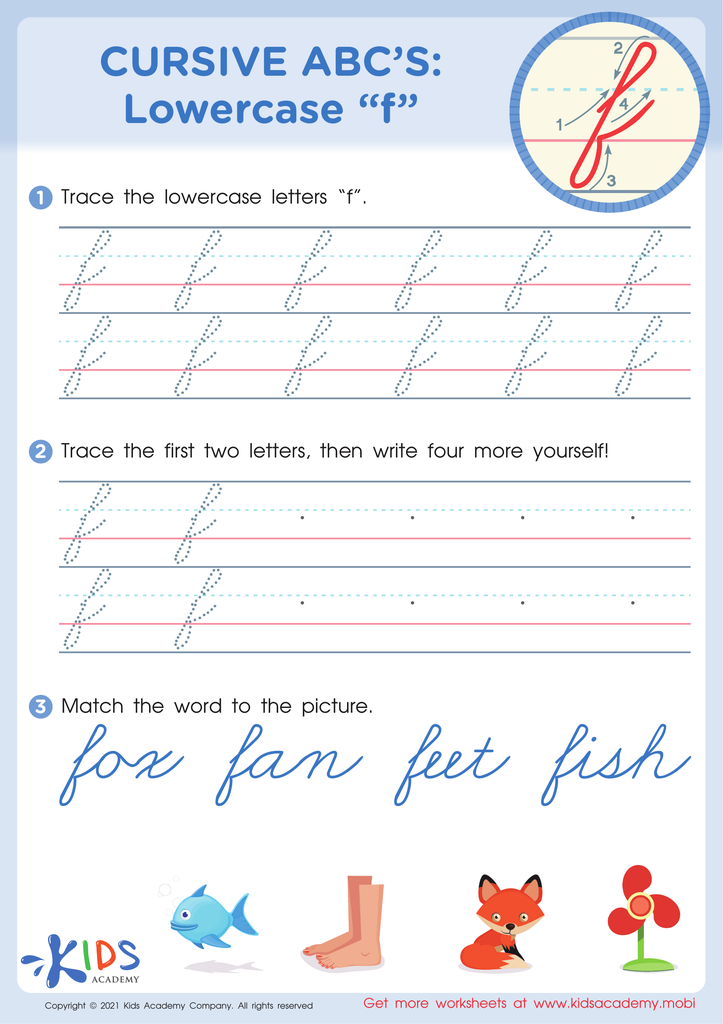
This worksheet helps your child improve letter writing and recognition. Each letter has its own form, so teaching is important. Practicing the lowercase letter 'f' helps kids memorize its shape and recognize it in words. With practice, they'll be able to write the letter correctly and identify it quickly.
Cursive ABCs: Lowercase f
Worksheet
Cursive ABCs: Uppercase F

Cursive ABCs: Uppercase F

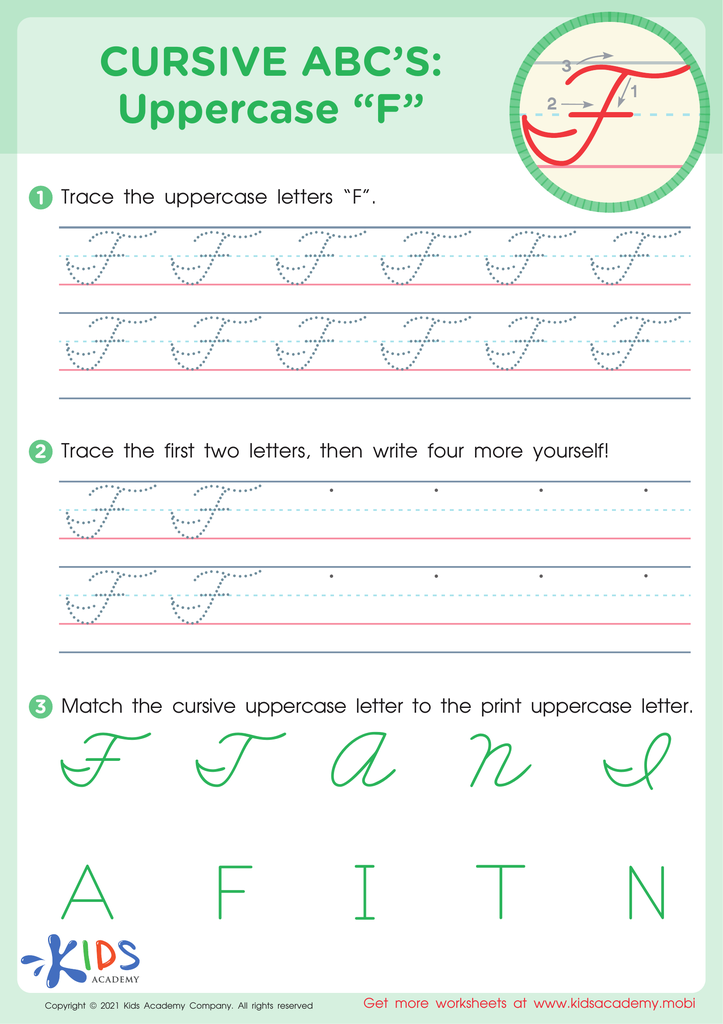
Help your kids trace the letters in these worksheets and watch their confidence grow as they learn to write cursive uppercase and lowercase letters. Ask them to identify the letters in words and give examples of words that start with an uppercase 'F', then have them write some letters on their own and assess their progress.
Cursive ABCs: Uppercase F
Worksheet
Cursive ABCs: Uppercase G

Cursive ABCs: Uppercase G

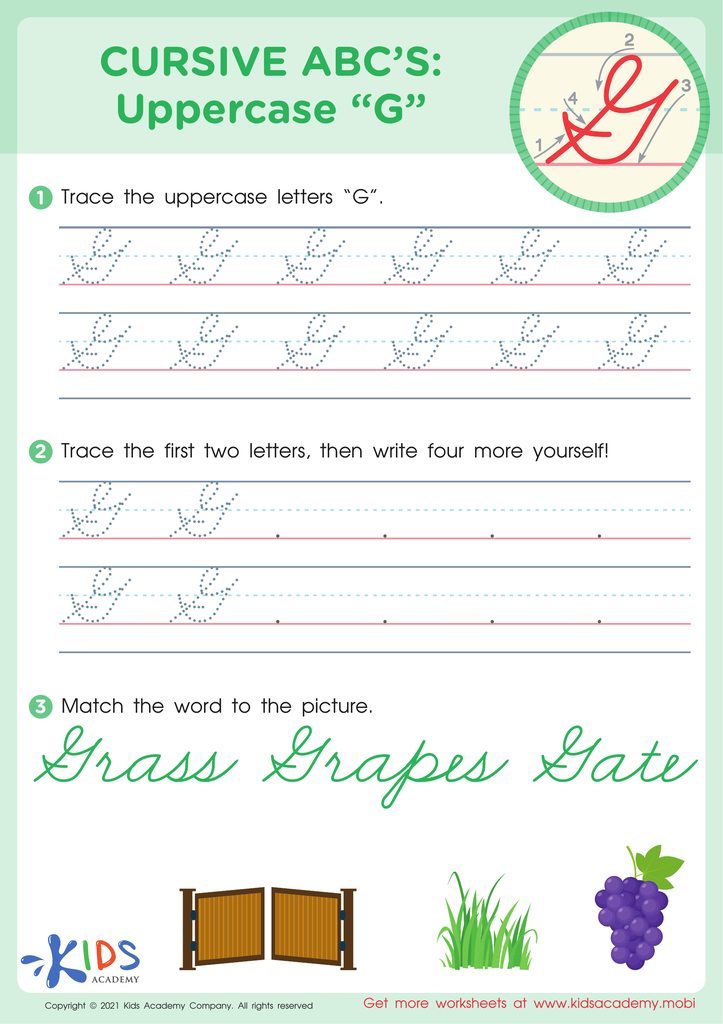
Remind your kids of words beginning with 'G' like 'girl' and 'goat'. Ask them to give examples too. Use this tracing worksheet to help your kids practice writing the cursive uppercase 'G'. It'll help them perfect their motor skills and get better at cursive letters.
Cursive ABCs: Uppercase G
Worksheet
Cursive ABCs: Uppercase D

Cursive ABCs: Uppercase D

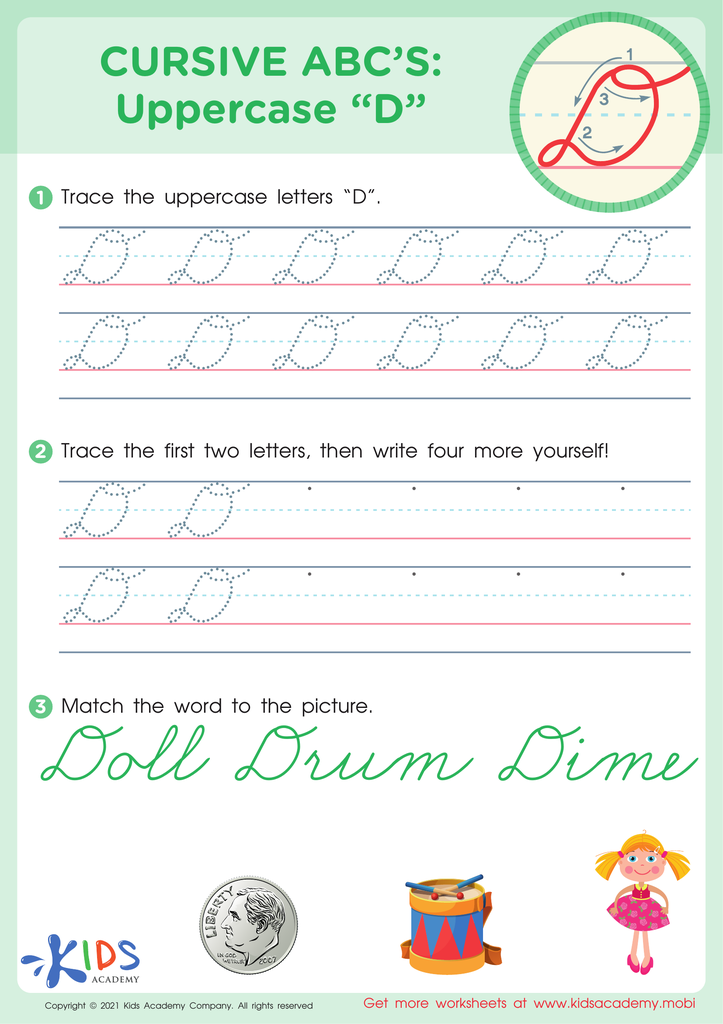
Help your kids learn to write the uppercase letter 'D' in cursive with the help of this tracing worksheet. Show them how to trace it over and over. When they're ready, let them write the letter on their own. Match pictures to words that start with 'D' and your kids will be pros in no time!
Cursive ABCs: Uppercase D
Worksheet
Cursive ABCs: Lowercase c

Cursive ABCs: Lowercase c

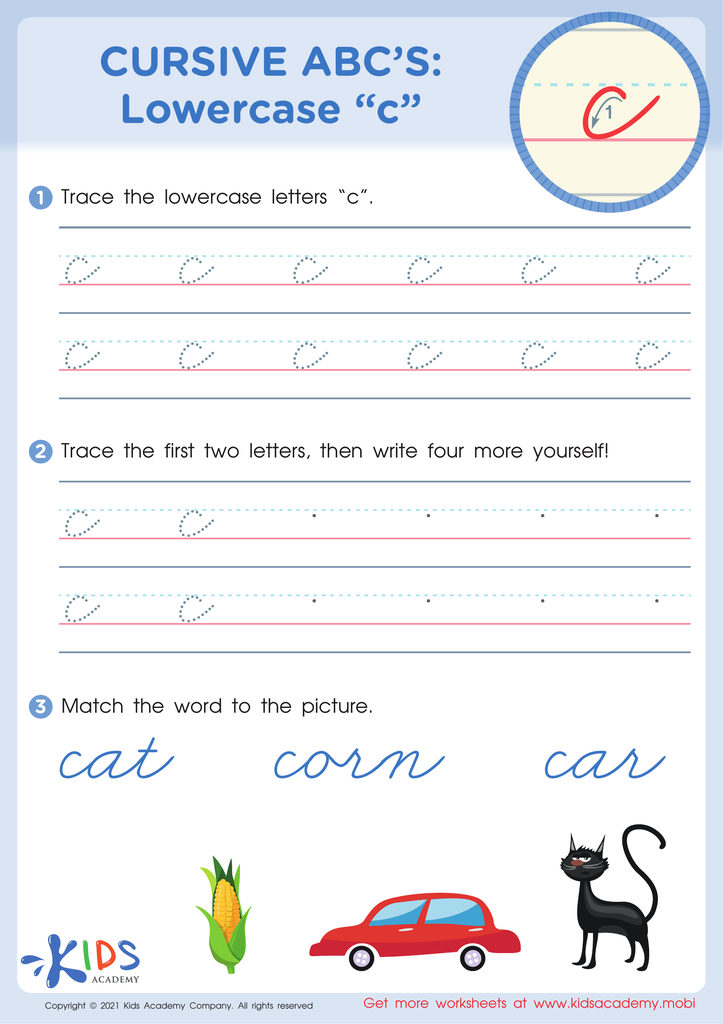
Once your child has successfully printed their letters, help them learn to recognize and write the alphabet in cursive. Struggling? This worksheet is perfect to assist them. Writing is an essential skill for kids to learn, so do all you can to help them. Use these tracing worksheets and guide them as they write the lowercase letter 'c' in cursive.
Cursive ABCs: Lowercase c
Worksheet
Cursive ABCs: Lowercase h

Cursive ABCs: Lowercase h

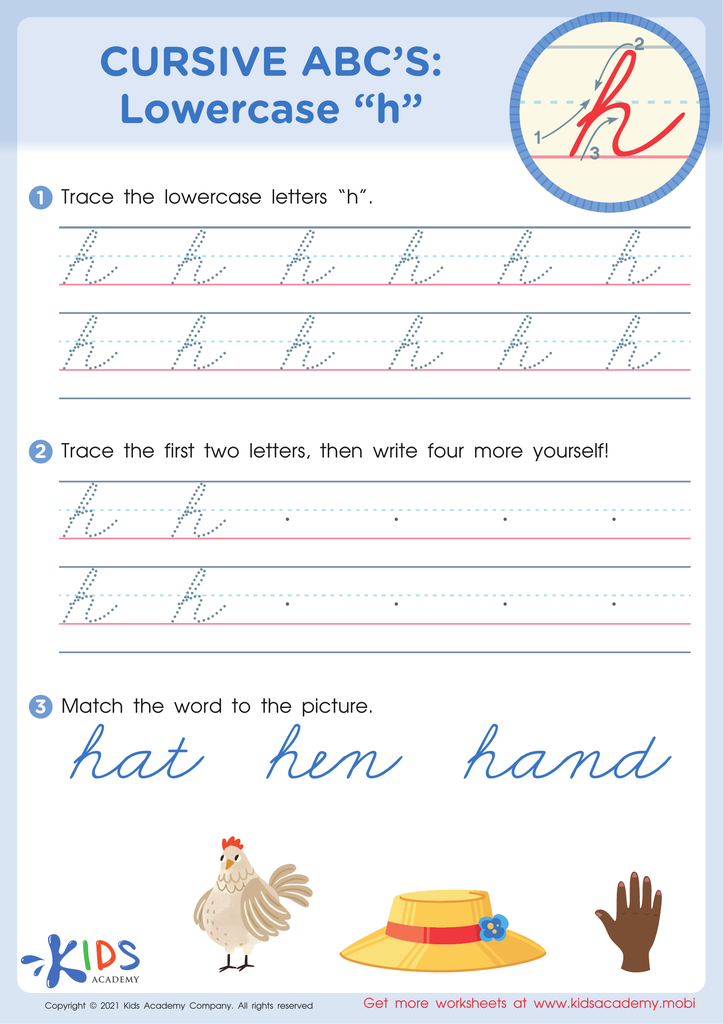
Your children will need more than just reciting the alphabet; they need to learn how to identify and write it. Cursive writing helps with neatness, and these tracing worksheets are great learning aids and offer exercises to practice writing lowercase 'h'. With these, your children get better writing skills and learn new words.
Cursive ABCs: Lowercase h
Worksheet
Cursive ABCs: Lowercase b

Cursive ABCs: Lowercase b

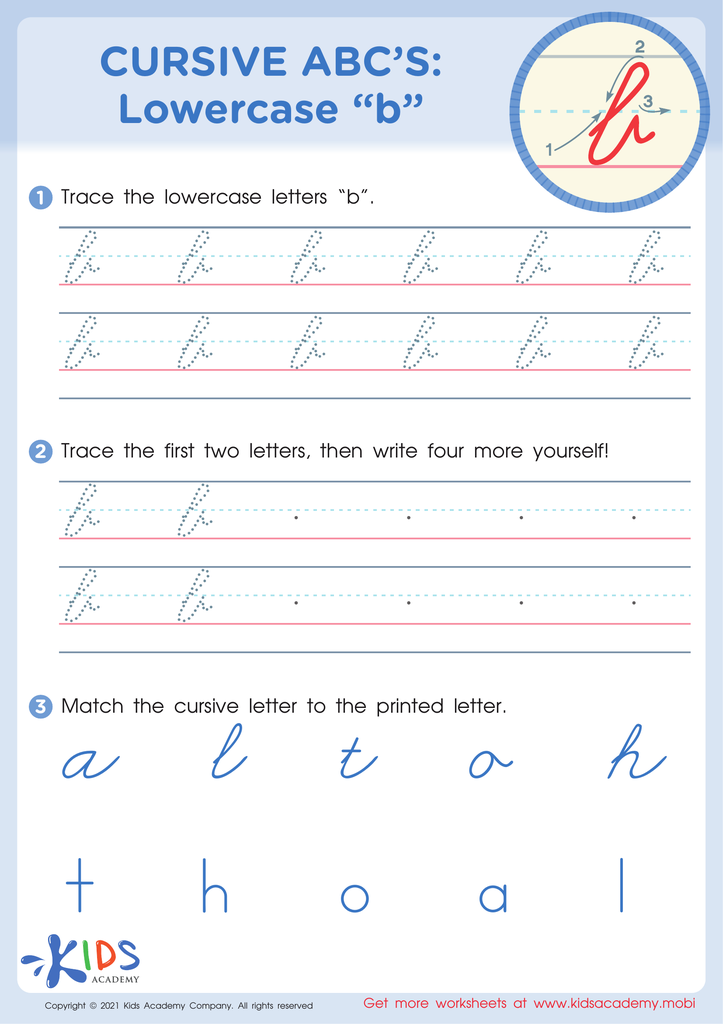
Trace two lines of lowercase b's with your kids. Guide them through the loops and swirls to help them learn cursive handwriting. Then let them practice writing the letter b themselves in the last two lines. With this exercise, your kids should become better at writing and recognizing the lowercase cursive b.
Cursive ABCs: Lowercase b
Worksheet


Fine motor skills development, particularly through the practice of cursive writing, is crucial for children aged 3-8. Parents and teachers should emphasize this because it directly supports essential cognitive and physical growth. Fine motor skills involve the coordination of small muscle movements, which are refined through activities like gripping a pencil and forming letters.

Practicing cursive writing enhances hand-eye coordination, dexterity, and precision, which are foundational for various daily tasks such as buttoning clothes or using utensils. These incremental skills contribute to a child's independence and self-esteem. Additionally, learning cursive stimulates neurological pathways associated with memory and cognitive flexibility, supporting academic skills like reading and comprehension.

Cursive writing acts as a multi-sensory activity, encouraging children to consider rhythm, flow, and spatial relationships between letters. This can improve their ability to process and synthesize visual and motor information more efficiently. Moreover, the skill requires sustained attention and patience, fostering better concentration and perseverance.

In conclusion, integrating cursive writing into early education is not merely about penmanship; it's a holistic developmental tool. By prioritizing it, parents and teachers nurture a child's fine motor coordination, cognitive development, and long-term academic success. Enabling young children to practice cursive lays down a foundation for well-rounded growth and readiness for future learning challenges.