
Basic measurement skills Worksheets for Ages 3-9
4 filtered results
Difficulty Level
Grade
Age
-
From - To
Subject
Activity
Standards
Discover our comprehensive collection of Basic Measurement Skills Worksheets for children ages 3-9 at Kids Academy. Tailored to accommodate young learners, these printables make understanding concepts of length, weight, and volume both engaging and fun. Through interactive activities and colorful images, children will develop crucial early math skills and an intuitive grasp of measurement that is critical for their academic success. These worksheets are perfect for classroom use or home practice, helping kids confidently measure, compare, and analyze objects in their surroundings. Encourage curiosity and support your child's learning journey with our expertly designed measurement worksheets!
Favorites
With answer key
Interactive
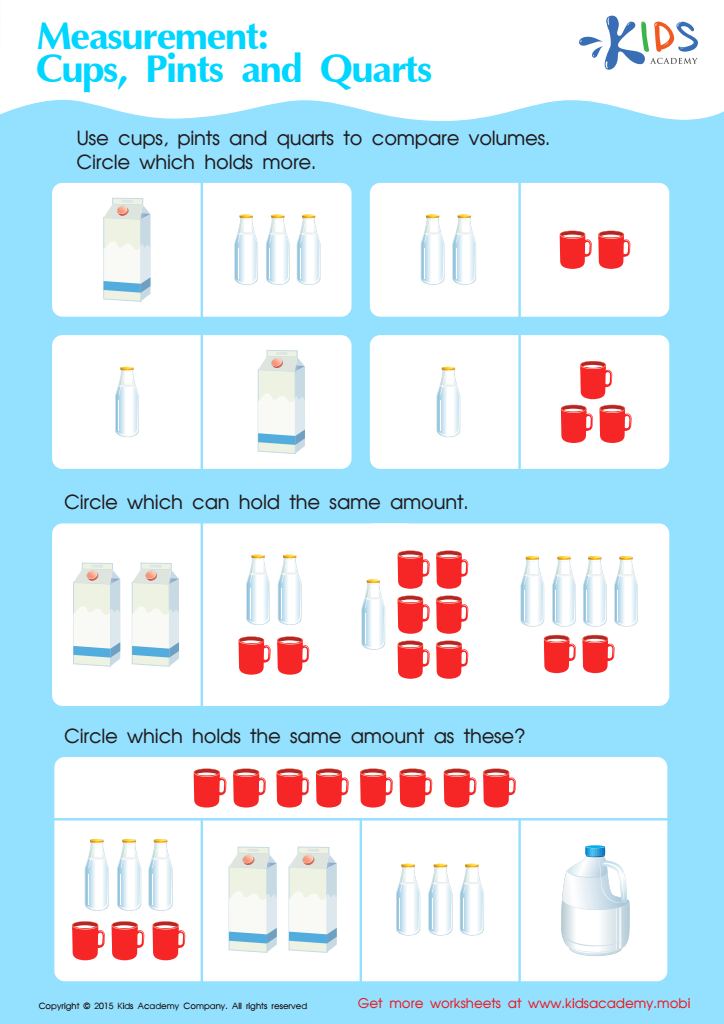
Measurement: Compare Volumes Worksheet
Compare volumes with Kids Academy and have fun! (80 words)
Practice measuring with Kids Academy and have fun! Compare volumes in pictures and circle which holds more. Keep learning with free math worksheets available on our website. Enjoy the process and have fun!
 Assign to My Students
Measurement: Compare Volumes Worksheet
Worksheet
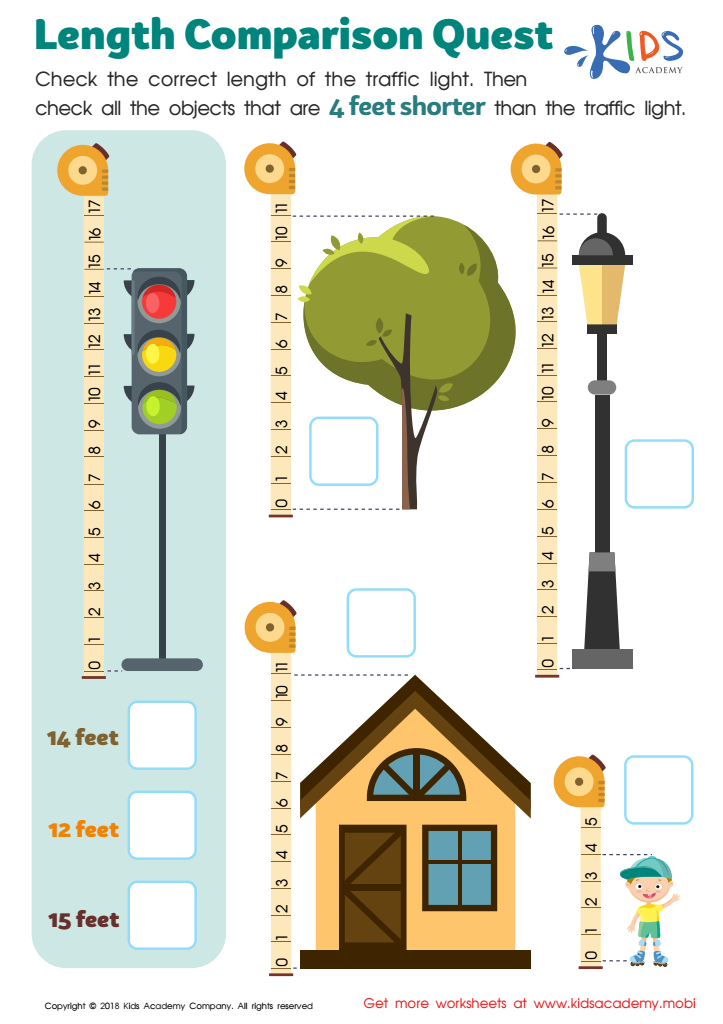
Length Comparison Quest Worksheet
Knowing measurement tools and how to use them is just the start. To be proficient, your kid must be able to accurately compare objects and their lengths. With the 'Length Comparison Quest' worksheet, they will check the correct length of the traffic light in the picture and then compare other objects to it, marking those that measure 4 feet shorter.
Length Comparison Quest Worksheet
Worksheet
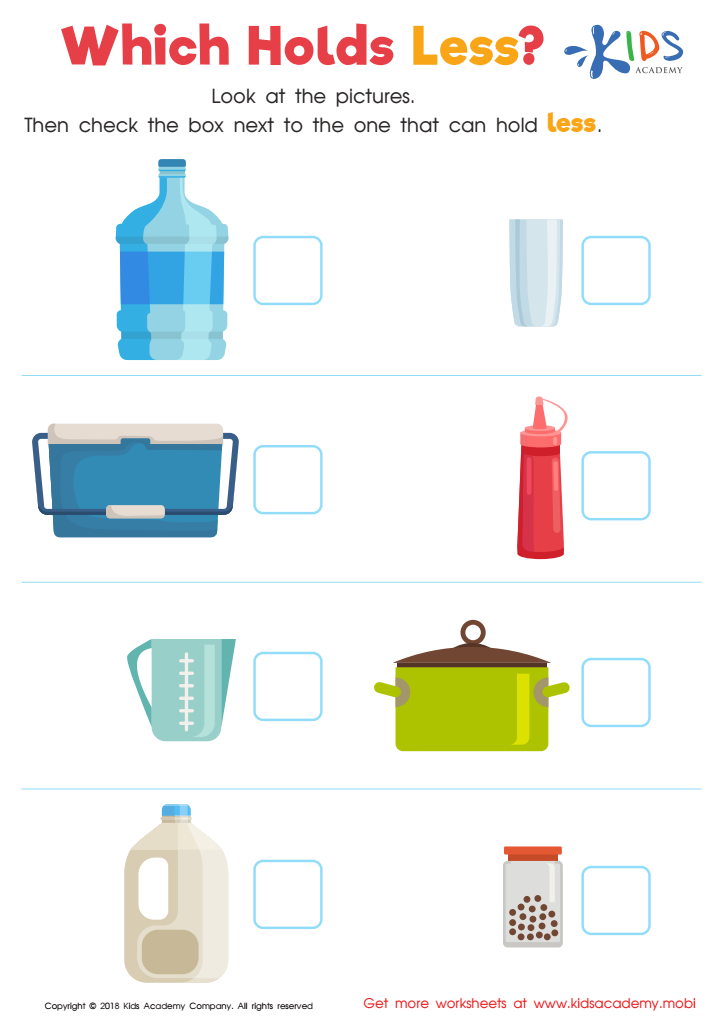
Which Holds Less? Worksheet
Students may find it hard to grasp volume without a visual aid. This free, downloadable worksheet helps with understanding by providing pictures of familiar objects. It allows students to practice comparing volumes and deciding which container holds less. It's a great introduction before they move onto using greater than and less than symbols.
Which Holds Less? Worksheet
Worksheet
Join Kids Academy for Free
Who is primarily going to use this learning content?







Basic measurement skills are foundational for young children's intellectual and practical development. For children between the ages of 3 and 9, understanding measurements helps build a concrete sense of the world around them. These skills go beyond academics; they are essential life skills that children use daily, such as measuring ingredients for a recipe, understanding the concept of time when waiting for a school bus, and judging the amount of space needed for their toys.
From an educational perspective, measurement is a key component of math curriculums. It connects to other math concepts such as numbers, addition, subtraction, and geometry. Understanding and using measurements accurately can improve a child's ability to reason, make comparisons, and solve problems. For example, learning how to measure length, width, height, and volume can enhance their spatial awareness and their ability to make sense of patterns and sequences.
Moreover, integrating measurement into everyday activities nurtures curiosity and a sense of independence in children. Whether they are playing with building blocks or helping in the kitchen, these tasks become opportunities for learning and practical applications of measurement. Consequently, these early experiences lay a strong foundation for more complex scientific and mathematical concepts later on, fostering well-rounded cognitive development. Thus, parents and teachers should prioritize teaching basic measurement skills to prepare children for future academic success and everyday functioning.








