Compare fractions Worksheets for Ages 3-9
6 filtered results
-
From - To
Discover engaging "Compare Fractions Worksheets" specially designed for children aged 3 to 9! Our worksheets help young learners grasp the concept of comparing fractions through fun and interactive activities. With vibrant illustrations and age-appropriate exercises, these resources nurture early mathematical skills and reinforce fraction understanding. Kids will enjoy comparing shapes, sizes, and quantities while developing critical thinking and problem-solving abilities. Perfect for classroom use or at-home practice, these worksheets make learning about fractions enjoyable and effective. Explore our collection and watch your child's confidence in math soar as they master comparing fractions with ease!
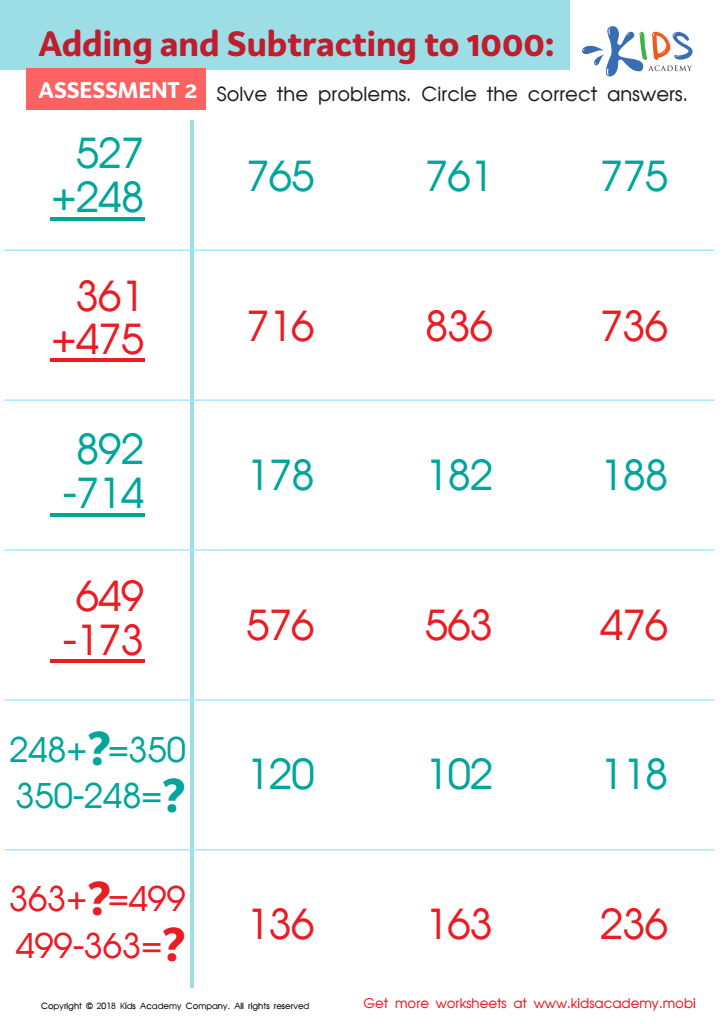
Adding and Subtracting to 1 Worksheet: Assessment 2
 Assign to My Students







Understanding how to compare fractions is crucial for children's mathematical development, especially for those aged 3 to 9. At this age, children are forming foundational concepts in mathematics that will support their future learning. Comparing fractions involves not just numbers, but also critical thinking and number sense, shaping how they approach various mathematical tasks.
Parents and teachers should prioritize this skill as it enhances children’s ability to make informed decisions in everyday situations, such as cooking or sharing their favorite toys—concepts that resonate well within their experiences. When children learn to recognize which fraction is larger, they are not merely memorizing rules; they are developing an understanding of proportions, relationships, and problem-solving strategies.
Additionally, engaging with fractions builds confidence in children’s math skills, making them more adept in tackling more complex topics later in their education, like decimals, percentages, and algebra. Furthermore, fostering this understanding at a young age creates a stronger mathematical foundation, ensuring children are better prepared for standardized testing and academic advancement. Simple activities involving real-life applications can make this learning fun and engaging, creating positive associations with math that can last a lifetime.








