
Identify colors Worksheets for Ages 3-9
4 filtered results
Difficulty Level
Grade
Age
-
From - To
Subject
Activity
Standards
Discover engaging and educational "Identify Colors" worksheets for children aged 3-9 at Kids Academy! Our unique collection of printable worksheets helps young learners recognize, match, and name colors through interactive activities. Perfect for preschool to Grade 3, these expertly designed sheets enhance visual skills, boost cognitive development, and make learning fun. Featuring vibrant illustrations and simple instructions, our worksheets are ideal for classroom use, homeschooling, or extra practice at home. Download now to give your child a colorful learning experience with Kids Academy – where education and creativity blend seamlessly!
Favorites
With answer key
Interactive
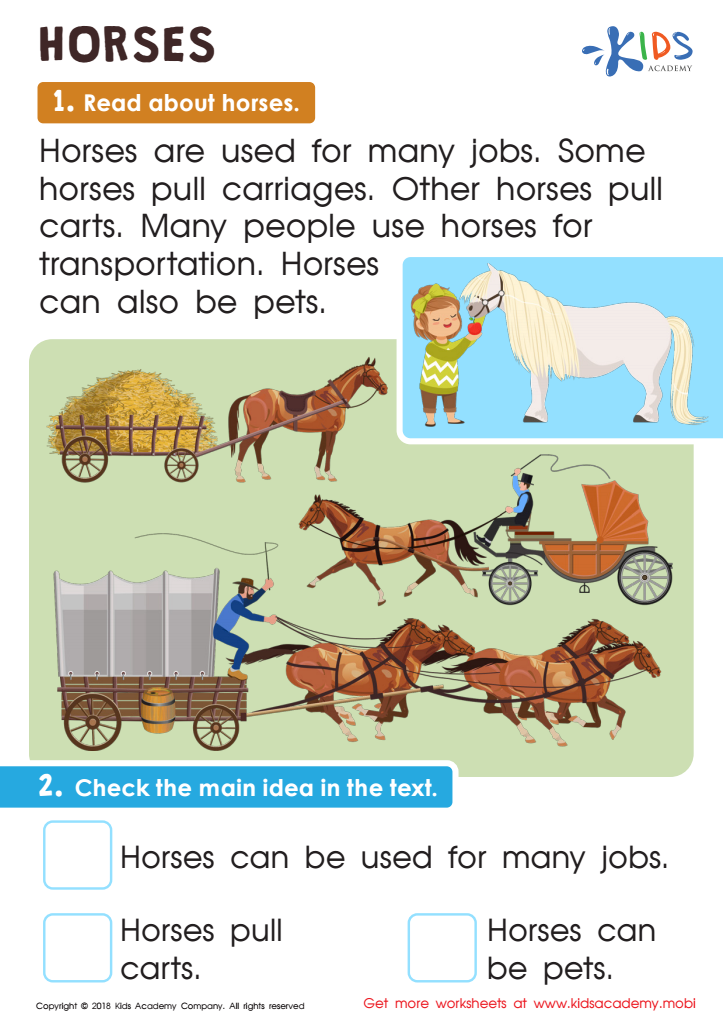
Horses Worksheet
Help your little reader differentiate between details and the main idea with this fun worksheet about horses. Kids will be excited to learn about the different roles horses play. To ensure they understand the overall concept, discuss it before having them choose the right statement at the end.
 Assign to My Students
Horses Worksheet
Worksheet
Join Kids Academy for Free
Who is primarily going to use this learning content?





.jpg)
Understanding and identifying colors is a critical developmental milestone for children ages 3-9, and parents and teachers should place importance on this for several reasons. Firstly, color recognition contributes to cognitive development. It helps children classify and categorize the world around them, providing a foundation for critical thinking and problem-solving skills. For example, being able to distinguish a ripe red apple from an unripe green one can be seen as an early form of sorting and classification.
Additionally, learning colors enhances language development. As children learn color names, they also expand their vocabulary and language abilities. Describing objects using color helps children to express themselves more clearly and enriches their communication skills.
Recognizing colors also plays a role in developing creativity and social skills. Engaging in activities that involve color, such as coloring books, painting, or identifying colors during play, stimulates imagination and artistic expression. This can lead to improved dexterity and hand-eye coordination as well.
Lastly, being able to identify colors has practical everyday applications, such as reading signs, following instructions, and choosing appropriate clothing. Overall, color recognition is not just about learning hues but also about supporting comprehensive cognitive, linguistic, and social development. Understanding this, parents and teachers should thoughtfully incorporate color-related activities into educational and daily routines.








