Mental math development Worksheets for Ages 3-9
3 filtered results
-
From - To
Discover our engaging Mental Math Development Worksheets designed for children ages 3-9! These worksheets foster essential arithmetic skills through fun and interactive activities tailored to young learners. Perfect for enhancing addition, subtraction, and problem-solving abilities, our resources promote critical thinking and boost confidence in math. Ideal for both classroom settings and home practice, each worksheet is crafted to align with developmental milestones, ensuring children build a strong mathematical foundation. Let your little ones explore the world of numbers in an enjoyable and supportive way. Unlock their potential in mental math and give them the tools they need for future success!
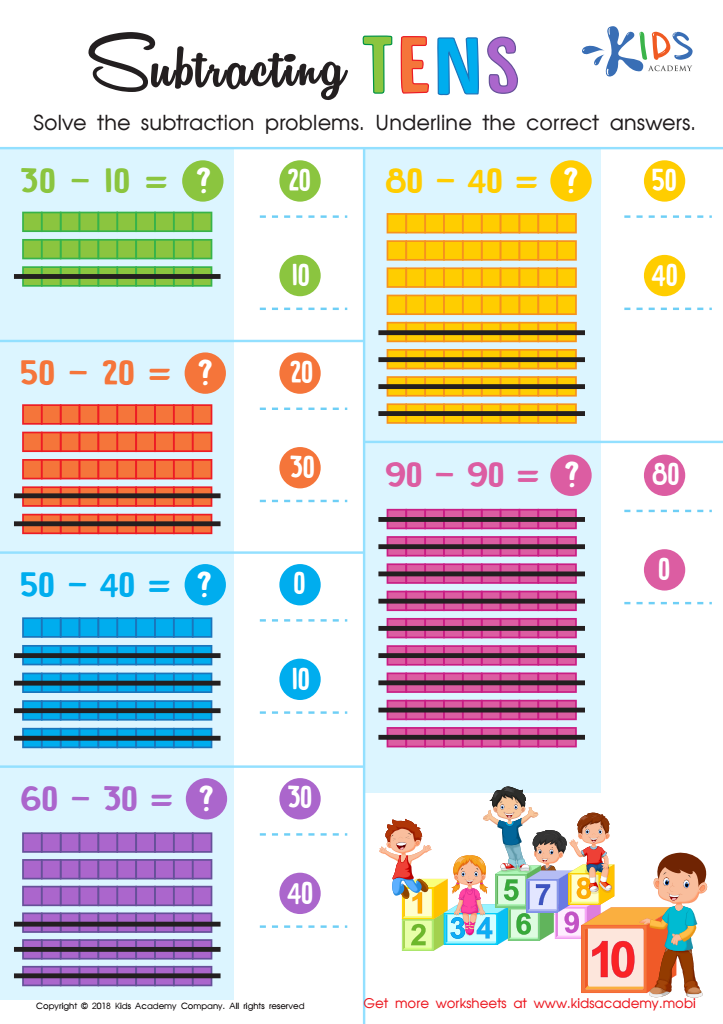
Subtracting Tens Worksheet
 Assign to My Students






Mental math development in children aged 3-9 is crucial because it lays the foundation for their mathematical understanding and critical thinking skills. During these formative years, a child's brain is highly receptive to learning, making early exposure to concepts like addition, subtraction, and number patterns essential. Mastering mental math promotes cognitive flexibility, helping children to visualize problems and apply reasoning without relying strictly on paper and pencil.
Furthermore, strong mental math skills can boost children’s confidence in their abilities. When children can perform calculations in their heads, they become more engaged in math-related activities and are less likely to develop math anxiety. This engagement is vital, as a positive relationship with math in early childhood correlates to success in later schooling.
Teachers and parents should foster mental math through fun, interactive activities, such as games involving counting, puzzles, and everyday problem-solving scenarios. Encouraging mental math not only amalgamates academic learning but also nurtures essential skills such as perseverance, creativity, and logical reasoning. By prioritizing mental math, parents and educators empower children to think critically and become adept problem-solvers, essential tools for lifelong learning and success in an increasingly complex world.








