
Understand number sequencing Worksheets for Ages 3-9
3 filtered results
Difficulty Level
Grade
Age
-
From - To
Subject
Activity
Standards
Discover our engaging "Understand Number Sequencing Worksheets" designed for children ages 3-9! These printable resources help young learners develop essential counting skills and understand number patterns through interactive activities. Our worksheets feature colorful images and enjoyable exercises that make learning fun, promoting cognitive development and fostering a love for math. Whether you're teaching at home or in the classroom, these worksheets aid in reinforcing number recognition, sequencing, and ordering concepts. Perfect for preschoolers and early graders, our materials support children's academic growth while engaging their creative side. Empower your child’s understanding of numbers today with our expertly crafted worksheets!
Favorites
With answer key
Interactive
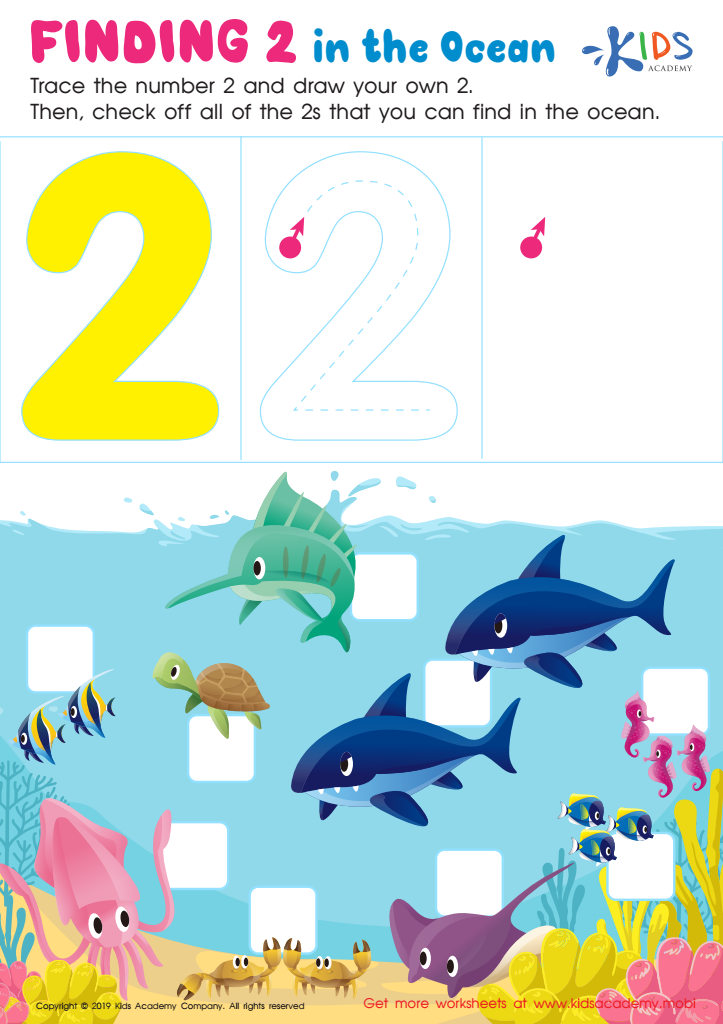
Finding 2: In the Ocean Worksheet
Kids start their math journey with basic numbers. Finger counting, number representation with pictures and this worksheet help build number sense. Kids trace lines and dots to write the number two and identify groups of two sea creatures for easy success and to feel proud of their math skills.
 Assign to My Students
Finding 2: In the Ocean Worksheet
Worksheet
Join Kids Academy for Free
Who is primarily going to use this learning content?





Understanding number sequencing is crucial for children aged 3-9, laying a strong foundation for their mathematical development. Number sequencing involves recognizing and arranging numbers in a specific order, which fosters critical cognitive skills essential for later learning. Parents and teachers should care about this concept for several reasons.
Firstly, mastering number sequences enhances a child’s ability to count, perform basic arithmetic, and comprehend more complex mathematical problems in the future. It helps them understand patterns, which is vital not just in math, but in subjects like science and logic as well.
Secondly, number sequencing contributes to cognitive development and problem-solving skills. By grasping the notion that numbers have a specific order, children learn to organize their thoughts, a skill that extends to various aspects of their lives.
Finally, early mastery of these skills can boost a child's confidence in their academic abilities. A strong grasp of number sequencing can foster a positive attitude towards learning and mathematics, leading to more successful outcomes in education.
In summary, focusing on number sequencing in young children epitomizes early intervention that can cultivate lifelong skills, instill confidence, and enrich educational experiences.








