
Understanding equivalence Worksheets for Ages 3-9
3 filtered results
Difficulty Level
Grade
Age
-
From - To
Subject
Activity
Standards
Explore our "Understanding Equivalence Worksheets" designed for children ages 3-9! These engaging resources help young learners grasp the concept of equivalence through fun, interactive activities. Our worksheets include visual aids, matching exercises, and creative puzzles, reinforcing foundational math skills while keeping learning enjoyable. Ideal for both classroom and home use, these worksheets promote critical thinking and problem-solving abilities. Parents and educators can guide children to identify equal quantities, enhance number sense, and build confidence in their math capabilities. Start your child's journey toward mathematical understanding today with our comprehensive and accessible worksheets that cater to early learners!
Favorites
With answer key
Interactive
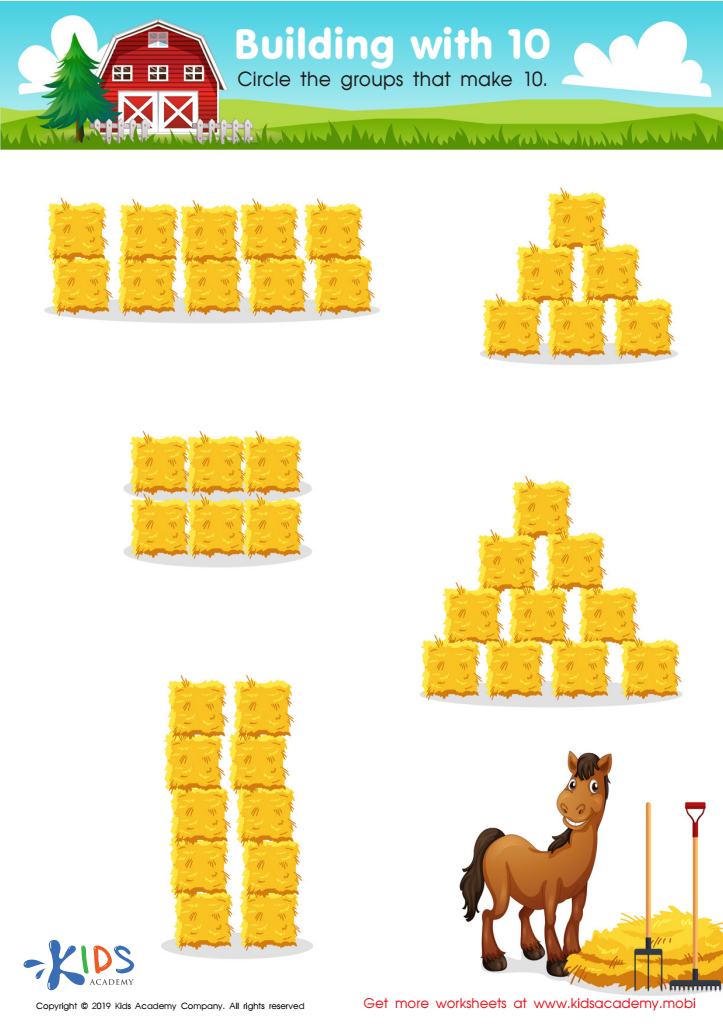
Building with 10 Worksheet
Counting numbers can be simple with this worksheet: Ask your kids to count the stacks of objects, ensure accuracy with your help, then circle the ones of ten. With practice and guidance, your children will soon become counting pros!
 Assign to My Students
Building with 10 Worksheet
Worksheet
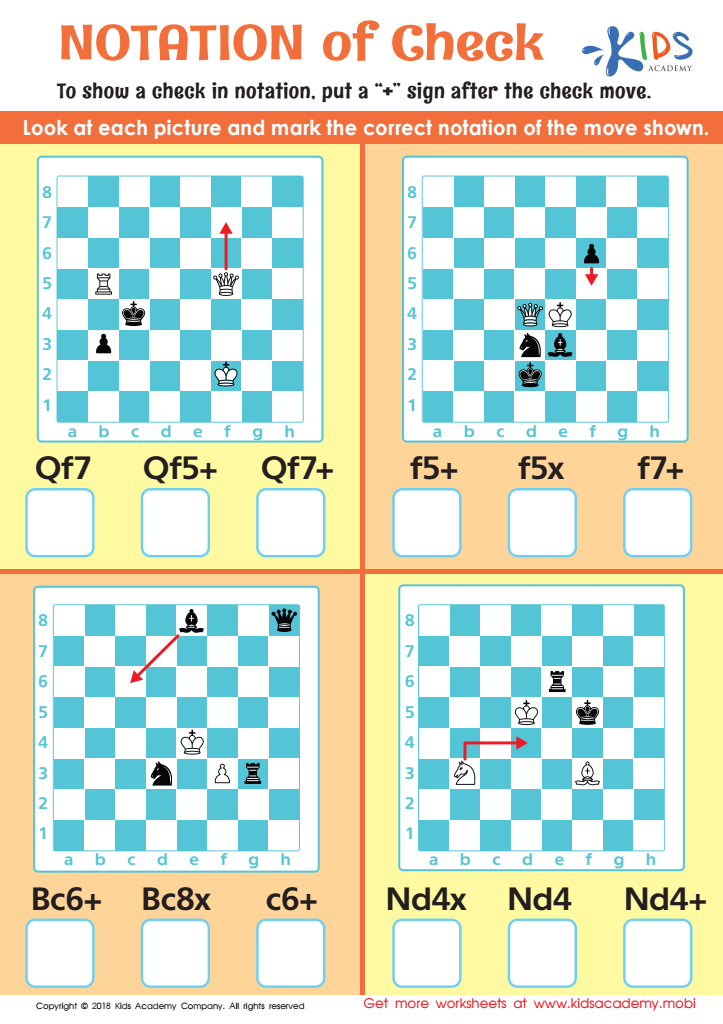
Notation of Check Worksheet
Chess is an addictive game! Once you know the basics of check and checkmate, you'll be hooked! Teach your little one to make check notation with this free PDF worksheet. They can use downloadable practice to look at each picture and mark the correct notation, strengthening their problem-solving skills while they learn to play - and win - this fun game!
Notation of Check Worksheet
Worksheet
Join Kids Academy for Free
Who is primarily going to use this learning content?







Understanding equivalence is a fundamental concept in mathematics, essential for children's cognitive and academic development from ages 3-9. This concept involves recognizing that different quantities can represent the same value, laying the groundwork for more advanced mathematical ideas such as addition, subtraction, multiplication, and division.
For parents and teachers, fostering an understanding of equivalence promotes critical thinking and problem-solving skills. At a young age, children learn to group objects, compare numbers, and develop an intuitive sense of numbers, which not only boosts their confidence but also their mathematical fluency.
Building a strong foundation in equivalence helps prevent future difficulties in math, as children who struggle with basic concepts are often at a disadvantage as they progress to higher grades. Moreover, promoting equivalence encourages connections between various mathematical ideas and real-world applications, making learning relevant and engaging.
By actively emphasizing equivalence through games, hands-on activities, and discussions, adults can cultivate a positive attitude towards mathematics and develop lifelong learners. Understanding equivalence not only supports academic achievement but also empowers children to navigate everyday situations requiring comparison and measurement, underscoring its significance beyond the classroom.








