Understanding quadrilaterals 2D Shapes Worksheets for Ages 3-9
4 filtered results
Difficulty Level
Grade
Age
-
From - To
Subject
Activity
Standards
Explore our engaging “Understanding Quadrilaterals” worksheets designed for children aged 3-9! These colorful, interactive resources help young learners recognize, differentiate, and understand 2D quadrilateral shapes, such as squares, rectangles, trapezoids, and rhombuses. Each worksheet encourages fun hands-on activities promoting shape identification, tracing, and matching exercises. Our thoughtfully created materials aim to build a solid foundation in geometry while sparking curiosity and creativity. Perfect for classrooms or home learning, these worksheets cater to learners at various development levels. Dive into the wonderful world of quadrilaterals and foster essential math skills in your child today with our delightful and educational activities!
Favorites
With answer key
Interactive
Make Quadrilaterals Worksheet
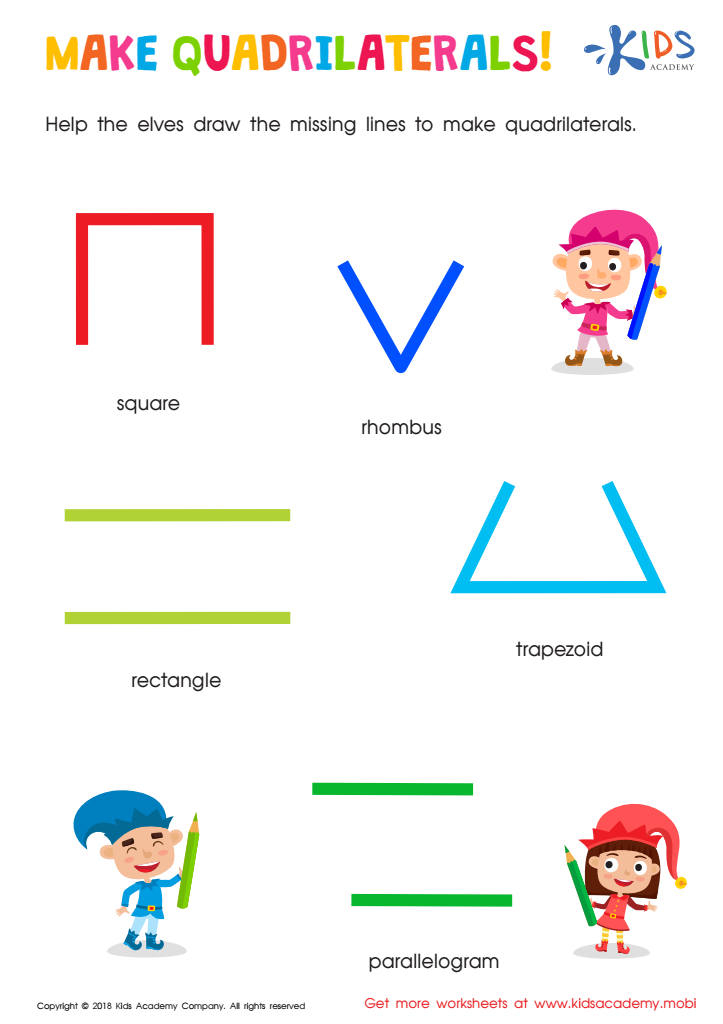
This fun and colorful worksheet will help your child understand and identify quadrilaterals. It's simple and encourages them to draw lines to create a square, rectangle, rhombus, trapezoid, and parallelogram. Stimulate their minds and watch them learn while they have fun!
 Assign to My Students
Make Quadrilaterals Worksheet
Worksheet


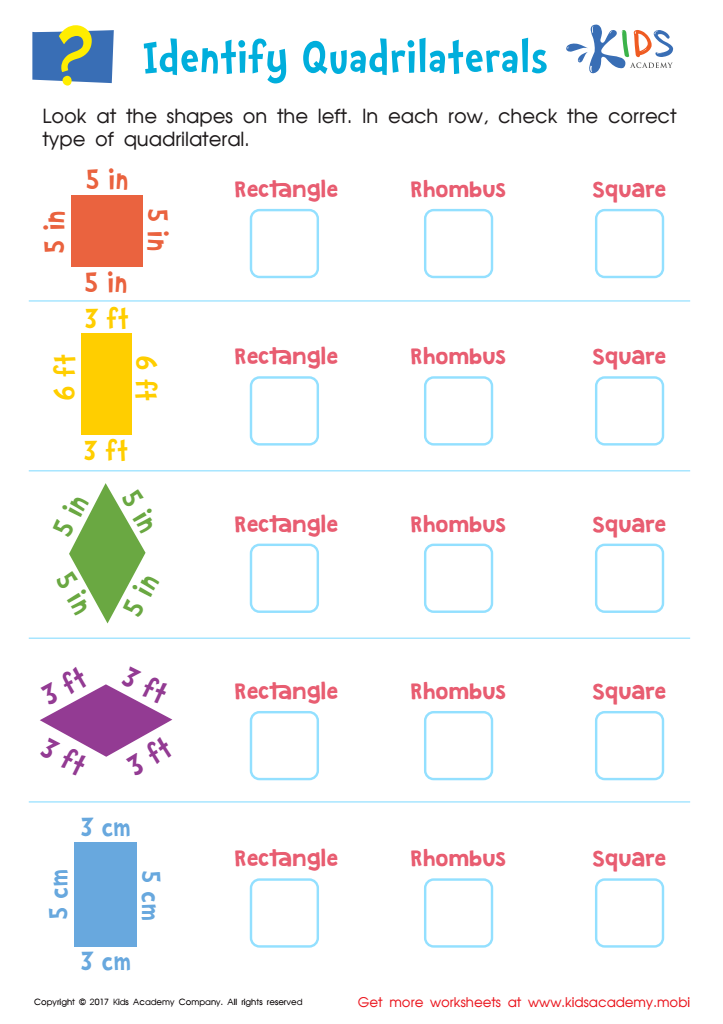
Identify Quadrilaterals Worksheet
This PDF worksheet helps kids identify different quadrilaterals using pictures and measurements. From rectangles to diamonds, children will use their knowledge of geometry to observe and classify shapes. A colorful and fun way to learn!
Identify Quadrilaterals Worksheet
Worksheet
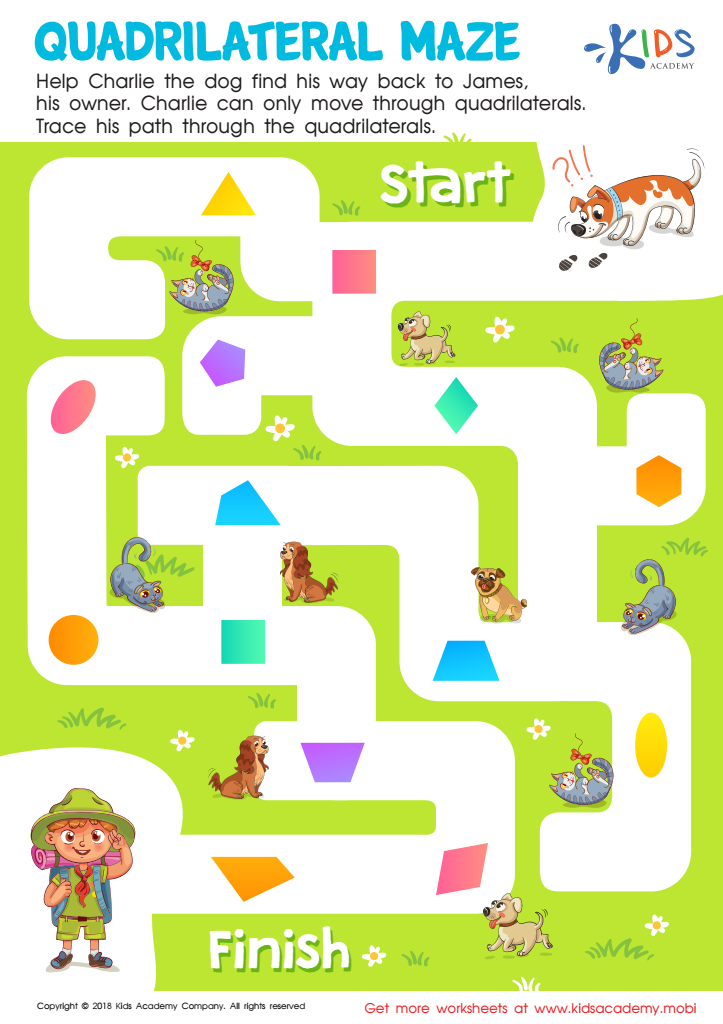
Quadrilateral Maze Worksheet
Does your kid love dogs? If so, this exercise is ideal for them! Help Charlie the pup find his way back to his owner, James, in the quadrilateral maze worksheet. Your child must trace Charlie's path only through squares and rhombuses in order to solve it. Careful planning is key!
Quadrilateral Maze Worksheet
Worksheet
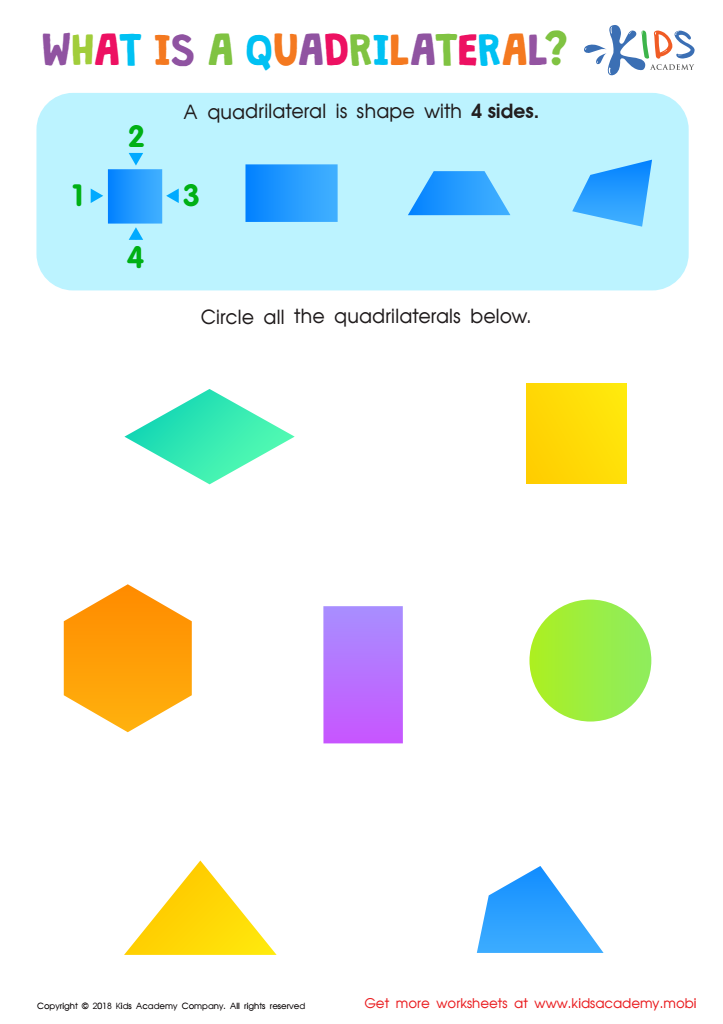
What Is a Quadrilateral? Worksheet
Does your kid know what a quadrilateral is? If not, this worksheet can help teach them. Explain that a quadrilateral is a shape with four sides and give examples, like a square or a rectangle. Then ask them to circle the quadrilaterals in the pictures. If they already know what a quadrilateral is, this task might be too easy.
What Is a Quadrilateral? Worksheet
Worksheet
Join Kids Academy for Free
Who is primarily going to use this learning content?








Understanding quadrilaterals and other 2D shapes is vital for children aged 3-9, as it lays the foundation for their mathematical skills and cognitive development. At this age, children are naturally curious and eager to explore the world around them. By introducing them to shapes, particularly quadrilaterals—like squares, rectangles, and trapezoids—they not only learn to identify and classify these figures but also develop critical thinking skills.
Learning about shapes enhances spatial awareness, helping children visualize and understand their environment more efficiently. This knowledge supports a plethora of future academic disciplines, including geometry, science, art, and everyday problem-solving. Teachers and parents can engage children in interactive activities that promote shape recognition, such as games, puzzles, and hands-on projects, fostering an engaging and playful learning atmosphere.
Moreover, understanding shapes promotes language skills as children learn to articulate their thoughts about geometry. Recognizing and naming shapes assists in improving their vocabulary and communication abilities. Hence, investing time in the understanding of quadrilaterals is not merely an academic exercise; it's an essential aspect of holistic development that influences children's confidence and capacity for critical thinking well beyond their early years.