
Mental math development Addition & Subtraction Worksheets for Ages 3-9
3 filtered results
Difficulty Level
Grade
Age
-
From - To
Subject
Activity
Standards
Unlock your child’s math potential with our Mental Math Development Addition & Subtraction Worksheets, designed for ages 3-9! These engaging worksheets help young learners build a strong foundation in basic math concepts through fun and interactive exercises. Tailored to enhance mental calculation skills, they encourage children to think critically and solve problems quickly, boosting their confidence in mathematics. Each worksheet offers a variety of challenges that cater to different skill levels, promoting independent thinking and mental agility. Foster a love for numbers and improve computation speed with our expertly crafted resources—perfect for home or classroom practice! Start your child’s math journey today!
Favorites
With answer key
Interactive
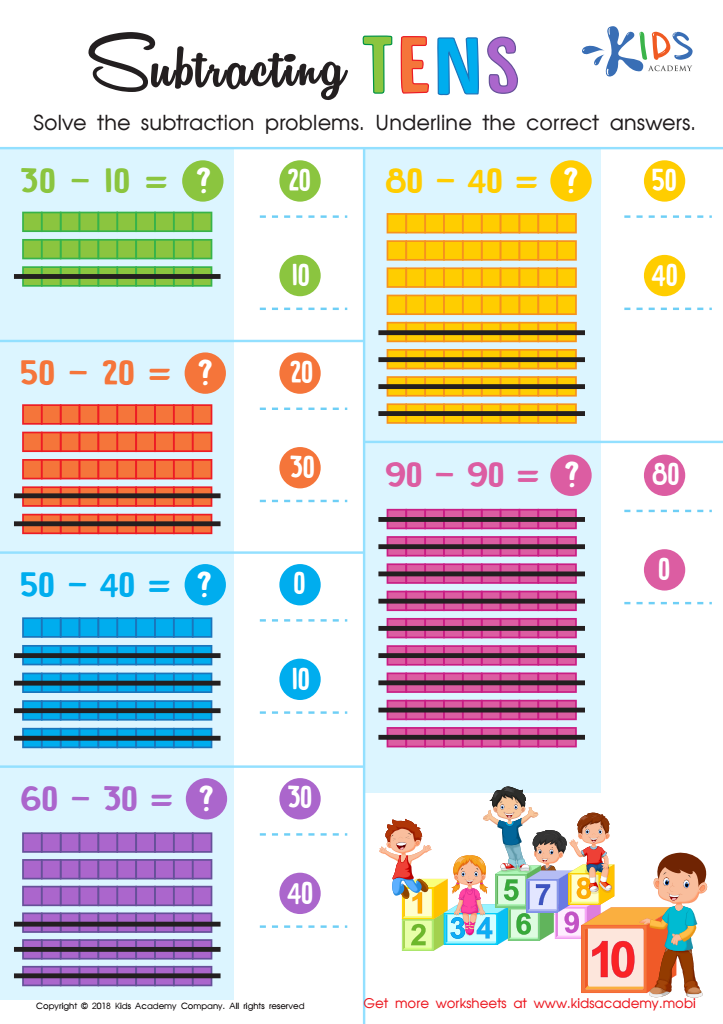
Subtracting Tens Worksheet
Base ten blocks enable kids to make practical math connections and develop number sense. This free worksheet, using bright-colored tens blocks, helps children learn to skip count and subtract. It lays a strong foundation for upcoming higher level math problems.
 Assign to My Students
Subtracting Tens Worksheet
Worksheet
Join Kids Academy for Free
Who is primarily going to use this learning content?








Mental math development in addition and subtraction for children aged 3-9 is crucial for several reasons. Firstly, it builds a strong foundation for more complex mathematical concepts. Mastering basic operations enhances children's numerical fluency, enabling them to solve problems quickly and efficiently without the reliance on calculators or written methods. This independence fosters confidence and a proactive attitude toward learning.
Moreover, mental math supports cognitive development, stimulating critical thinking and enhancing memory skills. Engaging children in mental calculations encourages them to explore number relationships and develop estimating skills, preparing them for real-world applications of math.
Additionally, incorporating mental math strategies can make learning enjoyable. Fun games and activities promote a positive attitude toward mathematics, leading to increased engagement. When parents or teachers invest time in nurturing mental math abilities, they help children develop resilience and persistence, essential skills for long-term academic success.
Lastly, fostering numeracy skills at an early age can impact overall academic performance, as confident math learners are more likely to succeed across various subjects. By prioritizing mental math, adults can equip children with essential tools for their educational journey and everyday life.








