Solve word problems Addition & Subtraction Worksheets for Ages 3-9
3 filtered results
-
From - To
Discover our collection of engaging worksheets designed specifically to help kids aged 3-9 develop their addition and subtraction skills through solving word problems. Each workbook is carefully crafted to make learning fun and interactive, with a variety of themes and illustrations that capture children's attention. Our worksheets aim to enhance critical thinking and problem-solving abilities while ensuring the foundational math concepts are thoroughly understood. Suitable for use in classrooms or at home, these worksheets are perfect for parents and teachers looking to reinforce math skills in a meaningful and effective way. Start boosting your child's math proficiency today!
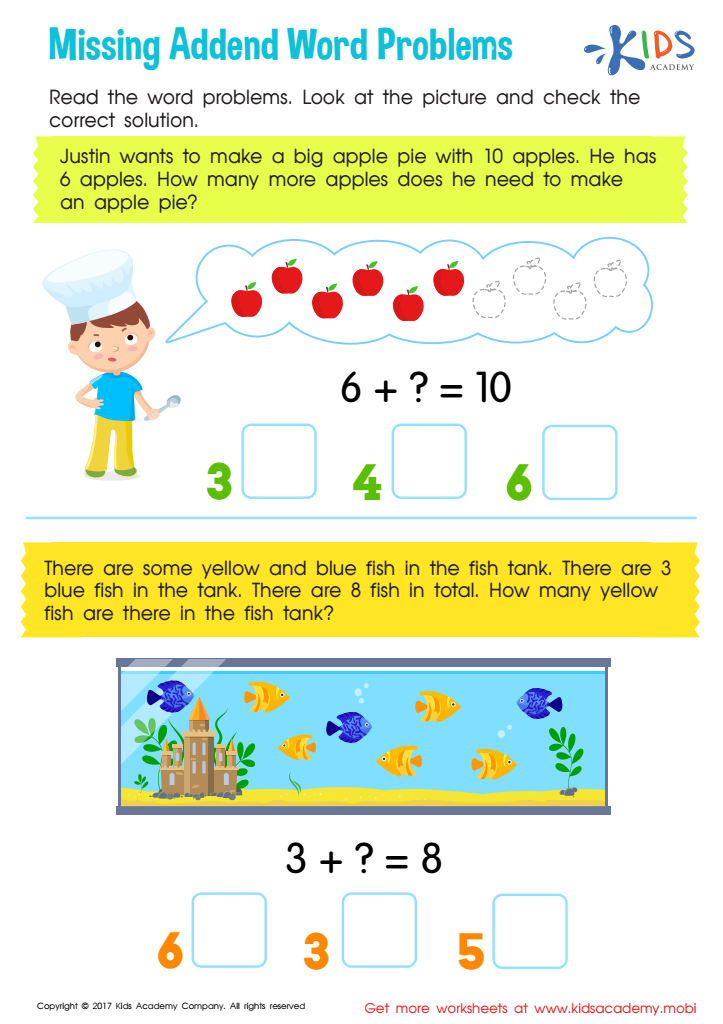
Missing Addend Word Problems Worksheet
 Assign to My Students








Introducing and practicing addition and subtraction word problems for ages 3-9 is essential for several key reasons. First, these foundational math skills are the building blocks for all future mathematical learning. They help children understand more complex concepts as they grow older. Secondly, word problems move beyond simple arithmetic by situating math in real-world contexts, enhancing critical thinking and problem-solving skills.
When children work on word problems, they learn to break down a scenario, identify relevant information, and determine the steps needed to reach a solution. This process fosters analytical thinking and logical reasoning, crucial skills not just for math but across all subjects and in everyday life.
Moreover, word problems enhance reading comprehension and language skills. Solving these problems requires students to read carefully, understand, and process information accurately to construct meaningful solutions. This dual benefit—improvement in both math and literacy—forms a robust educational foundation.
Lastly, engaging with word problems can boost a child's confidence. Successfully solving problems nurtures a sense of achievement and encourages a positive attitude towards math. This positive relationship with math can significantly influence academic success and instill a love for learning early on. In summary, focusing on addition and subtraction word problems equips children with essential cognitive tools, promotes interdisciplinary development, and builds confidence.








