Understanding number bonds Addition & Subtraction Worksheets for Ages 3-9
3 filtered results
-
From - To
Explore our engaging Understanding Number Bonds Addition & Subtraction Worksheets, designed for children aged 3-9. These interactive resources simplify fundamental math concepts by introducing number bonds, helping young learners grasp the relationships between numbers. Our worksheets provide a variety of fun activities that enhance addition and subtraction skills through visual aids and practical exercises. Ideal for both classroom and home settings, they encourage independent learning while building confidence in early math. With a focus on foundational skills, our worksheets aim to make learning enjoyable and effective, setting the stage for future mathematical success. Discover the joy of understanding number bonds today!
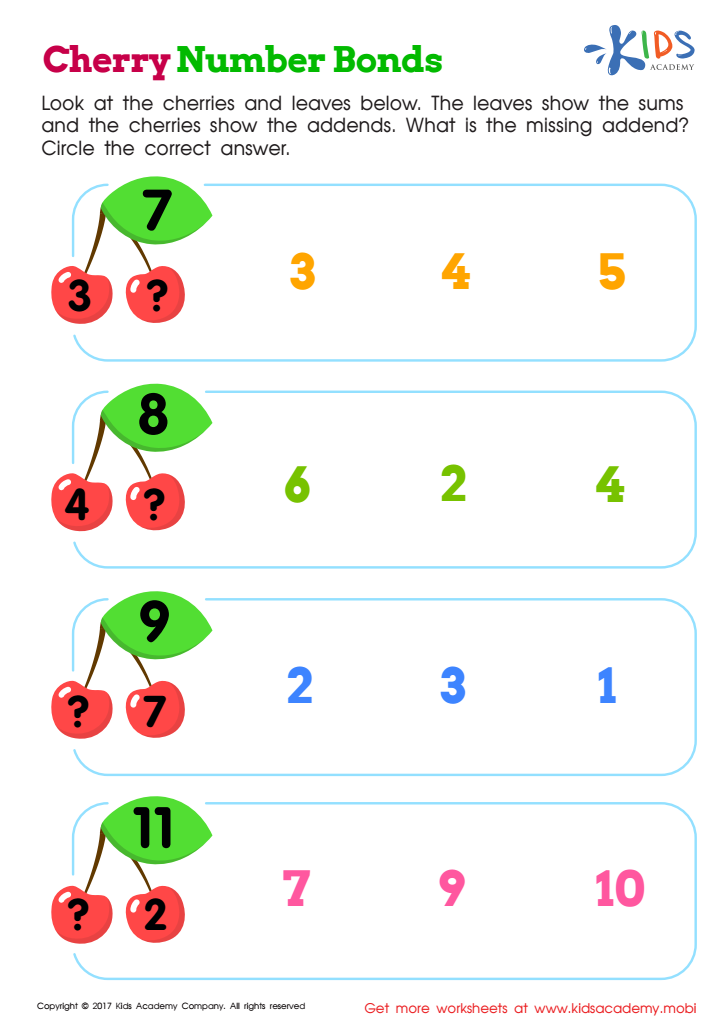
Cherry Number Bonds Worksheet
 Assign to My Students
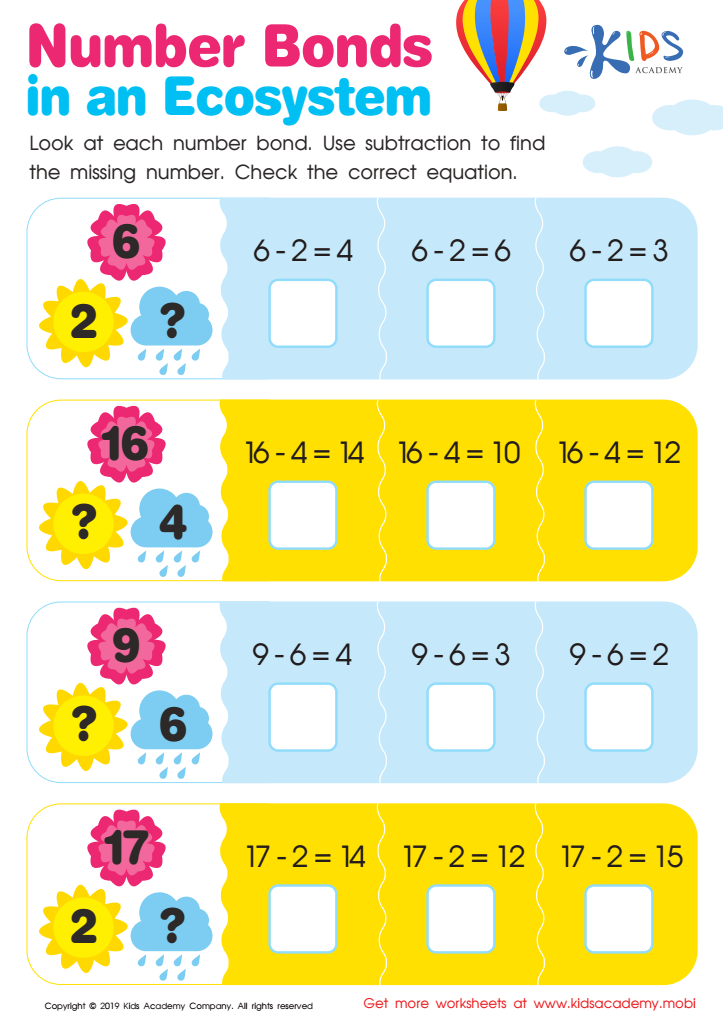
Number Bonds in an Ecosystem Worksheet








Understanding number bonds is crucial for children aged 3-9 as it lays the foundation for their mathematical skills and problem-solving abilities. Number bonds represent the relationship between numbers, showing how they combine to form a whole. For example, the number bond for 5 can be represented as 2 + 3 or 4 + 1. This understanding helps children grasp addition and subtraction concepts more intuitively.
Parents and teachers should care because this foundational knowledge enhances children's confidence and builds a positive attitude towards math. Mastery of number bonds allows children to perform calculations mentally, breaking down tougher problems into manageable parts. This skill fosters flexibility in thinking and aids in understanding larger mathematical concepts, such as algebra and arithmetic.
Additionally, early proficiency in number bonds sets the stage for future academic success and can lead to better performance in standardized tests. Engaging in activities that explore number bonds—like games and hands-on exercises—can make learning enjoyable. By prioritizing this understanding, parents and teachers support holistic development in cooperative learning environments, fostering a curious mindset that thrives on exploring numbers and relationships as children advance through their cognitive stages.








