
Observational skills Addition Worksheets for Ages 3-9
5 filtered results
Difficulty Level
Grade
Age
-
From - To
Subject
Activity
Standards
Enhance your child's mathematical abilities with our Observational Skills Addition Worksheets, designed for ages 3-9. These engaging and educational worksheets aim to boost young learners' addition skills while honing their observational capabilities. Each activity employs vibrant illustrations and captivating exercises that encourage kids to identify patterns, spot differences, and make connections. This dual approach not only strengthens their math foundation but also improves critical thinking and attention to detail. Ideal for both classroom and home use, these worksheets provide an enjoyable learning experience that will foster your child's confidence and love for maths.
Favorites
With answer key
Interactive
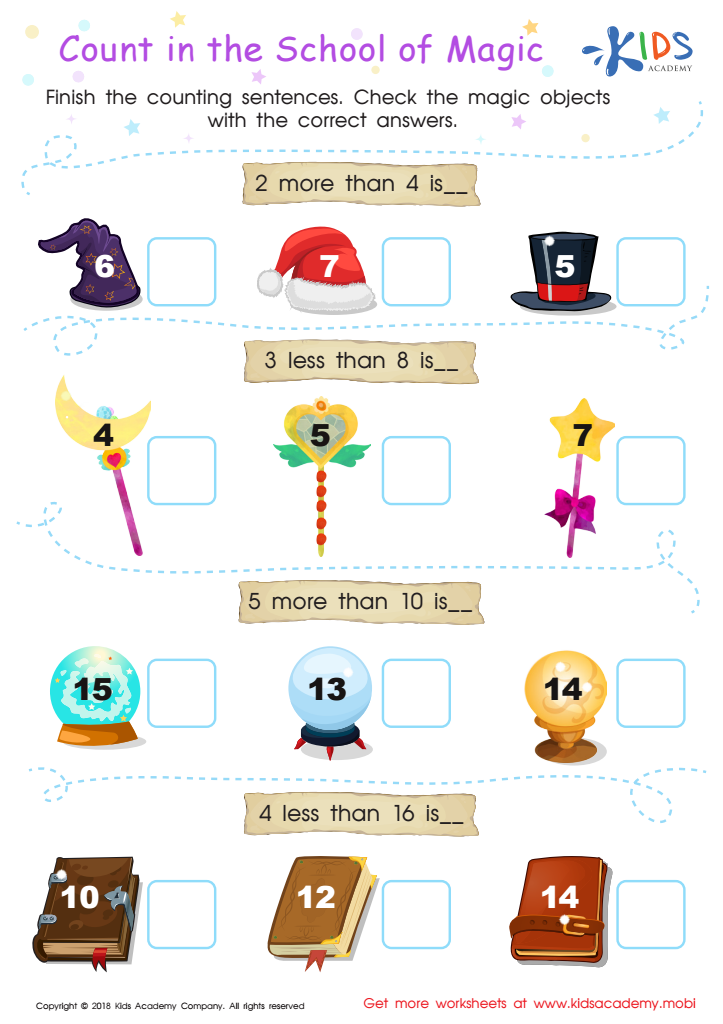
Count in the School of Magic Worksheet
Your math learners can explore the School of Magic with this worksheet. They'll read equations with addition and subtraction numbers under 20, count back and forth to find the answer, then complete the counting sentences. Fun pictures and easy accuracy make it an enjoyable and successful learning experience.
 Assign to My Students
Count in the School of Magic Worksheet
Worksheet
Join Kids Academy for Free
Who is primarily going to use this learning content?








Observational skills are crucial for young children ages 3-9 as they form the foundation for cognitive development and learning. These skills involve the ability to notice, analyze, and interpret the world around them. Parents and teachers play a pivotal role in nurturing this ability which can lead to numerous educational and personal benefits.
Encouraging observational skills helps children become more aware of their surroundings, which enhances their understanding of various concepts in science, mathematics, and literacy. For example, through observing nature, children can learn about life cycles, weather changes, and animal behaviors, thereby fostering curiosity and a love for learning.
Observational skills also stimulate critical thinking and problem-solving. By noticing details and patterns, children develop the ability to make connections, predictions, and informed decisions.
Moreover, strong observational skills can aid social development. By observing social cues like facial expressions and body language, children learn to empathize and communicate effectively with peers and adults.
Teachers and parents should integrate activities such as nature walks, picture books, and hands-on experiments into curriculum and playtime to strengthen these abilities. Investing effort in nurturing observational skills during these formative years paves the way for children to become keen learners, thoughtful analysts, and effective communicators in their future academic and everyday life.








