Building vocabulary Math Worksheets for Ages 3-9
3 filtered results
-
From - To
Discover our engaging Building Vocabulary Math Worksheets designed specifically for children aged 3-9! These fun, interactive resources seamlessly combine math concepts with vocabulary development, helping young learners enhance their language skills while mastering essential mathematical ideas. Each worksheet is tailored to support early childhood education, encouraging children to explore numbers, patterns, and operations through words. With a variety of activities that promote critical thinking and creativity, our worksheets are perfect for home or classroom use. Foster a love for learning and enable your child to communicate their math knowledge effectively. Boost your child's confidence and vocabulary today! Explore our collection now!
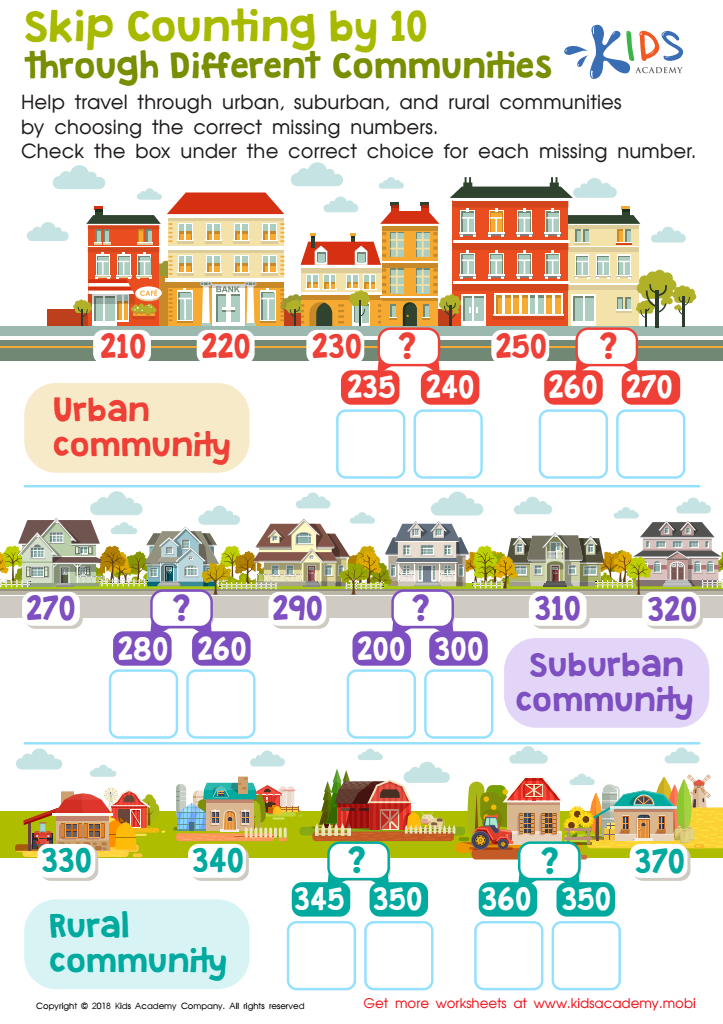
Skip Counting by 10 through Different Communities Worksheet
 Assign to My Students







Building vocabulary in mathematics for children aged 3-9 is crucial for their overall cognitive development and future academic success. Language plays a significant role in how children understand and engage with mathematical concepts. By expanding math-related vocabulary, children can better articulate their thoughts, comprehend complex problems, and communicate their reasoning effectively.
For parents and teachers, developing math vocabulary helps foster a strong foundational understanding of numbers, shapes, measurements, and relationships. For instance, children who can confidently use terms like "addition," "subtraction," "greater than," and "equal" develop a clearer understanding of operations and problem-solving methods, which can enhance their confidence and interest in math.
Moreover, when children can express their ideas using appropriate vocabulary, it encourages deeper thinking and fosters a growth mindset, allowing them to tackle challenges more readily. Furthermore, a strong vocabulary in math helps bridge the gap between spoken and written language skills, empowering children to articulate their understanding in both forms.
Ultimately, investing time in building math vocabulary during these formative years sets the stage for lifelong learning and an appreciation for mathematics, which is essential in our increasingly numeracy-focused world.








