
Counting money Math Worksheets for Ages 3-9
3 filtered results
Difficulty Level
Grade
Age
-
From - To
Subject
Activity
Standards
Enhance your child's financial acuity early with our engaging Counting Money Math Worksheets designed for ages 3-9. Focused on real-world skills, these printable worksheets help kids recognize coins, understand values, and develop arithmetic abilities through interactive and fun activities. With a wide range of age-appropriate exercises, children will practice counting pennies, nickels, dimes, and quarters, and even tackle mock purchases. Inspire confidence and foundational math prowess as your young learner journeys from basic counting to making change. Perfect for home or classroom use, these worksheets provide essential life skills for the future. Start their financial education today!
Favorites
With answer key
Interactive
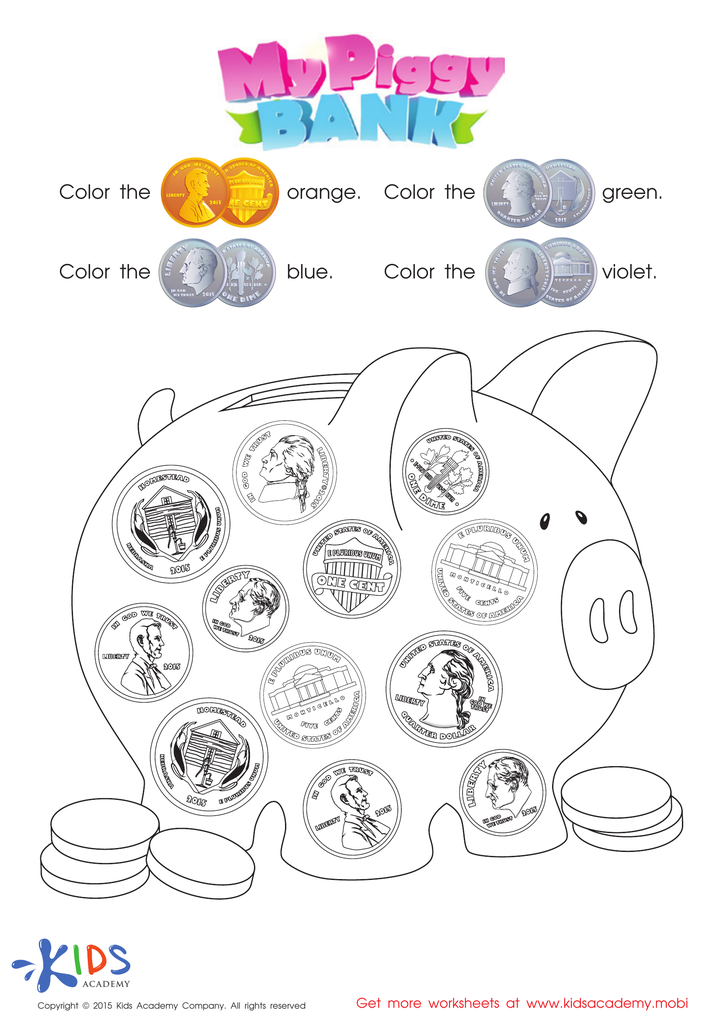
Recognizing Money Money Worksheet
Help the piggy bank by coloring its coins with Kids Academy's free money worksheets! Learn the different coins and their values with your kids. Printable worksheets are available to continue the lesson. Let's learn and have fun!
Recognizing Money Money Worksheet
Worksheet
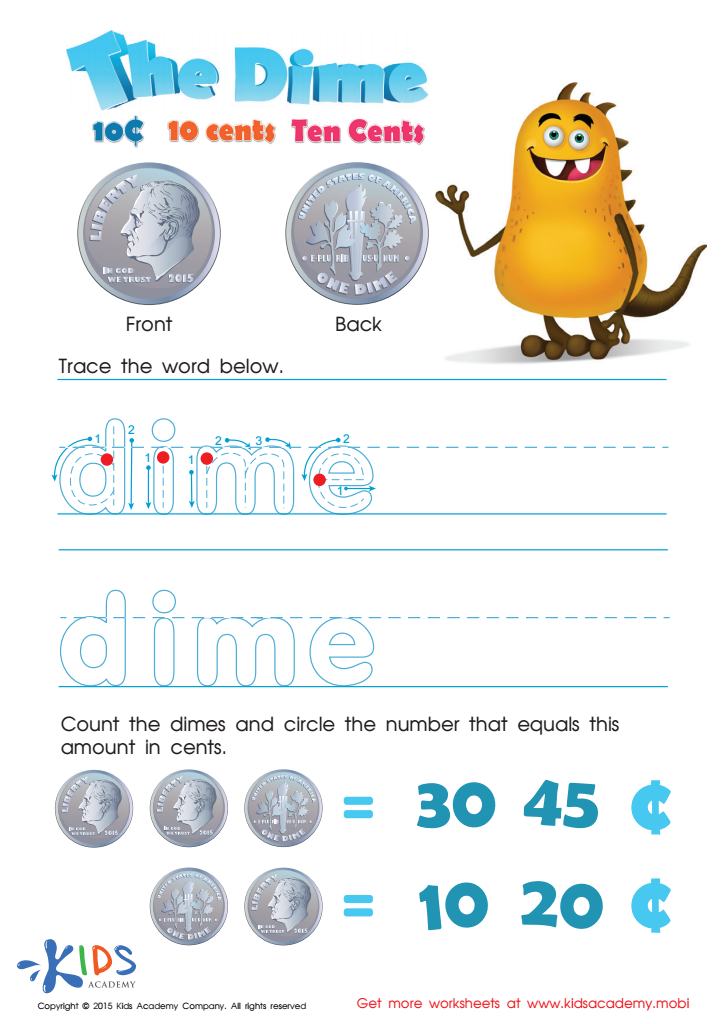
Ten Cents or the Dime Money Worksheet
Introduce your kids to coin games! Start with a dime: trace the word on both sides and count the dimes. Kids Academy has printable worksheets to help your kids learn how to count money.
 Assign to My Students
Ten Cents or the Dime Money Worksheet
Worksheet
Join Kids Academy for Free
Who is primarily going to use this learning content?








Counting money is a fundamental skill that has far-reaching implications for young children's cognitive development and practical life. For ages 3-9, this skill isn't just an academic exercise; it builds a foundation for everyday financial literacy. Introducing counting money at an early age helps children develop number sense—an understanding of numbers and their relationships. It promotes addition, subtraction, and even early multiplication and division skills as children learn to count coins, add dollar amounts, and make change.
Moreover, counting money aids in the development of fine motor skills and hand-eye coordination as children handle coins and bills. It offers real-world applications, emphasizing the value of money, basic economic principles, and the importance of saving and spending wisely. By learning to count money, children grasp concepts of value and exchange, enhancing their decision-making skills.
For parents and teachers, investing time in teaching this skill helps prepare children for future responsibilities. It builds their confidence to handle money, fostering independence and accountability. Additionally, integrating this skill into daily activities and games can make learning enjoyable, cementing both math proficiency and practical life skills. Ultimately, counting money equips children with essential tools for lifelong financial competence and independence.








